Archive by Author

Trip to Japan – Part Three – Nara and Osaka

1 Dec

Dáire and I left Kyoto on Friday morning, November 14th. We checked out of our room and walked with our bags back to the station. It was a sunny morning and our next destination would be Nara for a few hours en route to our hotel in Osaka. There are two trains between Kyoto and Nara: the local and the express train. We just missed the express because we had to top up our IC cards.(Metro cards that are good on all trains in Japan) Google maps helpfully tells you approximately how much the train fare will be between cities, in this case the local was about 720 Yen (about 3.97 Euro) It took about 1 hour and 15 minutes, which was fine, after all, because we weren’t really in a massive hurry, plus we got seats because we got to the platform early. We also left after rush hour. One feature I especially noticed from our train rides in Japan were the many river beds that only had a small amount of water running through a much larger river area and under wide and tall bridges. In the rainy season – June and July, which also brings typhoons, these rivers really fill up. We were well advised to avoid going to Japan between June and August. First it is bucketing rain, followed by unbearable heat. We found November just lovely. 
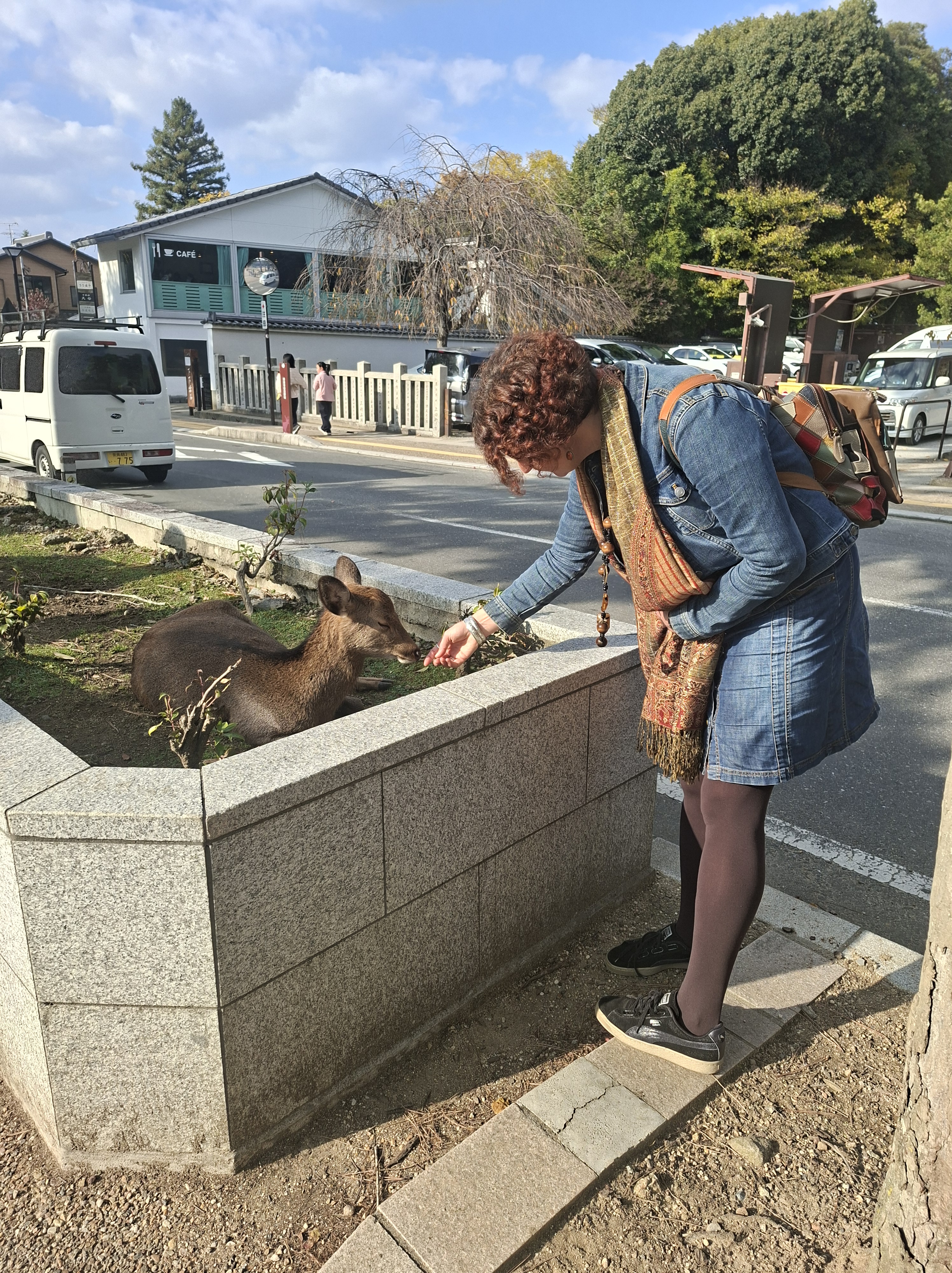
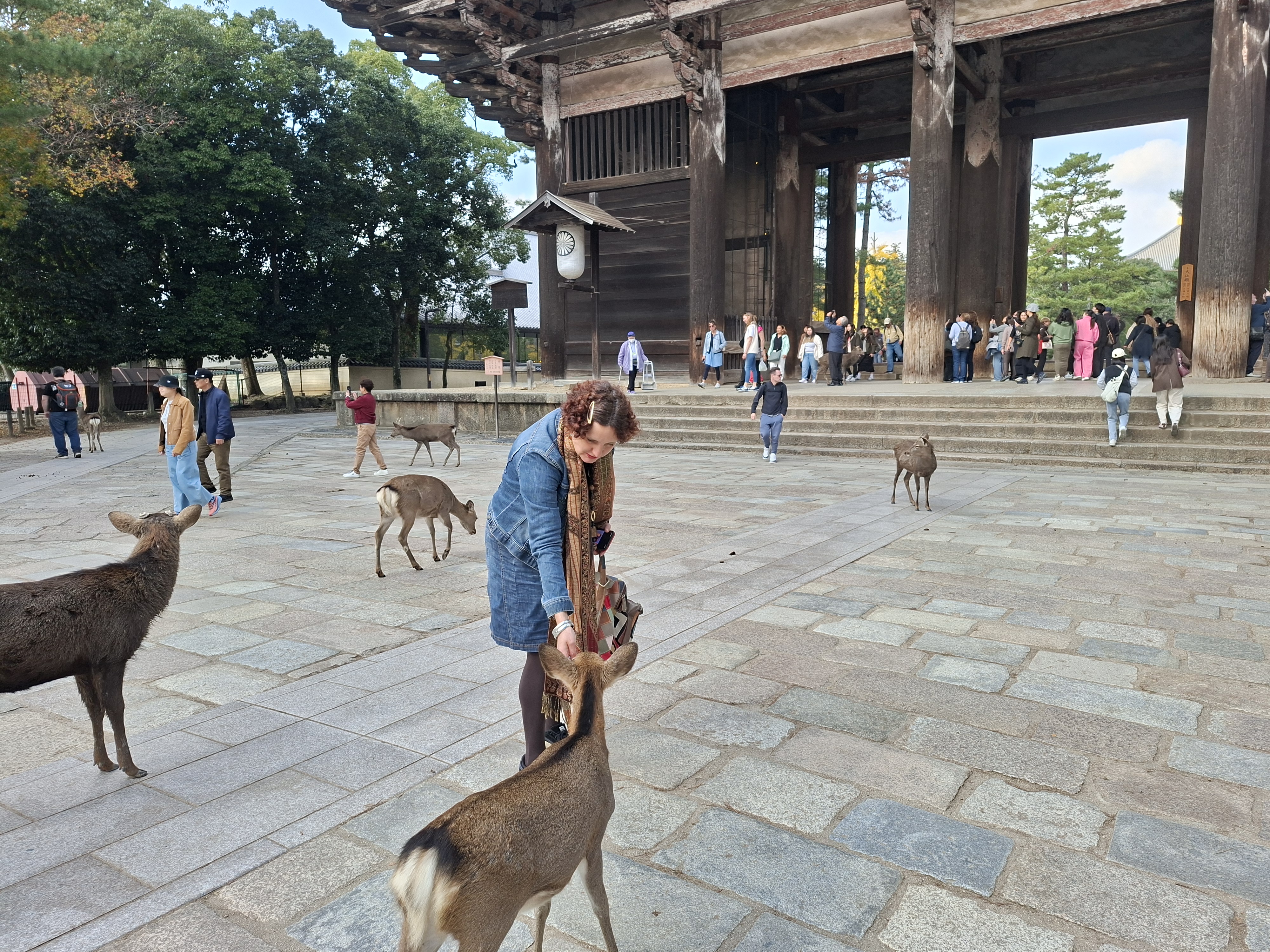
Bowing Deer at Nara Park

We arrived at Nara Station at about noon and looked for a locker for our bags. This took us about 20 minutes to do because the lockers upstairs were all full, but we found more downstairs in the station. One locker was quite big and fit both our wheelie bags (cabin sized) and both our backpacks. It cost 1,000 Yen (about 5.60 Euros). We then walked out of the station and there was a big sign saying Nara Park and a bus right next to it. This is why visitors come here: to see Nara Park and like most places in Japan, it was easy; there were attendants standing there, instructing you to stand in line and within 10 minutes we were on the bus to see one of the strangest things we have seen: bowing deer. Yes, that’s right. As soon as you arrive at Nara Park, there are deer everywhere: sitting at the side of the street, wandering around freely, sitting in raised flower beds resting. City authorities have clearly given up on trying to grow any plants in these raised, concrete flower beds; the deer use them as their beds. As soon as you walk up to the deer, they stand there in front of you, bowing at you and let you stroke them. We couldn’t help but be highly amused by this. In Japan, where people bow, the deer also bow! They especially bow to people who purchase the special deer crackers to feed them. 

Toda-Ji Temple Entrance Gate and Dáire with a friendly deer

The deer were entertaining and they were all over the park, but the other incredible attraction in Nara besides these creatures is, of course, the unbelievable Toda-Ji Buddhist Temple. First you pass through a huge entrance gateway (with deer everywhere), then you walk past a beautiful pond with large orange koi swimming in it surrounded by perfectly landscaped gardens. From there you can pay a modest entrance fee into the temple which houses the world’s largest gilded bronze Buddha statue. The Buddha is seated on a platform and its height is 50 metres. We had just seen a lot of temples and shrines the previous week but this building blew our minds. It was the biggest one, by far, that we had seen. The site is a UNESCO World Heritage Site and it is no wonder. We have never seen anything like it. 

The Great Buddha Hall at Nara

Nara Park covers about 500 hectares and has multiple shrines, temples and beautiful gardens, but we really didn’t have time to do more because we still had to get back to Nara Station, retrieve our bags and get on the train to Osaka before rush hour but we were very happy we took this detour slightly east from the direct route between Kyoto and Osaka because it impressed us greatly. It was a beautiful day, so instead of taking the bus back to the station, we walked the half hour which was lovely. We were on a train to Osaka by 3.30pm. 
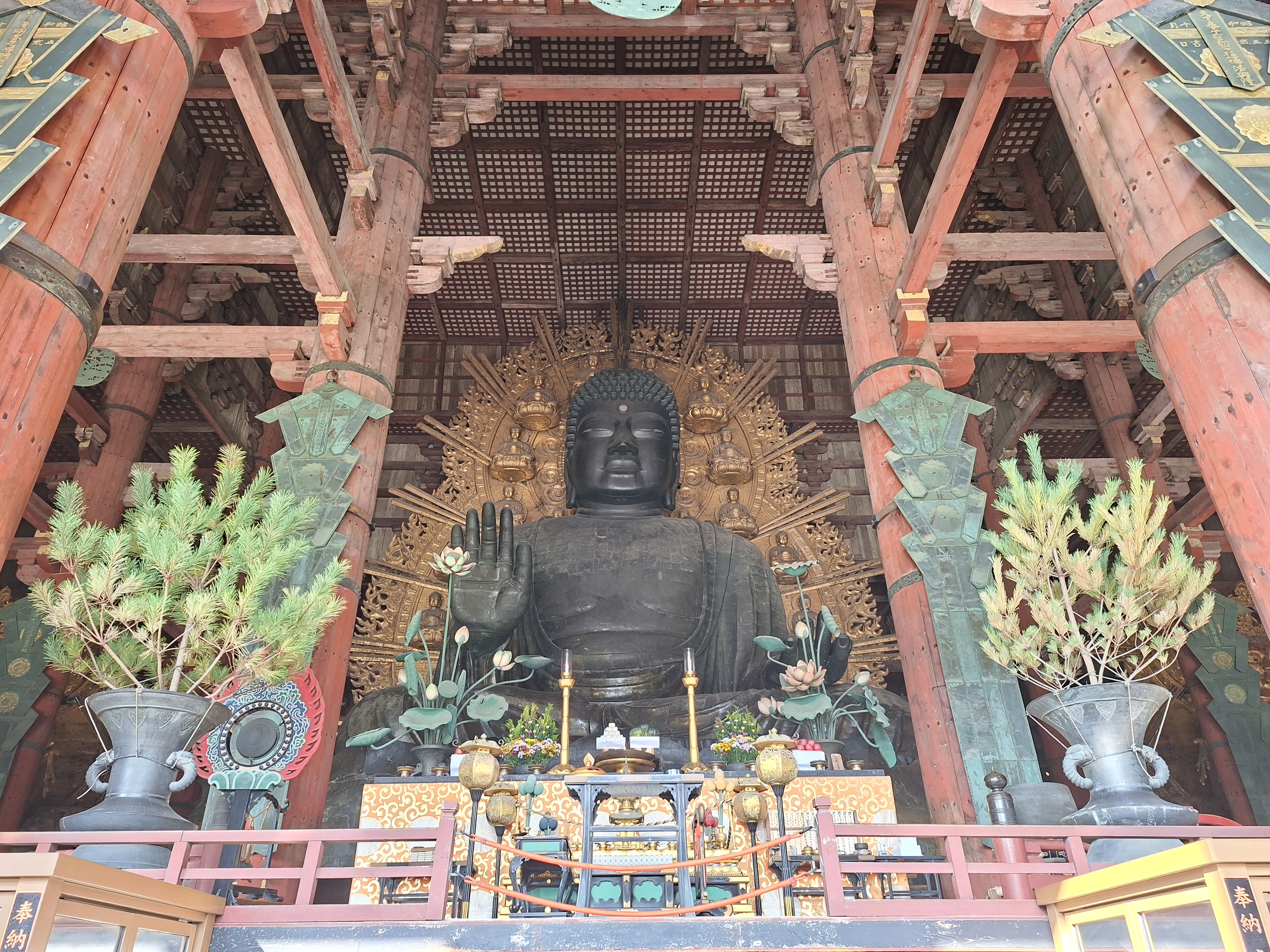
The World’s Largest Gilded Bronze Buddha Statue

We arrived at Tennoji Station in Osaka by about 4.30pm. During our whole trip to Japan we had no problems finding our way around on public transportation, with the exception of Tennoji Station. We had to change from the Japan Rail Station to the Metro Station which wasn’t more than a 6 minute walk but it was very confusing and not very well signposted. We found our train eventually. We also had to transfer back through this station en route to Osaka’s Kansai airport 2 days later and we weren’t stressed because we had left plenty of time, but apart from the station being quite confusing, the train to Kansai Airport also decouples after about 5 stops. The front half of the train goes to the airport and the back half goes to Wakayama. The announcements for this are only made in Japanese and English. Too bad if you don’t speak either of these languages. It seemed bizarre to us that, of all trains, they would decide to decouple the one going to the airport! We wondered how many travellers got caught out by this and missed their flights. 

Cooking my own meat in Osaka

In any case, we arrived at our hotel, the Hotel Luxcare, in Osaka by about 5.30pm. It was another lovely room with a separate room with a bidet toilet (They are EVERYWHERE in Japan) and another lovely high pressure shower room. The price: a very reasonable 230 Euros for 2 nights sharing. We consider 57 euros each a night a really good deal. It also came with endless toiletries and bottled water and tea. We dropped our bags and headed out pretty quickly to find something to eat. We found a place nearby where you order raw meat and they bring it to you and light the grill right at your table and you cook it yourself. We had a salad and an alcohol free beer with this meal. I found the meal okay, but I am not going to highly rate this restaurant, neither do I remember the name of it, because we didn’t have any rice or noodles with it so the meat didn’t sit well with me. Either they didn’t provide this or I didn’t see it on the menu but my stomach needed something to soak up the fat. Still, it wasn’t bad. It was an experience. The Japanese seem to love their interactive meals. You cook your own food, right at the table. Clearly this experience is not suitable for children because they could easily burn their hands.

Osaka Castle at Night

We had chosen a very good location in Osaka to stay considering this was the end of our trip and we only had 2 nights here. We were only a short walk from the impressive Osaka Castle which we walked to right after our dinner and we saw it illuminated in blue. We walked around the castle grounds and moat and then walked back to our hotel stopping at the 7-11 right opposite to get some milk and bananas for our breakfast. We had brought the rest of our muesli with us. We had just enough to last us the final 2 mornings in Osaka. We were also a short walk to two Metro stations.

Osaka Metro

We had booked a 5 hour bicycle tour the following morning on the Get Your Guide app for about 100 Euros each. We were so lucky because there wasn’t a cloud in the sky and it was 20 degrees. It was the perfect day to get on a bike. We also really welcomed it after the many miles of walking we had done the previous 2 weeks. This was mid November and it was gorgeous weather. It was all the more appreciated when we looked at the current weather back at home in Ireland: storms and floods. We would be flying back to that in 36 hours. 

Our tour started at 10am at the Temmabashi Station only a 5 minute walk from our hotel which made our life easy. We met our guide, a very pleasant Japanese man, probably in his late 30s. There were 4 other Americans on our tour. We highly recommend these small group tours. You get to meet a few other people and talk to them, but you are not in such a big group that you get overwhelmed or the tour is held up by too many people. I would definitely do these again while travelling. Fully private tours are very expensive and it is actually quite enjoyable to meet a few other people for a few hours and exchange experiences with them. None of our tours had more than 4 to 6 other people on them and were perfectly paced with chilled out guides who we found very pleasant. We picked up our bicycles from the station parking garage. (the bikes only had the flimsiest of locks. Bike theft is a problem in Japan, but not half as much as other places. Bikes were unlocked in Kyoto, but this was Osaka, a city of 18 million people.)
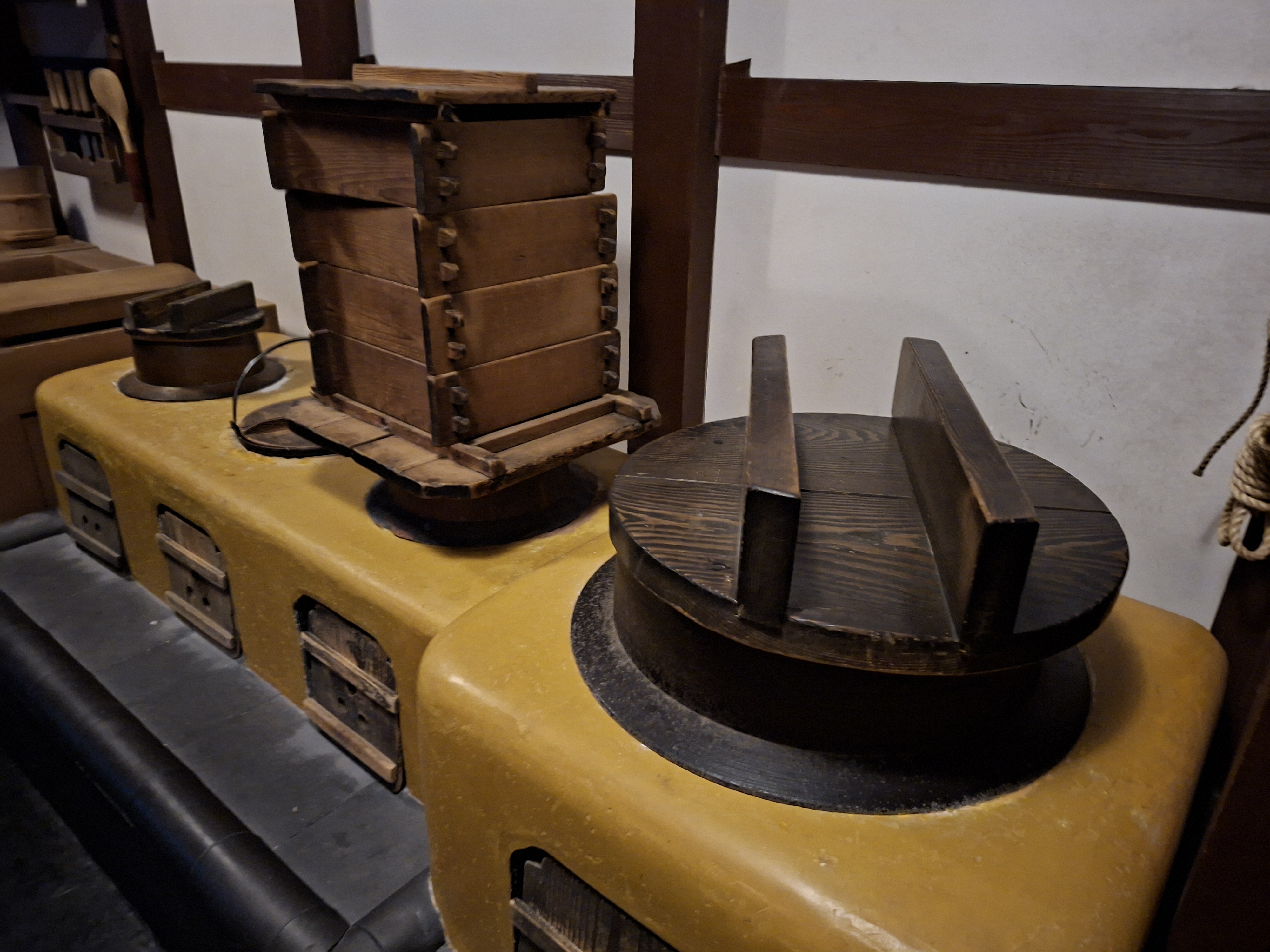
Traditional Oven and Rice Cooker at the Museum of Housing and Living

Our first stop on the bike tour would be Osaka Tenmangu Shrine. Here we saw quite a few young children in colourful outfits getting blessings for their health and growth. We then cycled to the Osaka Museum of Housing and Living. There was a reconstructed village from about 1830 showing us how life was in many parts of Japan then. It was interesting to see how the houses were laid out with their raised platforms for sleeping and resting on bamboo mats and futons (where removal of shoes is required) and their kitchens on the lower levels. A staple of each house was, of course, the rice cooker in the old style ovens. 
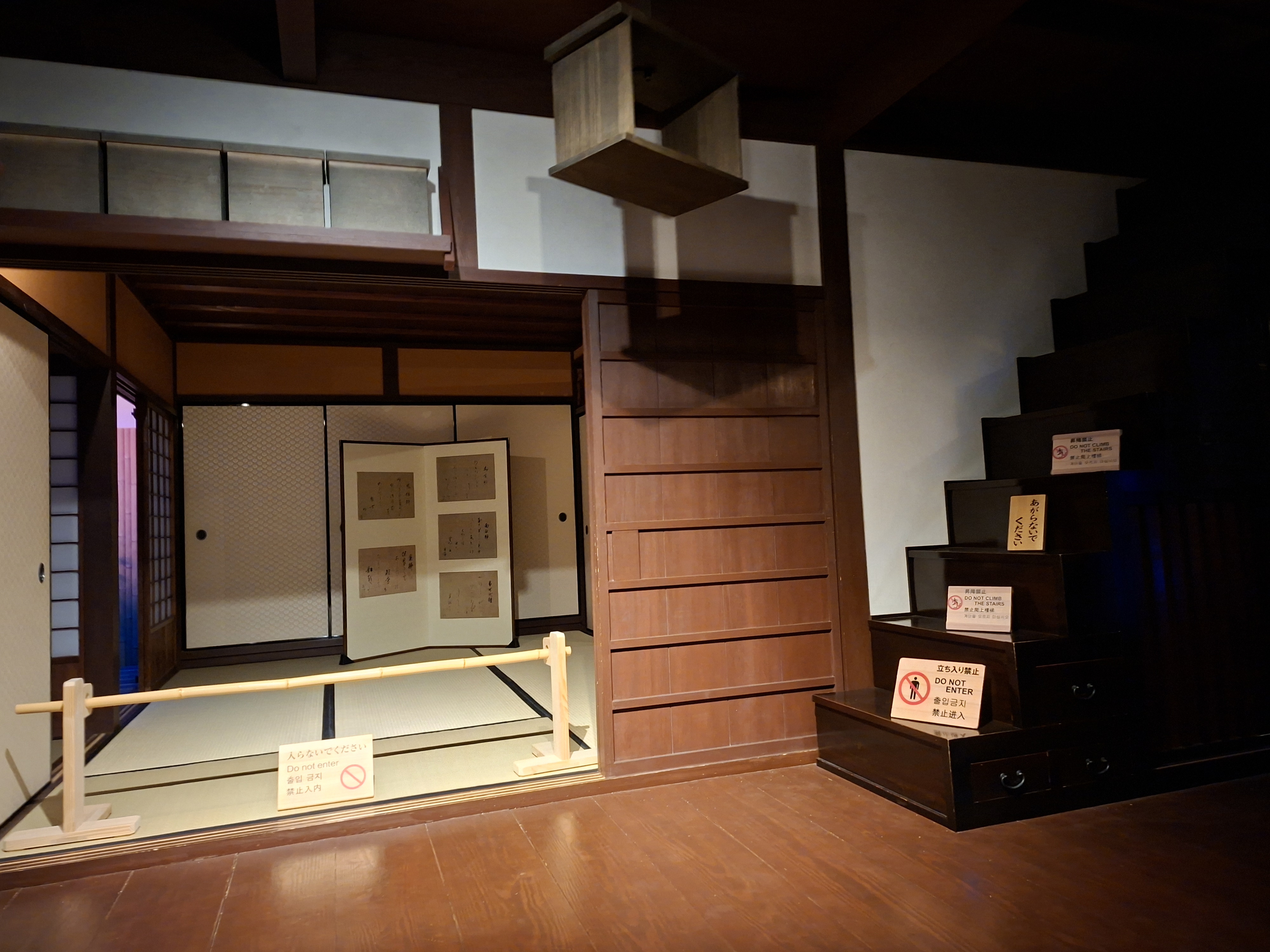
Interior Living Quarters at Museum of Housing and Living

From there we cycled along the Yodo River. Our guide pointed out a building that had a large round feature on it that looked like a giant coin. The city mint, he informed us. The Japanese love cash and you can pay almost anywhere with cash and a lot of places only take cash. The smallest denomination is a One Yen coin which equals about half a penny. We arrived at a restaurant at exactly 12.30pm for our lunch reservation. I credit our guide for his excellent timing with this. He obviously knew exactly what he was doing. We went in and had a semi private room in the back of the restaurant; a large table with a large griddle in the middle and lots of delicious condiments. We were here to try an Osaka speciality; Okonomiyaki which is a delicious Japanese savoury pancake made of wheat flour, batter and other ingredients. Dáire ordered the one with pork and I ordered the one with cheese and we shared them. It also had cabbage and spices in it. It is brought to you cooked and kept hot on the griddle while you pile it up with aonori (seaweed flakes) bonito flakes, okonomiyaki sauce (which is basically Worcestershire sauce) and a good squeeze of Japanese mayonnaise. We were hungry after all the cycling that morning, so we really enjoyed this. 

Okonomiyaki – An Osaka Speciality

After lunch we got back on our bikes and cycled another 15 minutes to the next stop on our tour: Osaka Castle. We parked our bikes and walked up and around the castle grounds which were stunning. It was Saturday afternoon so there was a long line to get into the castle. Our guide told us there is really no point trying to get in on a weekend when it is packed with visitors, this is why he opts for the Museum of Housing and Living instead. In any case, it was a lovely day so we were happy to stay outside. He took us to a great spot to take a photo of the castle with a pond and maple trees. Others were also waiting in line to get this picturesque shot. I found Osaka Castle to be quite a stunning piece of architecture. It is one of Japan’s most famous landmarks and was built in 1583 by Toyatomi Hideyoshi who unified Japan. The castle you see today is a 1931 reconstruction and it sits on a formidable stone base. 

Osaka Castle

After a while we got back on our bikes and peddled to our last stop: the foyer of a museum where they had a lovely matcha cafe. We sat on bamboo mats surrounded by huge plate glass windows and our guide ordered another Japanese speciality for us: matcha green tea and mochi. We had already eaten a lot of matcha green tea soft serve ice cream in Kyoto but this was the first time we had actually had a matcha tea. Personally I found it a little bland only frothed with water but I suppose it was good to taste it pure. (I would add hot frothy milk and honey to it).
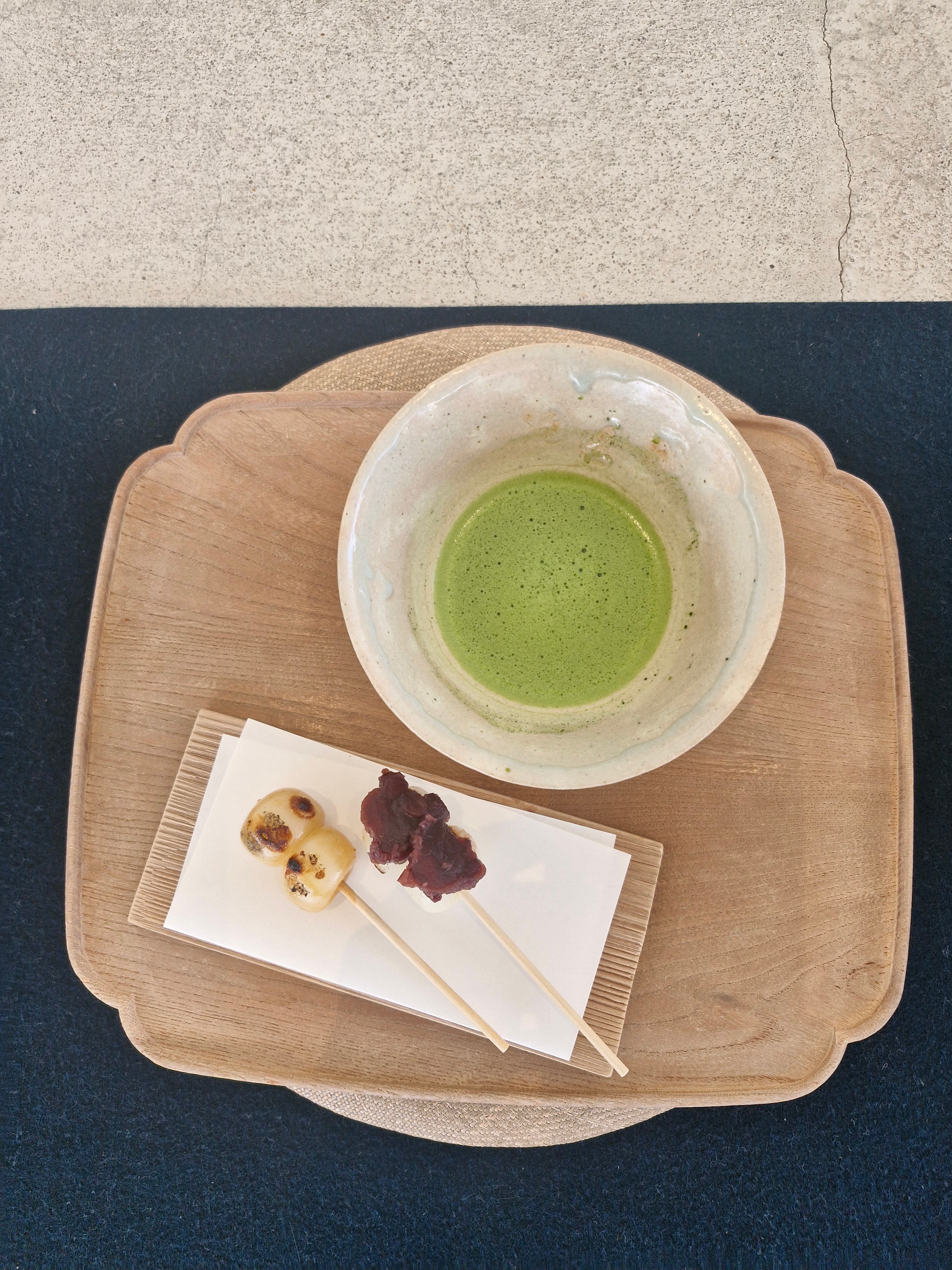
Matcha Tea and Mochi

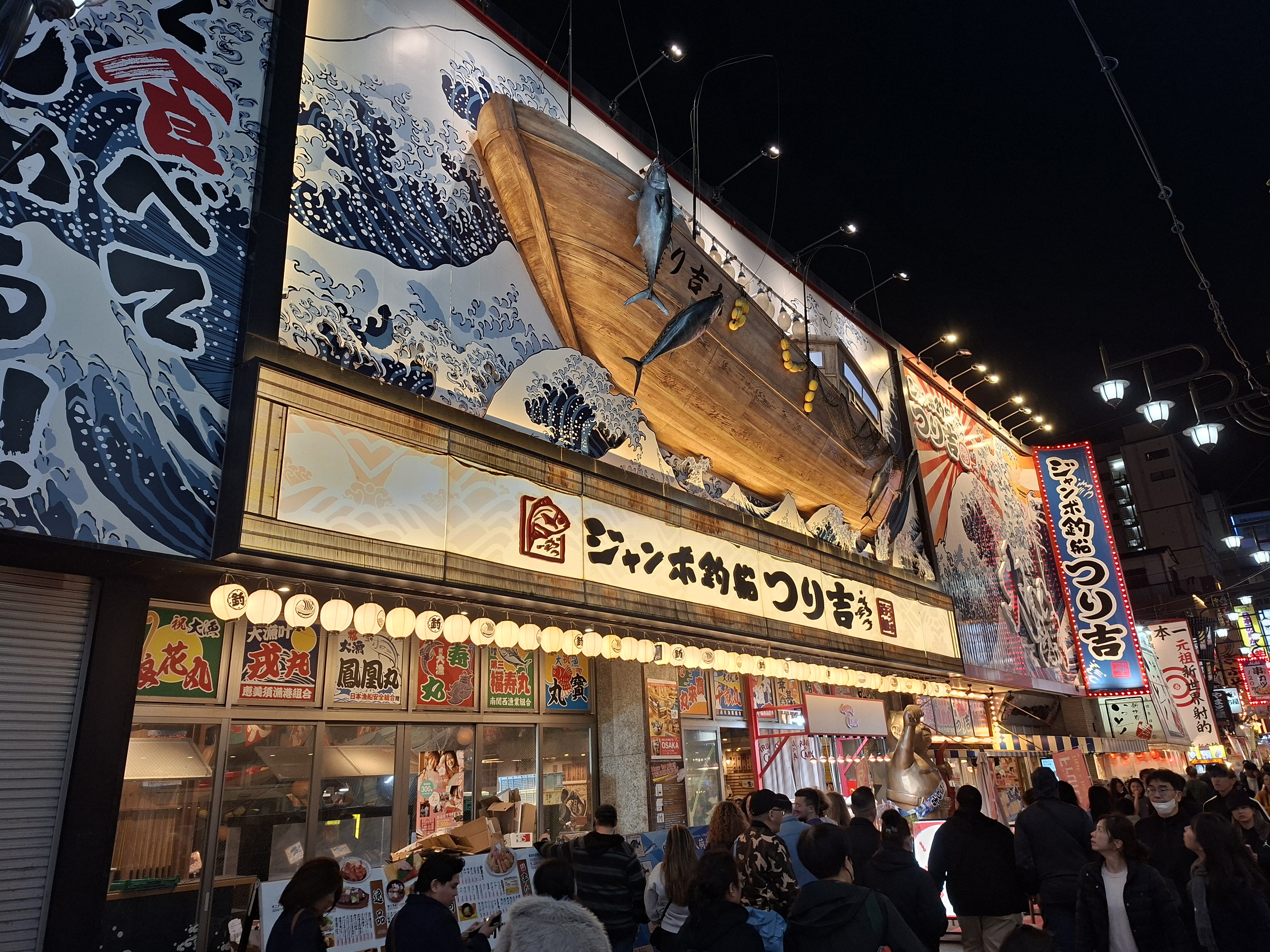
After tea we cycled back to Temmabashi Station, put our bikes back in the garage and walked the 5 minutes back to our hotel to relax for a while. We were tired but this was our last night in Japan so we had showers and went out again to an area that had been recommended by our guide: Osaka’s Shinsekai District and the Tsutenkaku Tower which was originally built in 1912 and modelled after the Eiffel Tower. The current tower was rebuilt in 1956 after World War 2 damage. It also has a slide from the 3rd floor down for people seeking an adrenaline rush. We took the train back to Tennoji Station and walked through Tennoji Park. It was dark and we could see the brightly lit tower in the distance. Before long we were in a bustling street with tonnes of neon lights and vendors selling all kinds of fried foods. A speciality of Osaka are fried octopus balls known as takoyaki. Vendors have hot skillets that have little round holes in them which they pour batter into and then add a bit of octopus into the middle of each ball. We decided not to eat these because they looked really greasy and we like octopus alive and not cooked because they are highly intelligent and lovely creatures. We saw a sign in Osaka that made us laugh. It was an octopus holding out a tray of fried octopus balls. Basically saying: ‘Eat me!’ Um, no thanks. Still, it was a kick to experience the atmosphere of this area on a Saturday night.

Octopus with Octopus Balls known as Takoyaki

We went up the tower and expected it to have a bar and restaurant on top, but no, it had a lot of weird looking figurines in glass cases and practically looked like a temple in the sky. People were getting their goshuin stamps in their colourful booklets as a souvenir of having been there. We learned later that the attraction up here for Japanese tourists is to rub the feet of the Billiken statue; The God Of Things As They Ought To Be. It is said to bring you good luck. 

Shinsekai District and the Tsutenkaku Tower

From there we walked back to Tennoji Station and back to our hotel room for hot showers and another pair of clean, fresh pajamas. This was our last night and we were very satisfied with how the trip had gone. After a good night’s sleep we checked out at 10am, stored our bags at reception and headed to Osaka’s famous Dotonbori district. Our flight wasn’t until 10.30pm that night so we still had time to do some exploring and have another meal. It was yet another beautiful day. Dotonbori has wooden boardwalks along the edge of a canal and is lined with restaurants and shops. We bought some matcha tea, matcha chocolate and sweets to bring home and also sat right at the canal in the sun and ate one last bowl of ramen and some gyoza. 
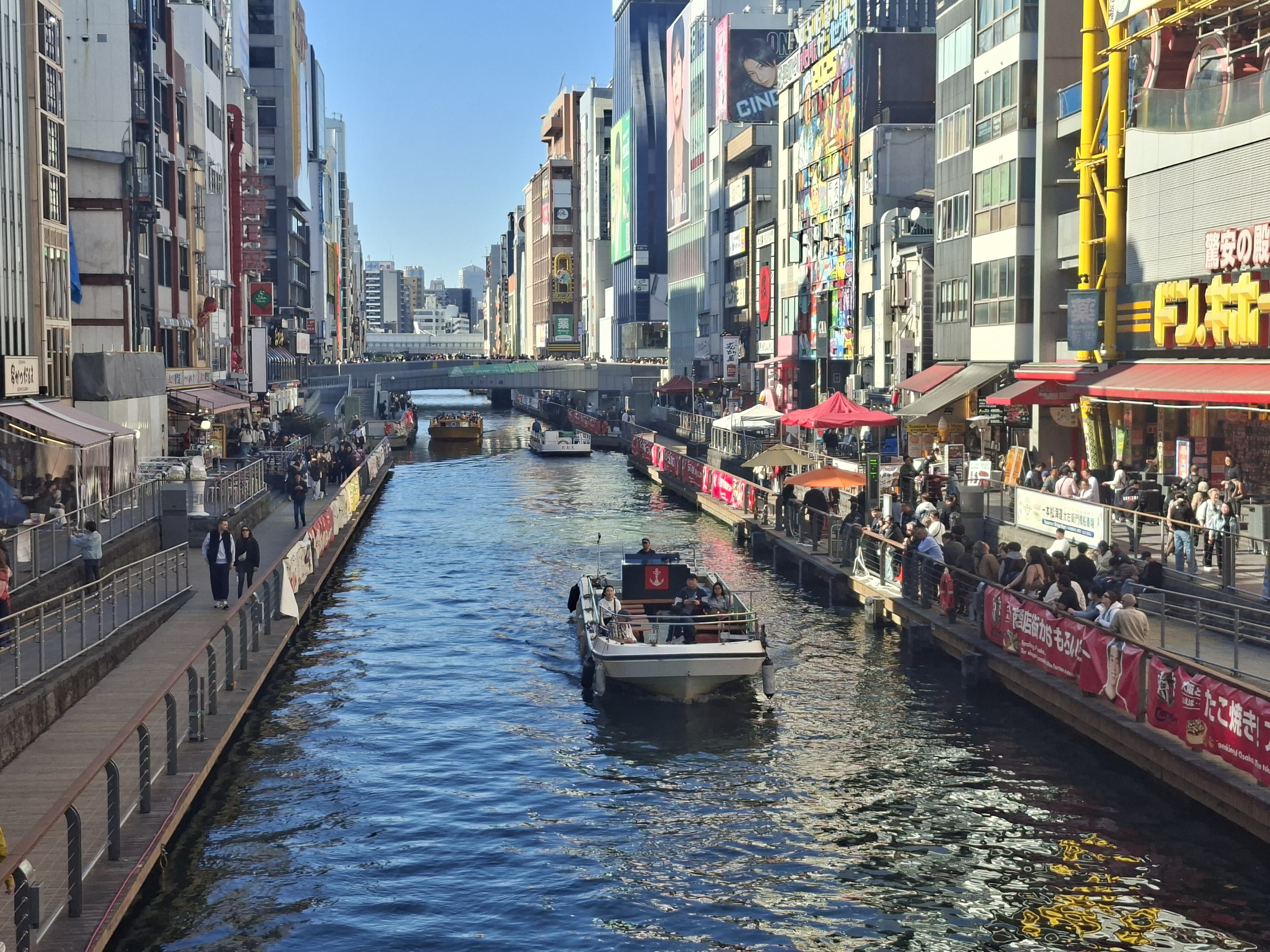
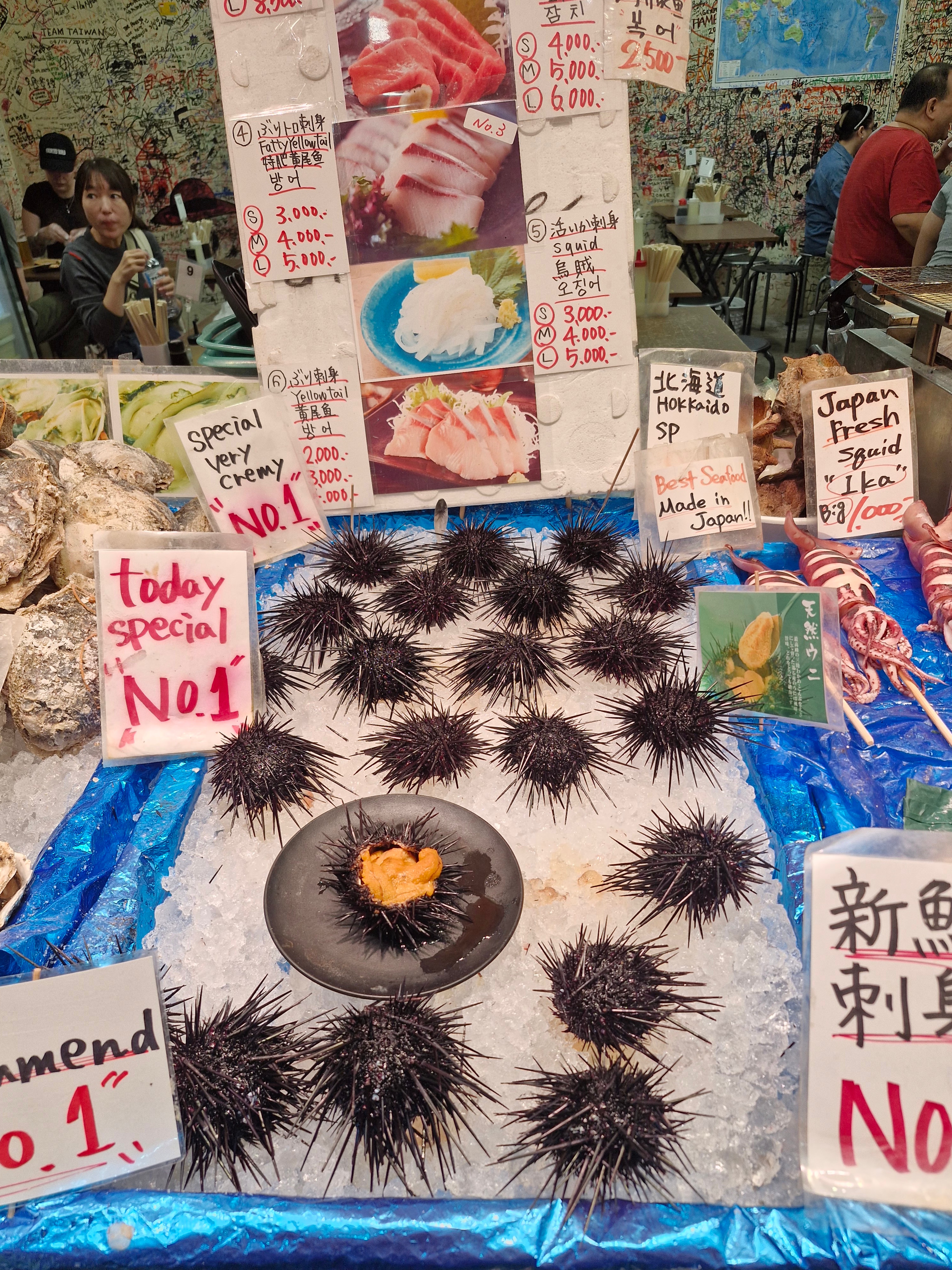
Dotonbori Canal and Kuromon Ichiba Fish Market

As we wandered out of Dotonbori, we happened upon the Kuromon Ichiba Market with its many stalls selling fresh fish; crab, sea urchins and many other delicacies. This was the most authentic market we had been to in Japan so far and also seemed a little off the beaten track. It was fun to just observe people and their goods for sale. We wandered a little more, aimlessly, enjoying the exercise and sun because in a few hours we would be heading to Kansai International airport for a 20 hour journey back to Dublin via Istanbul with Turkish Airlines which have excellent economy class service. We headed back towards our hotel, stopping again at a Cafe Veloce to have a large coffee for 2.18 Euros plus lots of free, very drinkable water. We got our bags from the hotel, headed to the airport in plenty of time (to deal with the Tennoji Station change and the decoupled train) As we waited to board our 12 and a half hour flight to Istanbul a group of at least 30 Japanese teenagers in their school uniforms (on a Sunday night) walked up to our gate. They were a bit excited as they stood there and we thought ‘Oh no, a school tour, we won’t get any peace.’ How wrong we were. They boarded and were seated all around us. We didn’t hear a sound out of them. That is Japanese discipline for you! We had our dinner and then fell asleep, so happy that our Japanese adventure had gone so smoothly. We had, of course, barely dipped our toes in Japanese culture and we had stayed on the well trodden tourist path, but it was a fantastic introduction to this fascinating culture and the time we had spent planning and researching what we wanted to do really paid off. We really recommend a 10 day trip to Japan. We broke the journey on the way there with 3 days in Istanbul which was also fantastic. When flying from Dublin you can generally fly via Dubai, Abu Dhabi or Istanbul and we chose the latter because we thought it would be the most interesting. It all worked out great. I am looking forward to the next adventure. Who knows where it will take us! 

Photos by Dáire Delmar and Rhea Boyden

Trip to Japan – Part Two – Kyoto

27 Nov

Dáire and I arrived at Kyoto Station after a fabulous, speedy Shinkansen (Bullet train) ride from Tokyo which only took 2 hours and 14 minutes to cover more than 450 kilometers. We took the Nozomi train which is the fastest service between the cities and we splurged on first class tickets which cost 107 Euros each. It was so worth it for this once in a lifetime experience: being whisked along at speeds of up to 300 kilometres an hour sitting in comfortable, reclining armchairs with lots of legroom. It was a sunny afternoon when we arrived so we decided to walk with our luggage to our accommodation which was less than a half hour walk away. Central Kyoto is a grid so it was easy to navigate. We had arrived in the city of shrines, temples, lanterns and Geishas and we had 3 nights here to explore this fascinating city on 2 tours to maximise the use of our limited time here. Kyoto is not a small quaint town with a couple shrines but has a population of two and a half million people and has approximately 1,700 Buddhist temples and a further 400 Shinto Shrines. 

The Gojo area of Kyoto

We stayed in the lovely residential area of Gojo at the Hotel Mondonce in a large self catering room with 2 double beds, a balcony, a kitchenette, a bathroom with bathtub and a separate room with a bidet toilet. It felt spacious after our Tokyo hotel. I wanted to call it the Moondance hotel but Mondonce simply means a concrete block of flats in Japanese and nothing quite so romantic as the ideas I have while humming the famous Van Morrison tune. We were quite satisfied with our room that cost us 64 Euros each per night. We had brought our muesli and tea and bought more milk, bananas, prunes and walnuts to start the day. They also offered fresh pajamas every night and lots of toiletries. We had to take off our shoes at the door of our hotel room, but any establishment that required us to remove our shoes provided slippers.

Flower Garden in the Gojo area of Kyoto

As soon as we dropped our bags we headed out and walked towards the Kamu River to find a bite to eat before joining an evening walking tour of the Gion District of Kyoto. We happened upon a restaurant called Kacto next to the river and their menu seemed appealing to us because it wasn’t ramen, sushi, gyoza or tempura, which we had just eaten a LOT of in Tokyo so we were craving something different, namely: vegetables. We ordered a large kale and sweet potato salad with pomegranate, followed by an excellent caesar salad and then a delicious beef ragu with pasta. We split each dish and it was a satisfying meal. We each had lemonade and lots of water. The bill came to about 22 euros each which was a bit pricier than Tokyo but it also wasn’t typical Japanese food so you pay a premium for it. The service and atmosphere was excellent and our guts welcomed the change in diet. 

Tea House in the Gion region of Kyoto

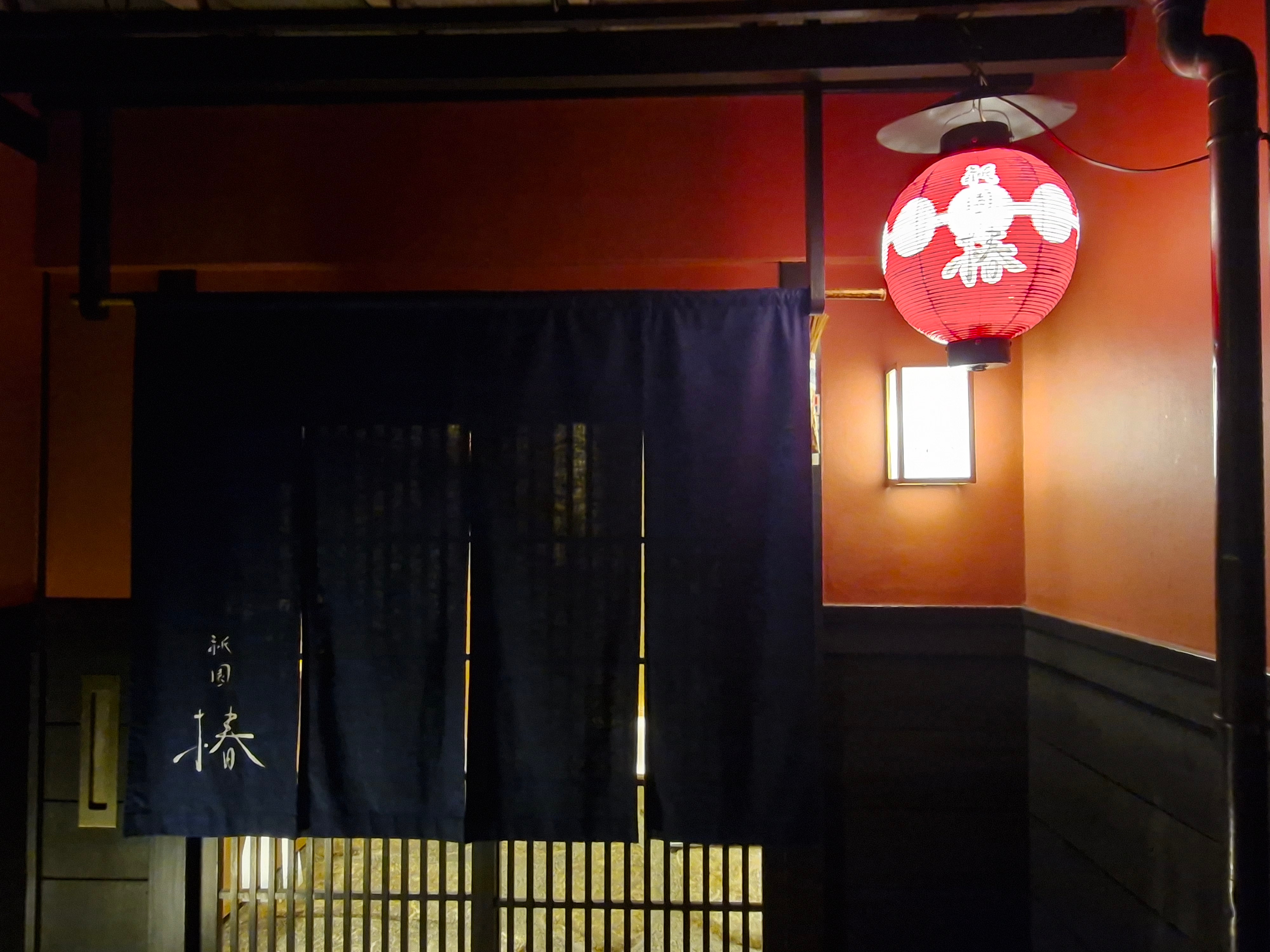
We arrived right on time for our 7pm tour of the Gion district of Kyoto. Our guide was a knowledgeable and very pleasant young Chinese man named Ryu who has lived in Kyoto for years. There were 6 other people on the tour. He walked us through the tea house area of Kyoto and these tea houses with their many lanterns are elite institutions and are mostly only accessible by invitation or booking: they are frequented by wealthy businessmen who have lengthy tea ceremonies and meals with many courses accompanied by Geisha performances. Someone in our group posed the question ‘So are the Geishas prostitutes?’ The answer: no. 

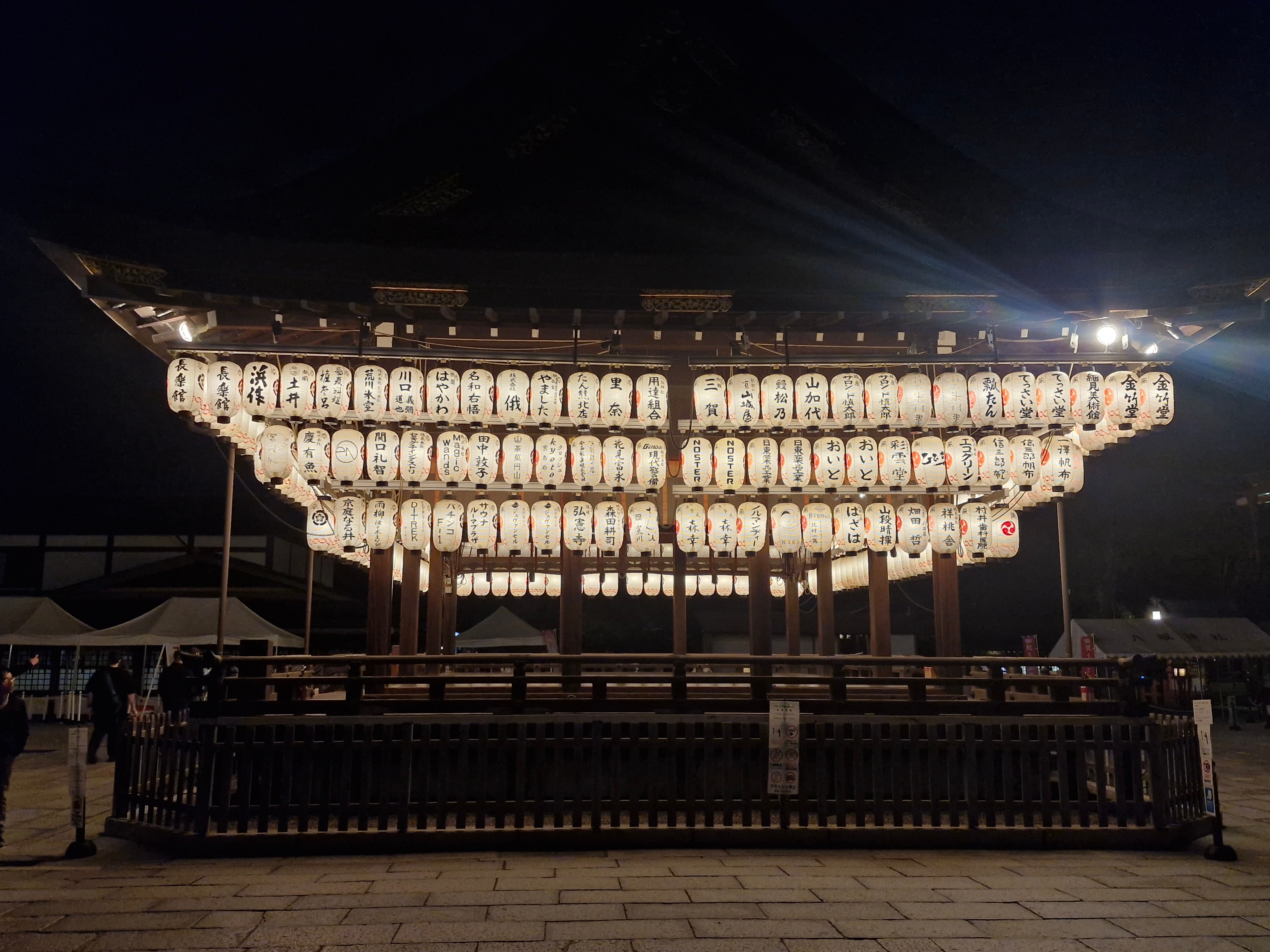
Yasaka Shrine

Our guide walked us past the front gate of Chionin Temple, through Maruyama Park and into the main grounds of the Yasaka Shrine. Shinto Shrines and Buddhist Temples exist side by side in Japan with most Japanese following both faiths. Buddhist rituals are especially used for funerals. Our guide told us that an evening walking tour is popular because it isn’t as busy as the day time tours. Kyoto is packed with tourists. Not only foreign tourists. The bulk of the tourists are Japanese from all over the country. It is a firm favourite with them and it is no wonder, with its incredible architectural charms on every corner. We walked onto the main grounds of Yasaka Shrine. There was Japanese script on the lanterns and it looked charming to us as foreign tourists. We liked to think that it is some kind of poetry or rituals written on the lanterns, but no, it is the name of wealthy individuals and corporations who pay for the upkeep of the shrine. It is basically an illuminated billboard, albeit a very pretty one. We ended the tour at the Kyoto Opera house and our guide gave a tonne of links and tips for Kyoto. It only cost 10 Euros each on the Get Your Guide app and was a great thing to do the first evening we arrived in Kyoto – dive right in and see that area of the city. But we were tired after travelling from Tokyo and we also had to get up at 5.30am to be back at Kyoto Station at 7.15am for a 6 hour Kyoto highlights tour also booked on Get Your Guide for 100 Euros each. 

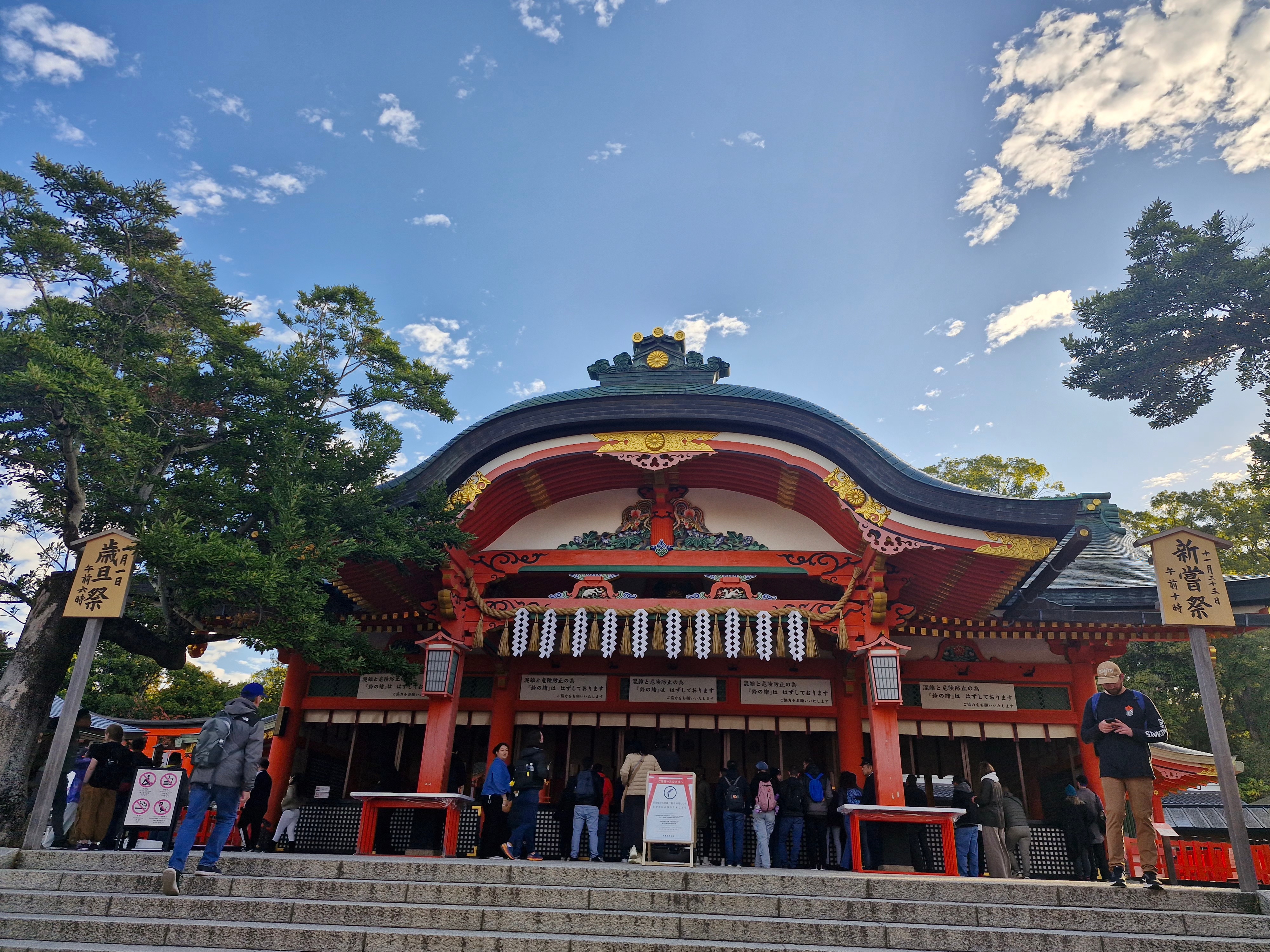
The Fushimi Inari Shrine

We had a short but good night’s sleep and were back at Kyoto Station by 6.50am, giving us enough time to grab a coffee at 7-11. (We had had our breakfast in the room and walked to the station). It was a nice morning and we met our guide, Leo, a fairly young Japanese student in Kyoto. There were 2 couples from Los Angeles on our tour, one with their 10 year old daughter. (They didn’t know each other beforehand). We all introduced ourselves as we would be together for 6 hours and they were all very pleasant. It was great to be in such a small group. The tour was well paced and was worth every penny because we had 3 main destinations to go to that were spread across the city: The Fushimi Inari Shrine, Arashiyama Bamboo Forest and Kinkaku-Ji- The Golden Temple. We took trains and buses to reach them. It was nice to be led around because there is no way we would have easily managed to see all three places as easily on our own. When you have limited time a tour is the best deal. 

Torii Gates at Inari

We took the train to the Fushimi Inari Shrine with its approximately 10,000 orange torii gates leading up Mount Inari. We arrived there before 8am and it was already packed. This is iconic Japan and everyone wants to see it. As I mentioned already, the crowds of people in Japan didn’t bother me or feel as overwhelming as in other places because people tend to be quiet and well-behaved. Everyone wants their photos for Instagram in front of the beautiful temples and gates so you just wait your turn and people politely take photos of each other with their smart phones. This is modern tourism. Like it or hate it, it is what it is. There are simply a lot of people on the planet who have money and want to travel. I sometimes get depressed and think, ‘Oh God, everywhere has been discovered, there is nothing new any more. Maybe I shouldn’t travel anymore because it causes problems with the local economies, housing and the environment’ and so forth. But then I am planning the next trip (and it is nice to get out of Ireland in November). I try to lessen my impact, respect local customs and be grateful that I can have these experiences. This is why we wanted to go to Japan in the first place: because it is something completely different. I am really glad we went but it is highly unlikely that I will ever return. It was a once in a lifetime trip that we had as much fun planning as we did on the trip. 

Torii Gates Leading up Mount Inari

We stopped at the shrine and our guide explained to us the prayer rituals at a shrine. First you purify yourself by washing your hands at a fountain with water flowing through bamboo pipes, then you make an offering by throwing a coin into the donation box. A five yen coin is considered good luck. (about 2.8 cents), you then ring the bell to get the deity’s attention. You then bow twice to show your respect. Then you offer your prayer (for good grades, gainful employment etc.) clap your hands twice to express joy and then bow a third time. There was a large sign that said, ‘This is a place of prayer, not an amusement park.’ Indeed. How do authorities combine a place of meaningful prayer and reflection for people and accommodate tour groups at the same time? It’s a tricky combo. We saw the same at the Hagia Sofia in Istanbul which has grappled with this dilemma forever and has had to pose different solutions: the upper part of the Hagia Sofia is now for tours and the floor of the mosque is for the devout only. It  must be hard to pray in peace with hoards of gawking tourists every day. But, the tourists bring in money for the upkeep of these buildings and monuments. 

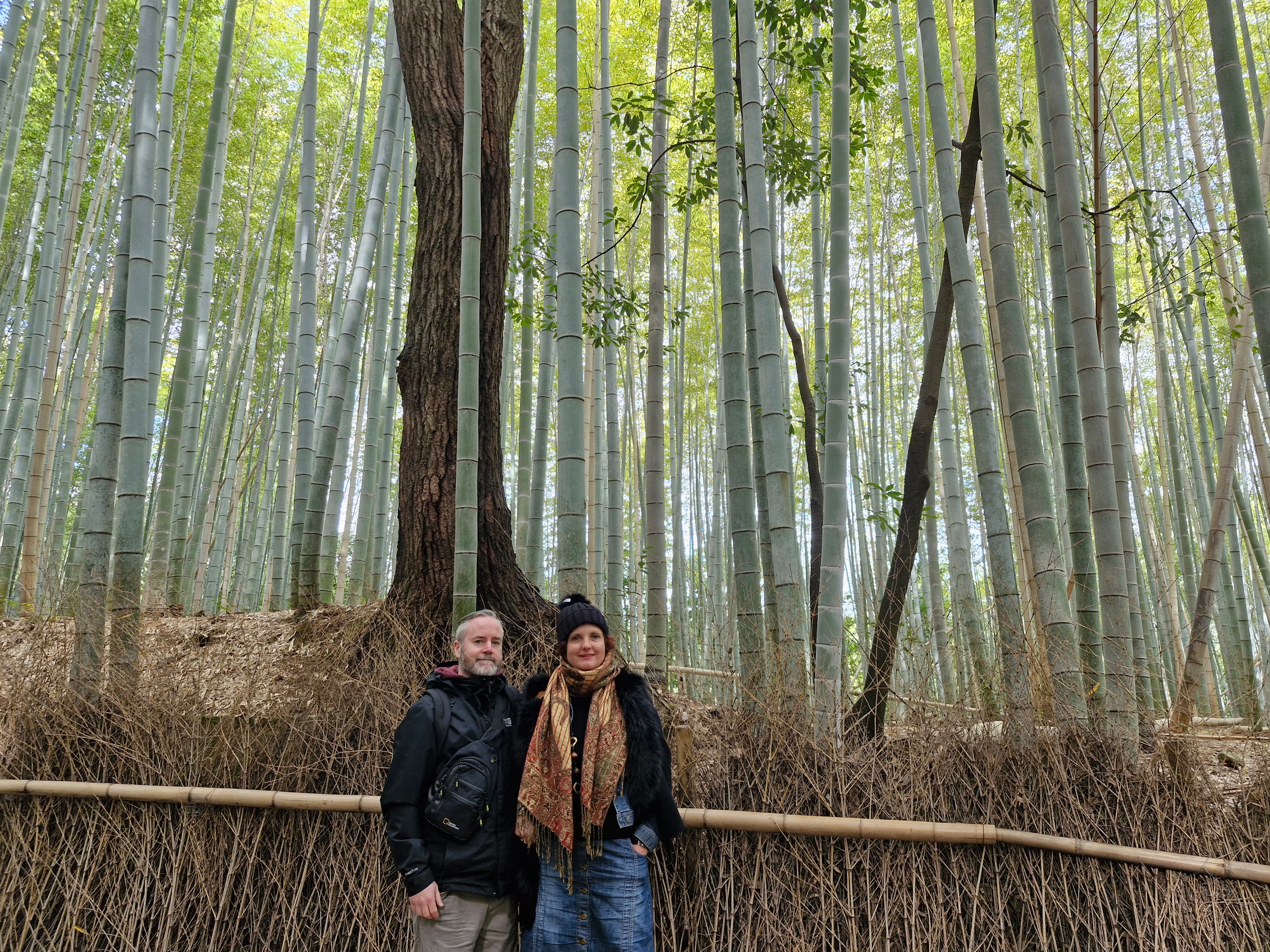
Arashiyama Bamboo Forest

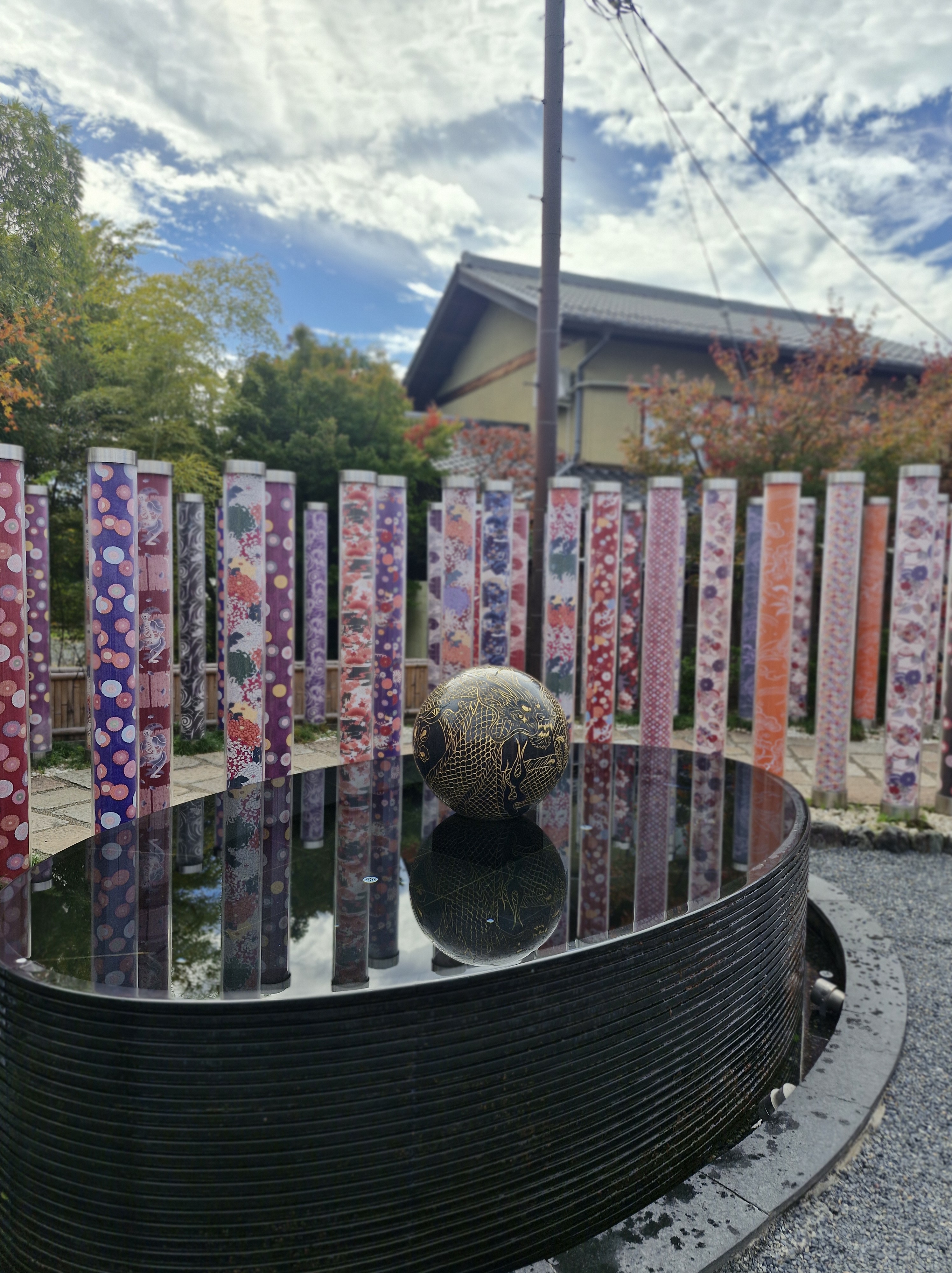
From there we took the train to the Arashiyama Bamboo Forest, which is a natural bamboo forest in the western part of Kyoto. We were there by 10am and it was packed, especially with groups of Japanese school children in uniforms. About a third of the Japanese population visits Kyoto every year. We walked with the throngs of other tourists, got our photos and then walked out of the forest through a quieter area of maple trees turning red and then down along the Katsura River where we saw boats being navigated by Japanese men wearing traditional round oriental bamboo sun hats. We then walked through what was called a Kimono forest which was basically a lot of poles which had colourful kimonos wrapped around them. There were many places where you could rent a kimono but I have mixed feelings about this. It’s one thing to buy a beautiful kimono in Japan and bring it home, but renting one as an American or European tourist and parading around Kyoto wearing it seems like a strange sort of cultural appropriation to me. 

A boat on the Katsura River and The Kimono Forest

Our tour was well paced and it was really relaxing to be led around and not have to think too much. Our guide then ushered us onto a bus and we headed to our next stop: Kinkaku -Ji – The Golden Temple. A note about buses in Japan: the bus driver is masked, has a microphone headset on and is constantly talking (very politely) telling passengers to move in more to the front, and away from the door, because the bus is packed. You board the bus through the door in the middle and you only pay as you exit the bus at the front and apart from having to drive the bus and instruct the passengers on what to do, the bus driver also nods and thanks every passenger individually as they exit the bus; in Japanese and in English if the person doesn’t look Japanese. If the bus is too full for the person to exit at the front, they get off at the middle door and walk to the front of the bus and board again to pay their fare before exiting again. When the driver isn’t talking there is a recorded female voice announcing the next stop no less than 3 times repeatedly in Japanese followed by once in English. People talk a little more on buses because there seems no real compulsion to remain as quiet when you are hearing a constant stream of announcements anyway. We have never seen anything like it. In Dublin, you thank the driver as you exit the bus, not the other way around! 

Kinkaku -Ji – The Golden Temple

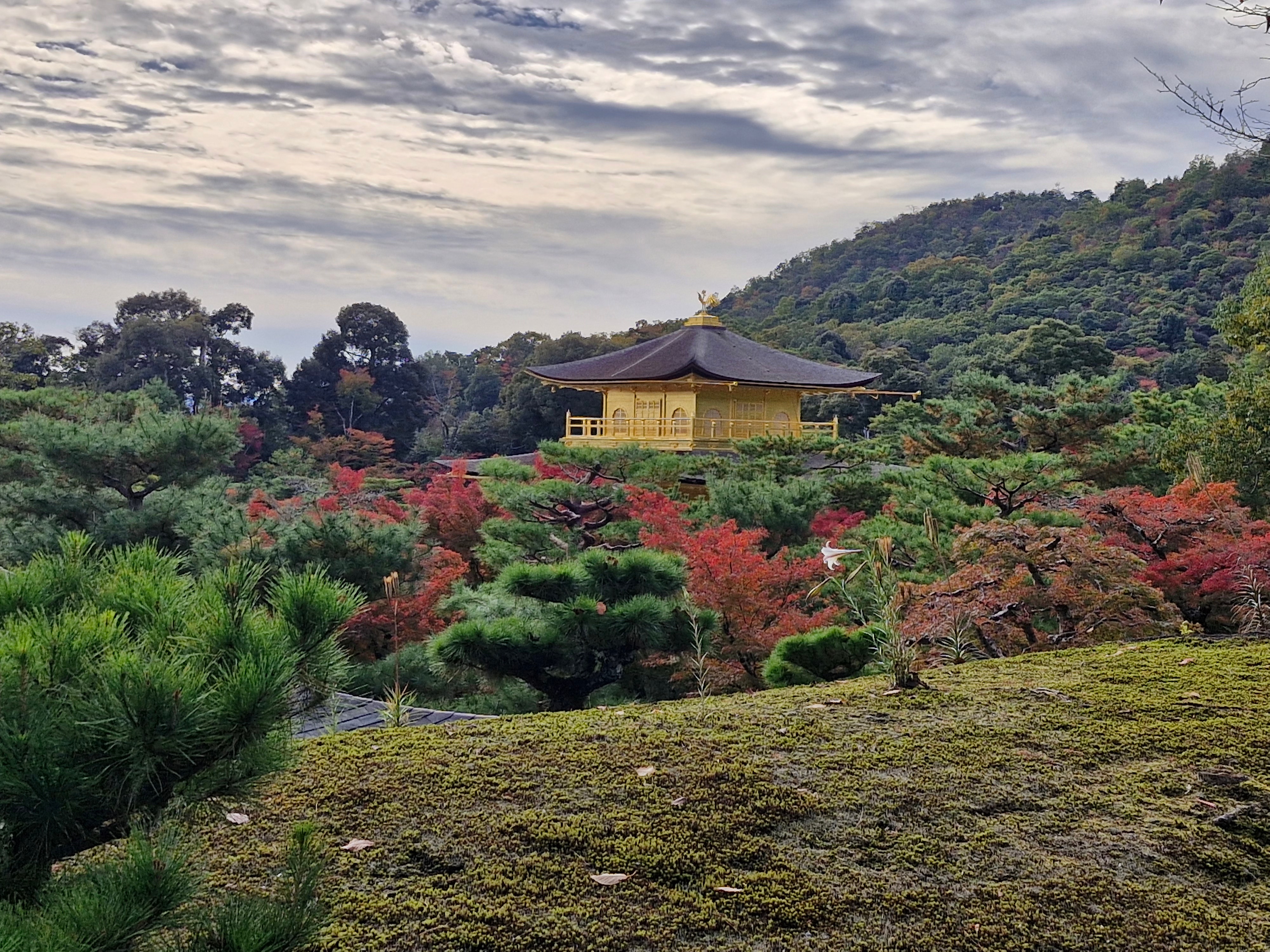
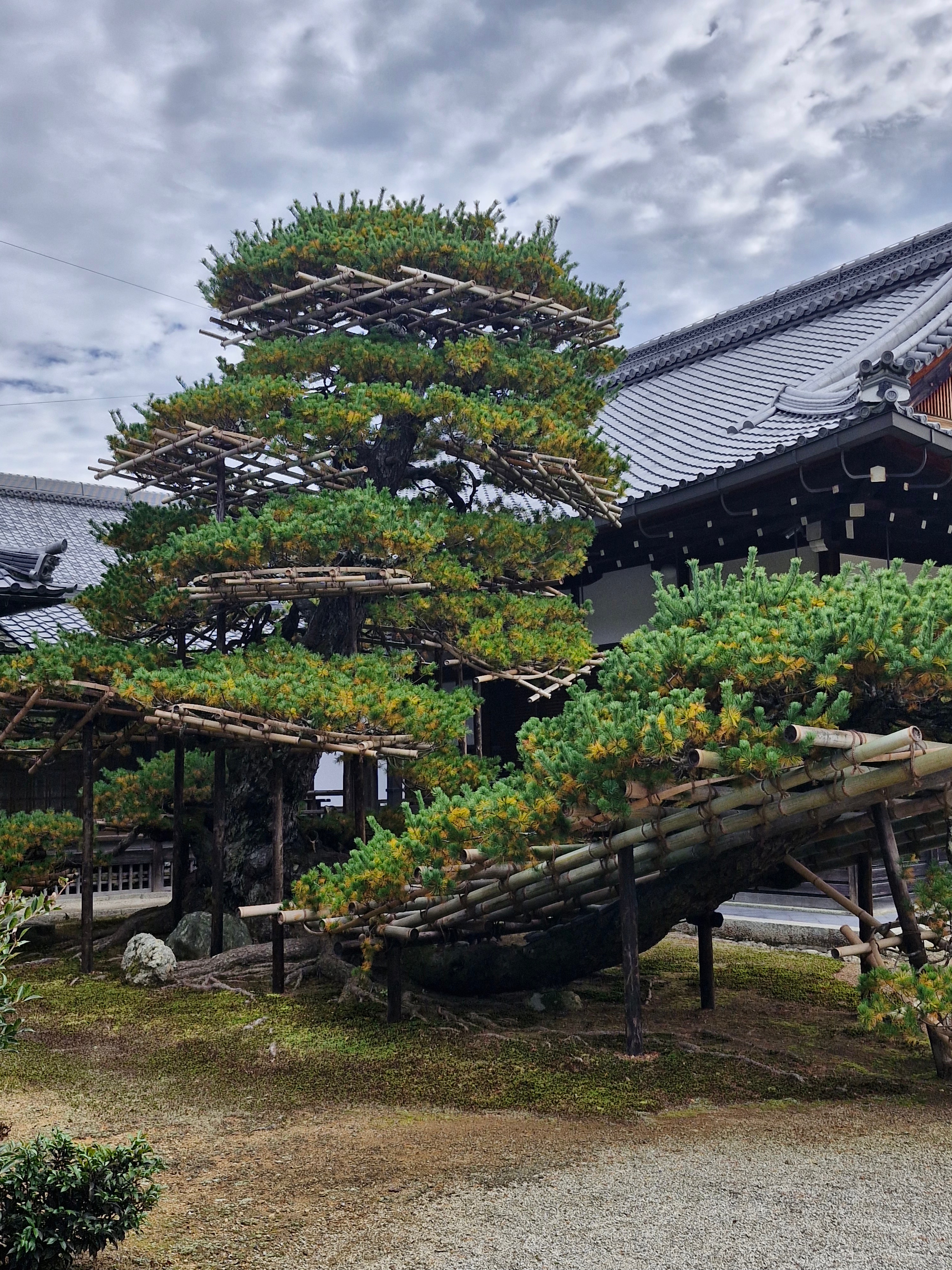
Our next stop was the Kinkaku -Ji – Golden Temple which is a Zen Buddhist Temple and is a designated World Heritage Site situated on beautifully landscaped gardens which included a huge bonsai tree that is 600 years old and shaped like a ship. You are not allowed to access the temple itself but only walk around it because it is, indeed, coated in real gold leaf. Our guide also pointed out that you are not allowed to drink alcohol on the site of the temple and as we exited, there was immediately a stall selling Sake (rice wine) again. Many temples and shrines have huge barrels of sake on either side of the entrances as offerings to the rice Gods for a good harvest. Rice, as most people know, is the staple grain of Japan and there have been shortages in recent years. 

600 Year Old Bonsai Tree

As we exited the temple grounds we said goodbye to our group and were told which bus to board for the half hour ride back to Kyoto Station. We got seats, which seemed like a miracle. Our feet were tired after all the walking so it was a welcome break. When we got back to the station we went to Cafe Veloce, a chain in Japan that serves large black coffees for about 2.18 Euros a cup. We went to this cafe several times in different cities. After our coffee we walked back to our hotel to take a break, as we had been up since 5.30am. We got back to the hotel just after 3pm. We also noticed on our walk back through our neighbourhood that not a single bicycle was locked (amazing!) and there were lots of them parked right outside houses. 

Small vans seen everywhere in Japan

A lot of Japanese also drive these small box shaped vans which are practical because they fit into the many small alleyways and people park them very precisely into their designated spot. We also couldn’t help but notice in Tokyo that everyone seemed to drive black, white or silver cars that were different to cars in Europe and The U.S. and also that practically every car looked brand new with not a scratch on them. Where do the old cars go? The exception being the vintage taxis that were nearly all black. Kyoto had more variety in cars but it was still fairly uniform. 

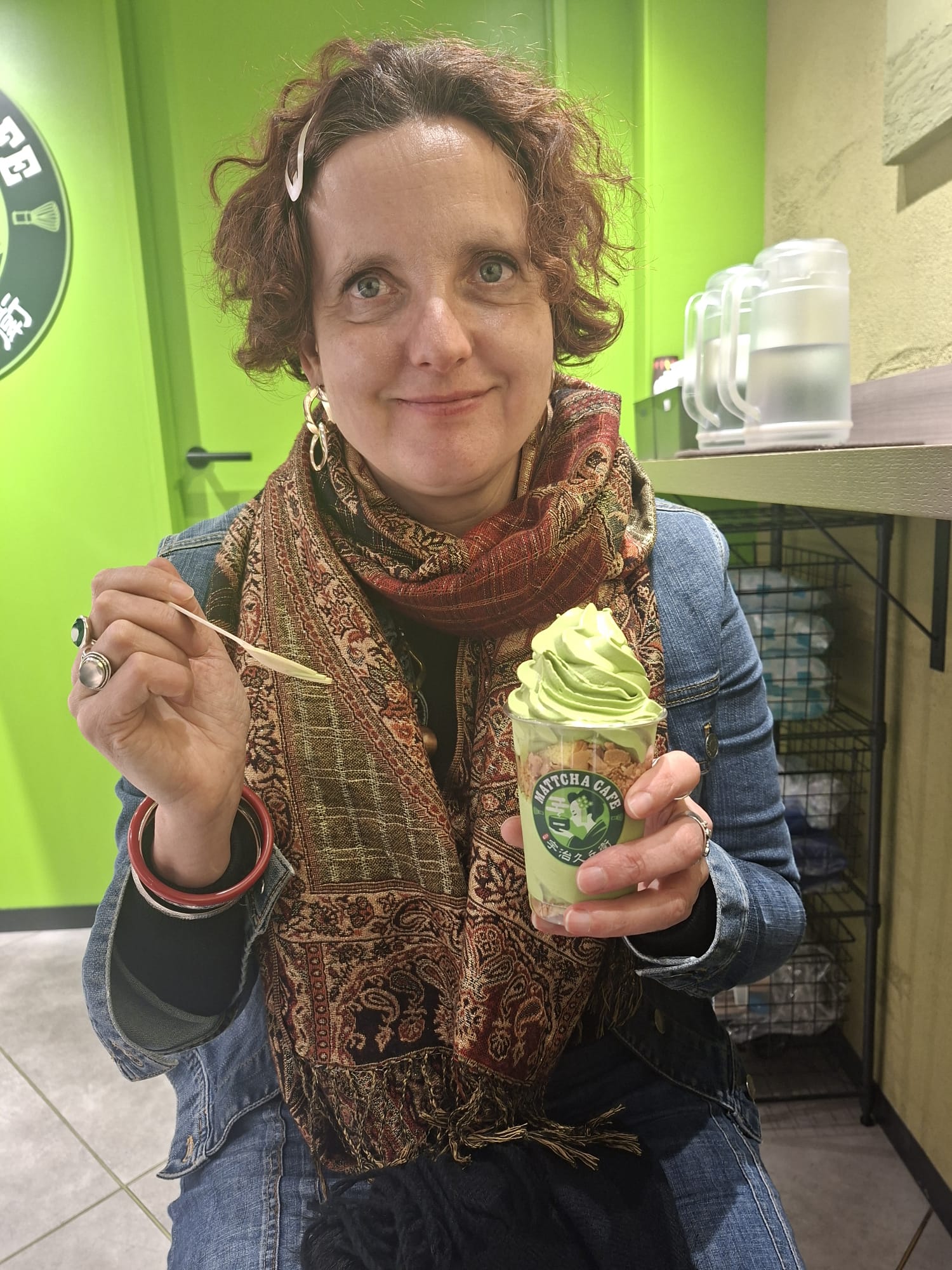
After relaxing for a while we were hungry and so ventured out to find some food. At this point, I will admit that we were really craving the following: PIZZA. Yup, after eating 4 bowls of ramen, lots of sushi, tempura and gyoza in Tokyo we really wanted CHEESE and TOMATO SAUCE for a change. At this point in the development of our planet, there is probably no place left on Earth that does not at least attempt to make some kind of pizza. We found really delicious pizza in Kyoto that night with a yummy salad at Pizzeria Osteria. It was a small restaurant with a brick oven. It satisfied our palates and was also very affordable. The next night we would eat more Japanese food. After dinner, we went and had one of the culinary delights of Kyoto: Matcha Green Tea Soft Serve ice cream. It was delicious. We ate it a few times there. 

Matcha Green Tea Soft Serve Ice Cream

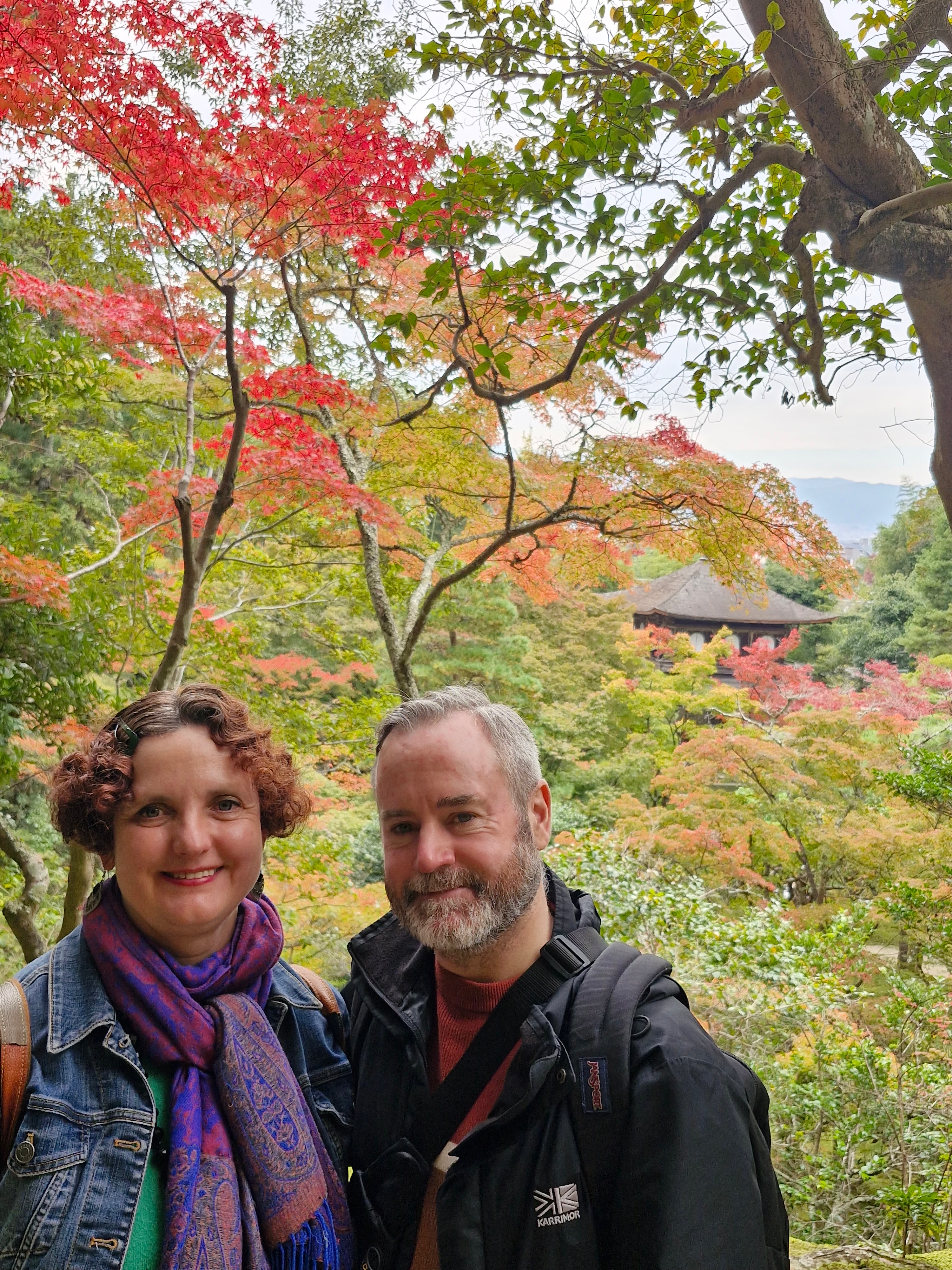
The next morning we slept in a bit after our whirlwind tour of Kyoto of the previous 24 hours. After a leisurely breakfast we took the bus (now that we knew how it functioned) to the Ginka Kuji Temple –  the Silver Pavilion. We didn’t have a guide for this section of Kyoto so we just rode the bus near to the temple, stopped for a coffee and then paid the small entry fee of 500 Yen to enter the temple grounds which were absolutely beautiful. As you enter you see a raked sand monument that is called the sea of silver sand. It is meant to look like ocean waves.

The Silver Pavilion and the Sea of Silver Sand

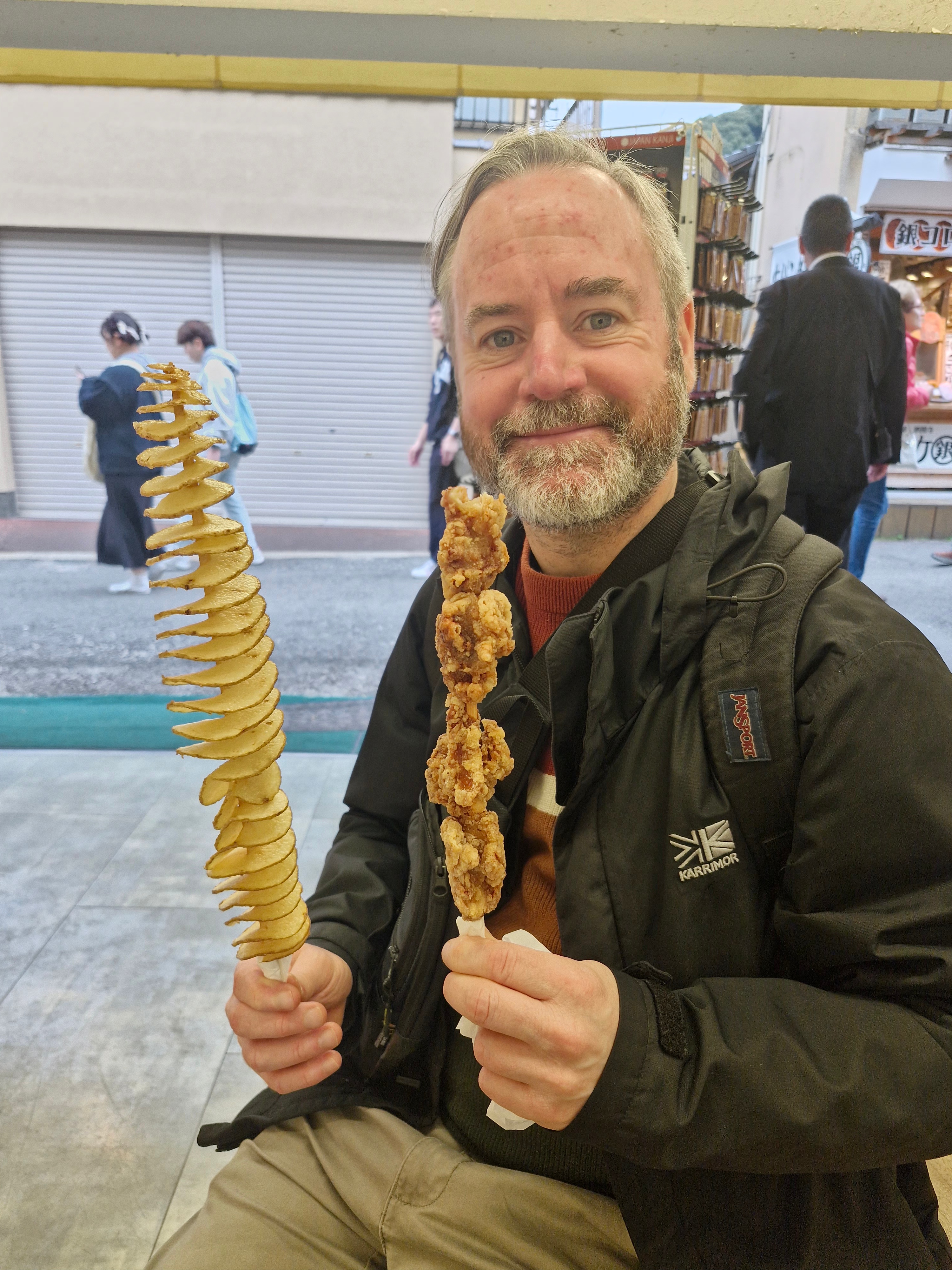
You then walk a loop uphill over bridges, streams and ponds and a well-maintained moss garden. The maple leaves were turning red and it was pleasant but overcast weather. We had noticed many Japanese people with beautiful coloured notebooks and they were lining up not for tickets to enter the temple but to get their goshuin stamps in their books. It is a souvenir and also a record of your visit to that shrine. Many of the goshuin stamps are hand painted calligraphy. It seemed to be a very important part of visiting the temple. When we left the temple we were a bit hungry so we got some chicken and potato swirls on sticks. Yakitori is the Japanese word for grilled chicken on a skewer but the term is used more broadly to refer to various savoury foods on skewers.

Yummy Yakitori make a great snack when you are walking miles every day

Another reason we had come to the eastern end of Kyoto was to walk along the famous Philosoper’s Walk. It is a 2 kilometre walk along a narrow canal (with no guard rails and very shallow water). It is lined with cherry trees so naturally it is packed in springtime, but it was very pleasant and quite peaceful to walk under the autumn cherry trees. There were ducks and large koi swimming in the canal. We even happened upon another temple that was completely empty. We had the whole temple to ourselves for a few minutes. A rare occasion on this trip! 

The Philosopher’s Walk

At this point we were getting hungry and Dáire had said he wanted to eat another Japanese speciality: tonkatsu, which is cutlet made from pork and battered in breadcrumbs and fried. He had done a bit of research and found a lovely place for dinner that evening called Katsukura Sanjo in downtown Kyoto. We entered the restaurant through a long alleyway off a shopping mall and suddenly we were in a wonderful atmosphere with excellent smelling food. We were immediately seated by a man who was probably in his sixties. We didn’t understand what he was saying but we could understand by his gestures and tone that he was probably saying quite loudly something akin to:“Welcome! Come in and have a seat, enjoy the food!” and handed us menus. He greeted every guest in this enthusiastic manner. He seemed like a real character. We ordered the tonkatsu (breaded pork) and the breaded shrimp and shared it. It was served with rice, miso soup and shredded white cabbage. We were also each instructed to grind a bowl of roasted sesame seeds and add various savoury sauces to it for dipping the pork and shrimp into. It was such a delicious meal that we thoroughly enjoyed and it only came to about 15 euros each including a lemonade and an alcohol free beer. After dinner we walked around exploring a bit more and had another matcha green tea soft serve ice cream cone. 

Delicious Food at Katsukura Sanjo in Central Kyoto

One thing that stood out to us while wandering around Japanese cities was just how many vending machines there were selling not only drinks (mainly iced coffee and energy drinks) but also machines called Gachapon which sold little plastic capsules with toys in them. You don’t know what you are going to get when you put your coin in so it is a little like gambling (which is illegal in Japan) There are whole stores filled with these machines. We did not buy anything in them, but the woman who was on our tour confided in me that her 10 year old daughter had been nagging her constantly for coins for these machines. One of the funniest things we saw in Kyoto was a sort of talking robot-like machine that clapped its hands over its head and tried to urge you to come into one of these Gachapon stores. It spoke to us in Japanese and English and we laughed at it every time we walked by it on our way to the station. 

This guy talked to us and clapped his hands every time we passed by

We packed as much as we possibly could into 2 and a half days in Kyoto. On the last evening we had nice, long hot baths, got into yet another clean pair of pajamas and got a good night’s sleep before departing for our next destination which would be Nara Park for a few hours followed by Osaka for 2 nights. We would be taking the regional train and leaving, as always, after rush hour. 

Photos by Dáire Delmar and Rhea Boyden

Trip to Japan – Part One – Tokyo

23 Nov

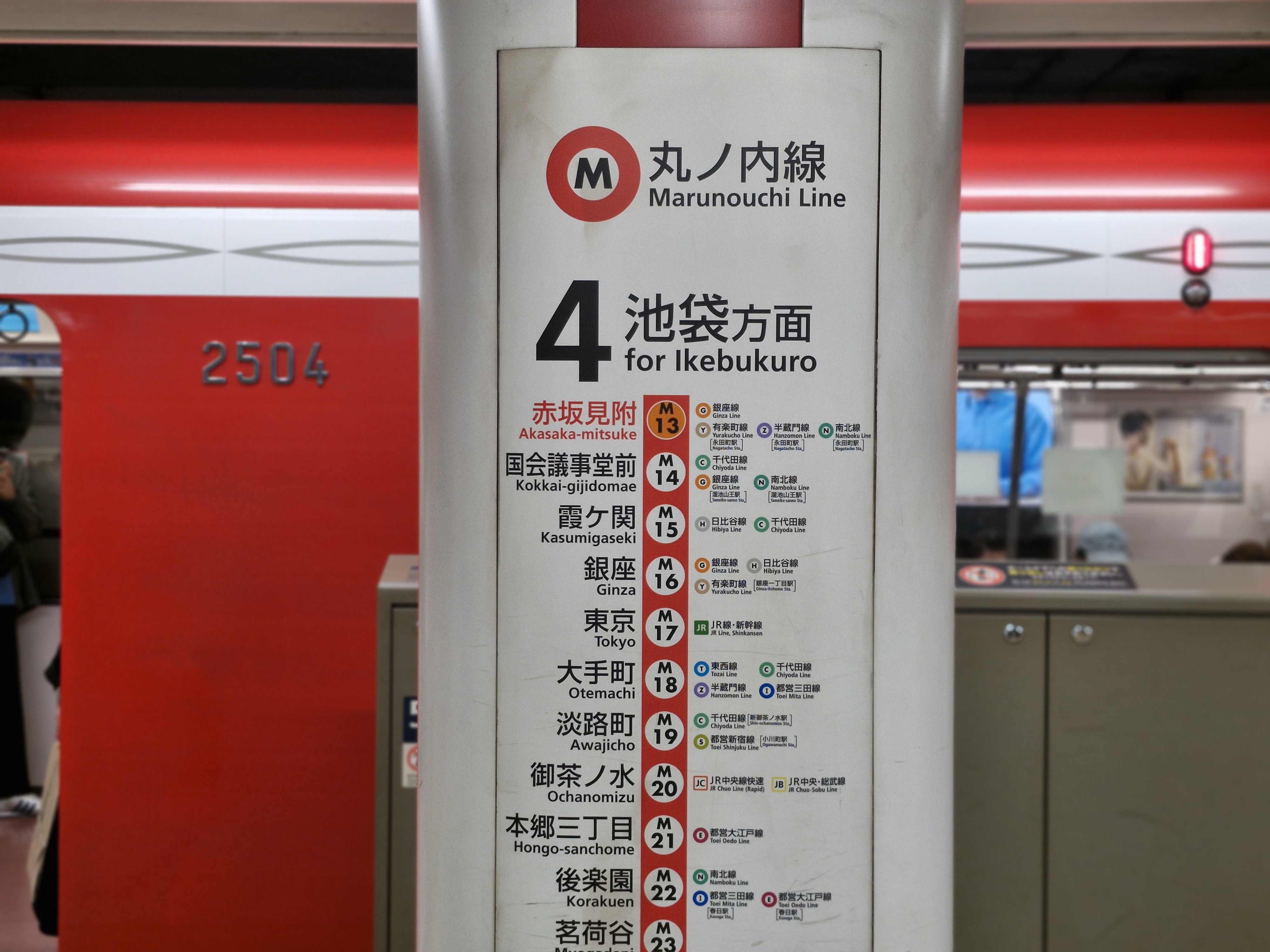
On the morning of November 6th, Dáire and I landed in Tokyo after an 11 and a half hour flight from Istanbul. We both expected to be somewhat overwhelmed by the language and the culture, (we had learned a few phases of basic Japanese) but from the first moment it was easy because a lot of things are also written in English and announcements are made in American English in airports and on trains. Neither of us had ever been to Japan and this was a long anticipated and well planned out trip. Last March, I turned to Dáire and said, half jokingly, ‘Shall we go to Japan?’ And he turned to me and said, ‘Sure, let’s do it.’ I have travelled a lot but the reason I thought Japan was a fantasy destination is because of the idea that it is so far away, exotic, expensive and somehow not easily accessible for a holiday. I was proven wrong in the planning phase by a couple of friends who had been there recently and informed us that Japan, is in fact, quite affordable with its weakened Yen and your Dollars and Euros stretch far. After disembarking from our flight, we easily went through customs because we had filled in all our immigration details beforehand on The Visit Japan website (strongly recommended) and had been issued a QR code which was scanned a couple times by polite immigration officers. Our eSIMS that we purchased in advance from Saily worked immediately on our phones which was also a relief. We then walked out, bought train tickets on the Skyliner train from Tokyo Narita airport for about 15 Euros each and were on a train 5 minutes later for the 40 minute ride to Ueno Station where we transferred to the Marunouchi Line and rode a couple more stops to the lovely Tokyo neighbourhood of Akasaka, which indeed proved to be an excellent choice to base ourselves with its wide range of affordable restaurants right in the neighbourhood and good connections to multiple subway lines. 

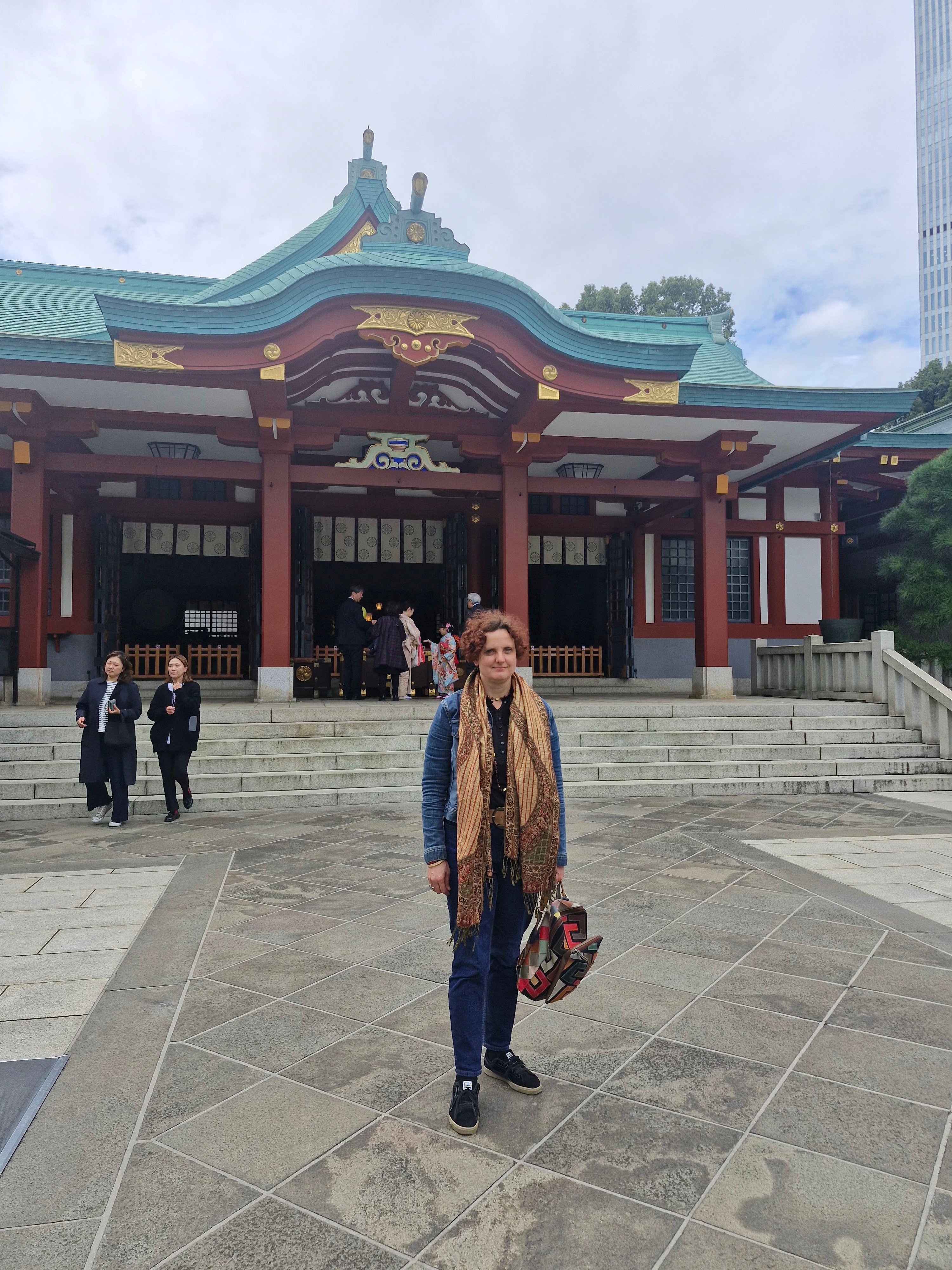
Hie Shrine in Akasaka

Our hotel was the lovely and affordable Hotel Risveglio Akasaka and we arrived there by about 12pm and dropped our bags. They offered free coffee in the reception so we recaffeinated and decided to go out walking and explore the neighborhood to beat the jetlag. (check in wasn’t until 2pm) It was a sunny day and we headed straight over to the Hie Shrine where we saw a few families with young children dressed in beautiful and colourful Japanese outfits. We learned later in the trip that the Shinto Shrines are especially revered as a place to take young children when they are aged 3, 5 and 7 to pray for blessings for their good health and growth. Shinto is centred on the belief in Kami, which are sacred spirits and deities found in natural elements like rivers, mountains and trees, as well as deceased ancestors. We then walked around the National Diet, the central government buildings in Tokyo and over to the Imperial Palace that is surrounded by a formidable wall and moat. We walked to the front gate and peered in but both the government buildings and Imperial Palace are guarded day and night by policemen and women in light blue uniforms wearing white gloves and holding long sticks. You can tour the Imperial Palace on a guided tour but decided against this.

 Imperial Palace Moat and Walls

We were starting to fade so we headed back to Akasaka and poked our heads in the first ramen restaurant we came across which was a little hole in the wall place about 5 minutes from our hotel. The proprietor, a friendly and welcoming man probably in his sixties beckoned us in in Japanese which was a relief. A woman cook came over and showed us how to use the ticket dispensing machine; you stick your cash in, hit the button of the type of ramen you want and it spits out a ticket that you hand to the cook. We sat at the counter, happy to be so hospitably received. We opted for the spicy pork miso ramen with egg; 2 large bowls of delicious ramen were placed in front of us within 10 minutes. The price: about  5.60 Euros a piece. Iced water was readily available to drink for free. The Tokyo tap water is of excellent quality. 

Our local Ramen Restaurant that served incredible ramen

We then went back to our hotel, checked in, had long hot, high pressure showers, put on the complimentary white cotton pajamas and fell into bed. The ramen had been the perfect meal after a long journey and we were both so delighted that our arrival in Tokyo and our first day had gone so smoothly. The bed was so comfortable and clean and the room was on the 9th floor with a view out over apartment buildings and office buildings and the pedestrian street below us. This was to be our base for the next 5 nights. Price: 890 Euros for 2 people sharing including breakfast. So, 89 Euros each per night, in central Tokyo in a desirable neighbourhood. We consider this a bargain for what we got. We opted for mid range hotels sharing the cost as a couple but Japan is apparently great for the solo traveler offering affordable capsule hotels. 

The view from our hotel room on the 9th floor

The next morning, after a somewhat broken night’s sleep due to jetlag, we headed downstairs to get our complimentary breakfast. We opted for what they called an American breakfast of an omelette (with no cheese or anything else on it) 2 pieces of toast with bacon, some rice crispies with yogurt and some pineapple. The breakfast was okay. It also came with a salad. We ate the salad for breakfast because our guts needed the vegetables. It also came with as much orange juice, grapefruit juice and delicious coffee as you wanted. I drank a lot of coffee and orange juice to get my day started. It tasted great. It was good to eat eggs for the protein because we were walking at least 20,000 steps a day, but by day 4 I couldn’t eat any more eggs. That’s just me. I am funny with eggs. We found a supermarket and bought muesli, prunes, bananas, walnuts and milk and also ate that in our room for good digestive health as well as the hotel breakfast because that is what our guts are used to and it kept us healthy during the trip. 

After breakfast we walked to the Mori Building in the Azabudai Hills. It was a sunny morning and only took half an hour to walk to what had been recommended as a highlight in Tokyo: Team Lab, Borderless, an immersive museum known for its colourful digital art installations. It had many different rooms of fascinating and constantly changing digital images. We enjoyed it and spent about 2 hours there. Advance booking is essential for a timed entrance ticket. Everything is so well organised in Japan and the staff everywhere are polite and accommodating. As we exited the museum and were walking back down the sunny street, a Japanese woman was holding a bunch of flyers advertising Tokyo Art Week and she dropped them on the ground. We helped her pick them up and she was so grateful and thanked us repeatedly for helping her. It seems to be a cultural phenomenon to express gratitude effusively like this. We encountered it a few times. Are we just less grateful in the West? On our walk back to the hotel we stopped at a grocery store and bought a small tub of Haagen Daz Green tea ice cream. We sat outside the store and ate it because it is not good manners in Japan to walk and eat at the same time.

Team Labs Borderless Digital Art Museum

After we got back to the hotel we were tired but we packed a backpack with our dirty laundry and walked to a nearby coin laundry. We lucked out as one of the washer and dryer machines was just being emptied so we put our laundry in and were instructed how to use it by a very friendly Japanese man. (We had spent 3 days in Istanbul before arriving in Tokyo so it was time to do laundry. I will write another post about Istanbul, which was fabulous). Our laundry was washed and dried in one machine in about an hour and 15 minutes which was fantastic because this was an easy task to complete and proved to not be complicated or time-consuming in the least. We walked around the neighbourhood while it was washing. We then went straight back to our hotel and then headed out to another ramen restaurant to try their fare: more ramen and gyoza.  We then went back to our room, had long hot showers again and got into another pair of fresh clean pajamas. We were offered clean pajamas every night of our holiday in Japan which was amazing and definitely made it easier to travel light. We only did one load of laundry the whole time. I wore the same shirt a couple days in a row but this is fine when the weather is lovely and mild between 11 and 20 degrees the whole time and you aren’t sweating. You couldn’t do it in summer, which one of our guides said was miserable this past summer with record breaking temperatures of 43 degrees celsius. November is a great time to visit with the maple leaves turning red and it was busy but not as busy as Sakura – Cherry blossom season – in March and April when Japan gets PACKED with tourists to see the cherry blossoms (and ducks struggle on ponds to dive for food because the ponds are so clogged with cherry blossoms).

Maple Trees in November in Japan 

The following morning the jetlag caught up with us and we didn’t wake up til 9.50am and we jumped out of bed, pulled on our clothes and ran downstairs hoping to still get breakfast which is served until 10am. We walked in at 9.59am and the Japanese woman serving breakfast looked at her watch and said to us with a big smile that we were still on time. (I suspect if we had arrived 2 minutes later she would have said it was too late. This is how everything is so orderly; rules are abided by. Japan reminded me of Germany quite a lot, a country I lived in for 15 years). After a leisurely breakfast and showers we took the subway over to Tokyo Station and jumped on the hop on hop off bus that has 3 different routes accompanied by an audio guide. We booked this and 4 other tours on the Get Your Guide app. This was a good choice because we knew we would be tired so there was no pressure to be at any specific timeslot. We rode past the Tokyo Sky Tree (which is the world’s tallest tower standing at 634 metres) a memorial to the victims of the Great Kanto Earthquake in 1923, as well as a memorial to the victims of the Second World War. 

Tokyo Sky Tree – The World’s Tallest Tower

We saw a lot of highlights from the bus and then got off not far from the famous Shibuya Crossing which is basically Tokyo’s equivalent of Times Square in New York. The biggest difference being that it just isn’t as loud as New York. We are so loud in the West. Being quiet and respectful in public is simply ingrained in Japanese culture and it makes even the craziest and busiest tourist spots quite simply not as overwhelming as their counterparts in London, Paris and New York. Dáire spotted a large Tower Records store so we went in there so he could browse. While he was browsing I got a message from Get Your Guide saying our Mount Fuji Tour had been cancelled because of people dropping out due to the bad weather forecast. We didn’t get to see Fuji but we did then have an extra day in Tokyo which we used well. Get Your Guide refunded the full ticket price within a few days. 

Shibuya Scramble Crossing from the Top of Shibuya Sky Observation Deck

Shibuya

It was so fascinating just walking around central Tokyo on a Saturday night watching the people. I would have loved to photograph the people of all ages and genders with their daring and incredible fashions which are so different from our own. Young women especially stood out in their high heeled boots,  mini skirts, slender and beautiful figures and their love of white socks, leggings and lace stockings. But even the more conservative fashions on older people were markedly different to our own; the combination of different textiles and shoes that you rarely see on the streets in the West. (Unless you want to get laughed and stared at). 

As we wandered out of Shibuya we happened upon a cat cafe which was next to a veterinary hospital. We had read about this so we decided to just go in. We went up the elevator, took off our shoes, as instructed, and put them in lockers with our bags and then got a drink from the vending machine which came with the price of the ticket (Our guide on one of our tours told us there are more vending machines in Japan than people and this is not hard to believe as they are EVERYWHERE. Japan’s current population is about 123 million and is dropping due to low birthrates.) We went into the cat cafe and petted a lot of cute kitties and fed a couple of them a tuna lollipop. It was a novelty. We both love cats. However we did notice during our whole time in Japan that there are shops that sell small dog breeds right in the centre of really touristy areas next to other accessory shops and this made us sad. It made it seem like these poor animals are nothing more than accessories, although I suppose the Japanese look after their animals and pets with as much respect as they do everything else. 

Cats in a Cat Cafe in Tokyo

After spending half an hour in the cat cafe we took the subway back to Akasaka and ate some vegetable and shrimp tempura with fried rice and an ice cold alcohol free beer in a cheap restaurant right near our hotel. We then went to the 7-11 right across the street from our hotel and bought a tub of Haagen Daz Green tea ice cream and a tub of purple sweet potato and pumpkin ice cream which we dutifully took back to our hotel room to eat. No eating on the street. And also, absolutely no smoking on the street. We saw several smoky smoking booths on our travels filled with people inhaling each other’s smoke. After our ice cream we took lovely hot showers again but not before laughing our heads off at a small sign that was posted at the top of the shower stall that we hadn’t even noticed till then. It read: ‘Caution. For one person only. No horseplay. Please refrain from using after alcohol intake. Please ensure that the water temperature is moderate before taking the shower.’ Well, we were respectful of Japanese culture so we refrained from engaging in any horseplay but I do like really hot showers so it was hard for me to abide by that rule. But no showering after alcohol intake? There are sake and whiskey bars everywhere in Japan. You aren’t allowed a shower after your night out? 

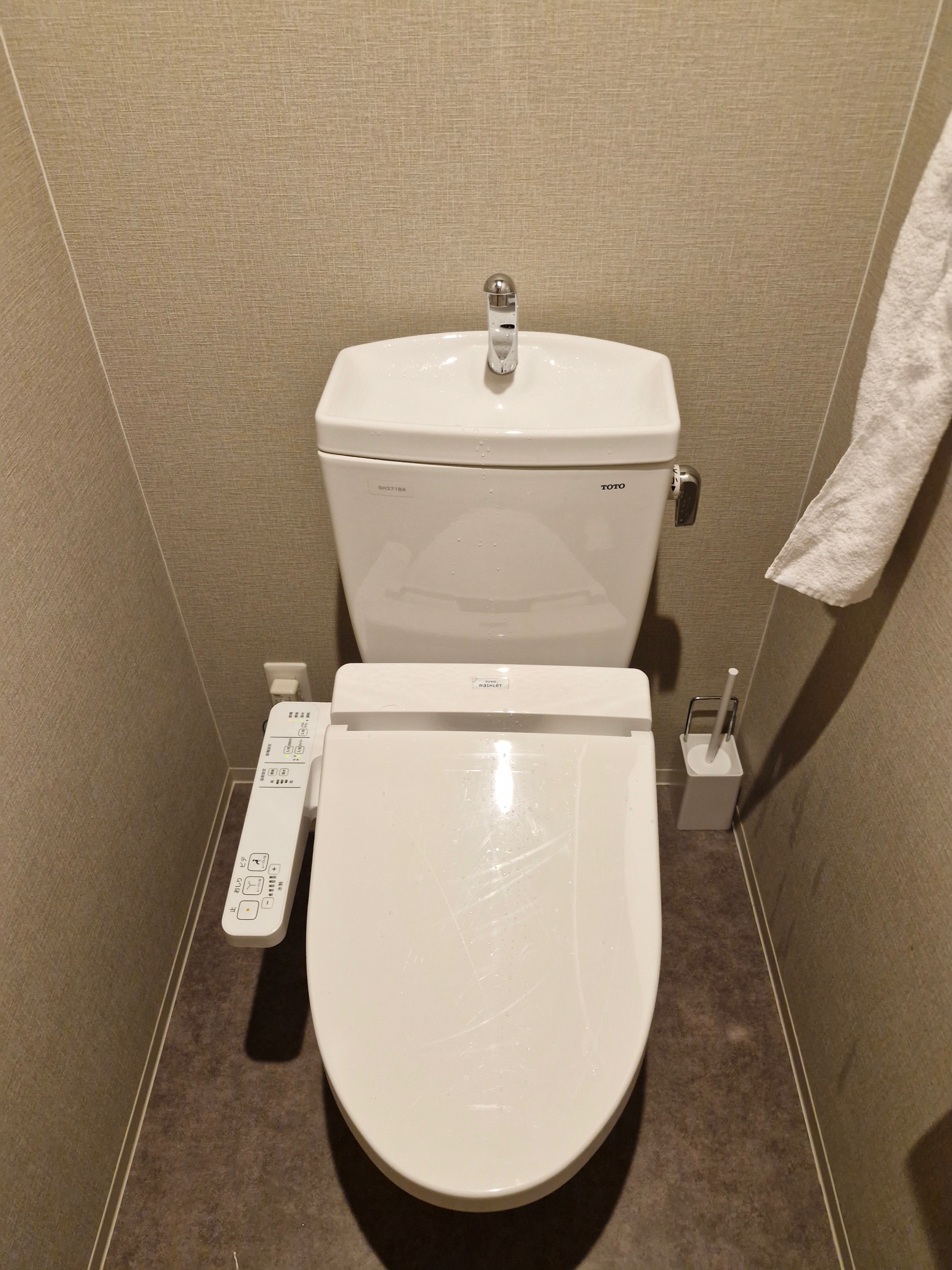
A Toto Bidet Toilet

We may have laughed at the sign at the top of our shower but we were in awe of the toilet in our room. It was a Toto toilet equipped with a heated seat and multiple bidet functions. It had an on/off button to control the time and pressure of warm water to your front or rear. Never have I experienced such clean nether regions as the duration of our stay in Japan. It had a pulsating and oscillating function to make it quite an enjoyable experience. It self flushes and the toilet lid closes automatically. These luxurious toilets are not limited to nice hotel rooms, oh no, not at all, they are EVERYWHERE in Japan. In all public spaces: parks, airports, train stations, museums, shrines, temples; you cannot walk 10 minutes without finding a clean public bidet toilet.  And they are spotlessly clean everywhere. This was wonderful for me: a middle aged woman with a weak bladder who gets stressed on long excursions wondering where the next toilet will be. Some toilets were even equipped with lights inside the toilet bowl and most toilets in public stalls had a privacy setting. You press a button and a musical and watery sound starts up to spare you the embarrassment and indignity of having someone hear you poop in a public stall. Some toilets are even equipped with sinks on top of the cistern so that the water you use to wash your hands goes straight back into filling the cistern instead of wasting it down the drain. A great solution for areas plagued by drought. Our guide told us that there is even a Shinto God protecting Japan’s toilets and this did not surprise me in the least. I noticed, however, that quite a few women’s bathrooms had no hand dryer so I would walk out shaking the excess water off my hands. I then noticed some Japanese women in the bathrooms pulling  their own little hand towels out of their handbags. The hand towels had different quirky patterns on them as well as animals including Miffy the Bunny and Hello Kitty. 

A spotlessly clean woman’s bathroom looking out onto a bamboo forest

The next morning after breakfast it was raining so we decided to go to the MOMAT – Museum of Modern Art Tokyo. It was a Sunday morning so the subway was peaceful. We observed a sign in the subway which very clearly indicated which annoying and noisy behaviours you are expected to refrain from in public spaces especially on trains and as we discovered that day: museums. We spent 3 hours at the museum and it was busy but so peaceful and quiet. The Japanese are really quiet on trains. No talking to each other or on your phone. All phones set to silent. There are even designated cars on the train that are only for women during really busy rush hour times, with signs telling you to the minute what time these cars are to only be occupied by women. (presumably so they do not feel harassed during the peak travel times when people are packed into each carriage.) We planned our activities to avoid peak rush hour. 

Tokyo Subway sign indicating which behaviours to refrain from engaging in

We really enjoyed the MOMAT with its large collection of Japanese art. We also couldn’t help but notice the lifespan of some of the artists; a LOT of the featured artists died in their thirties or forties. What was the cause? We pondered. Suicide? Feeling outcast for being different? A Google search gave the following answer: ‘the extreme pressures of work in a demanding industry, stress related health issues, and personal struggles with mental and physical health’. I am not inclined to now Google all of the artists and find out their cause of death, but we can conclude that many probably did die of suicide or alcoholism. We decided to enjoy the art and not dwell on their short lifespans too much, but it did make us think about the extreme work ethic in Japan. Harue Koga, whose art is featured below, died of the result of extreme pressure, chain smoking and syphilis. 

Woman Divers by Harue Koga (1895-1933) MOMAT 

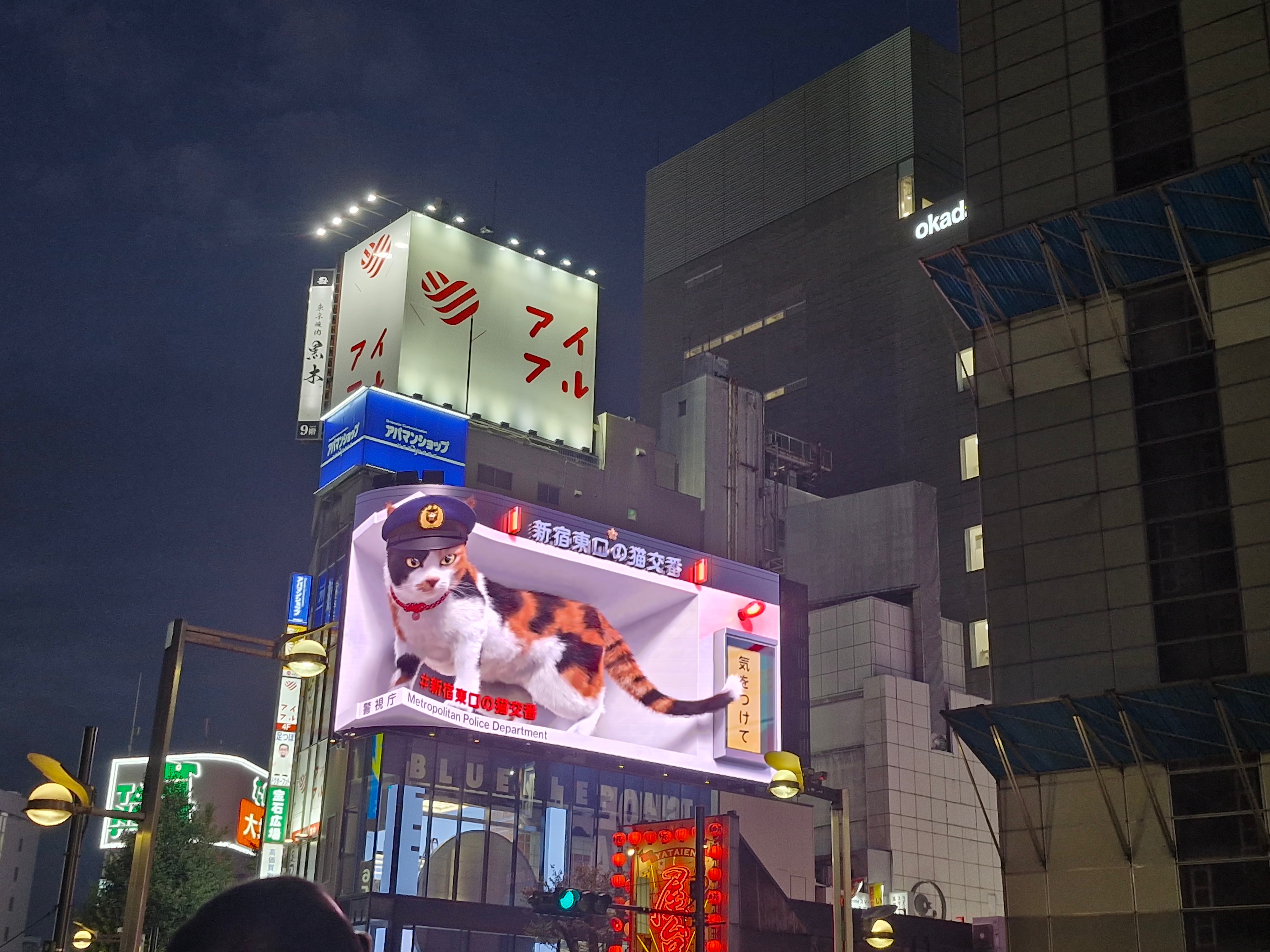
After visiting the art museum, we wandered to the Shinjuku district with its amazing mixture of old and new architecture; lanterns and neon lights. A silly highlight there is to stand on the corner and watch a massive 3D billboard of a cat meowing and talking in Japanese. There is also a The Hotel Gracery that has a giant Godzilla looking into the windows of the dining room. We considered staying there during the planning phase of our journey but were happy we opted for the laid back Akasaka instead. Again, I simply enjoyed watching the people that populate this city, their fascinating fashions inspiring me to be more daring. I had just finished an 18 month contract working in a charity shop (thrift store) in Ireland and had the chance to try on and purchase many interesting garments but nothing matches the daring of the Japanese. 

The Shinjuku Cat

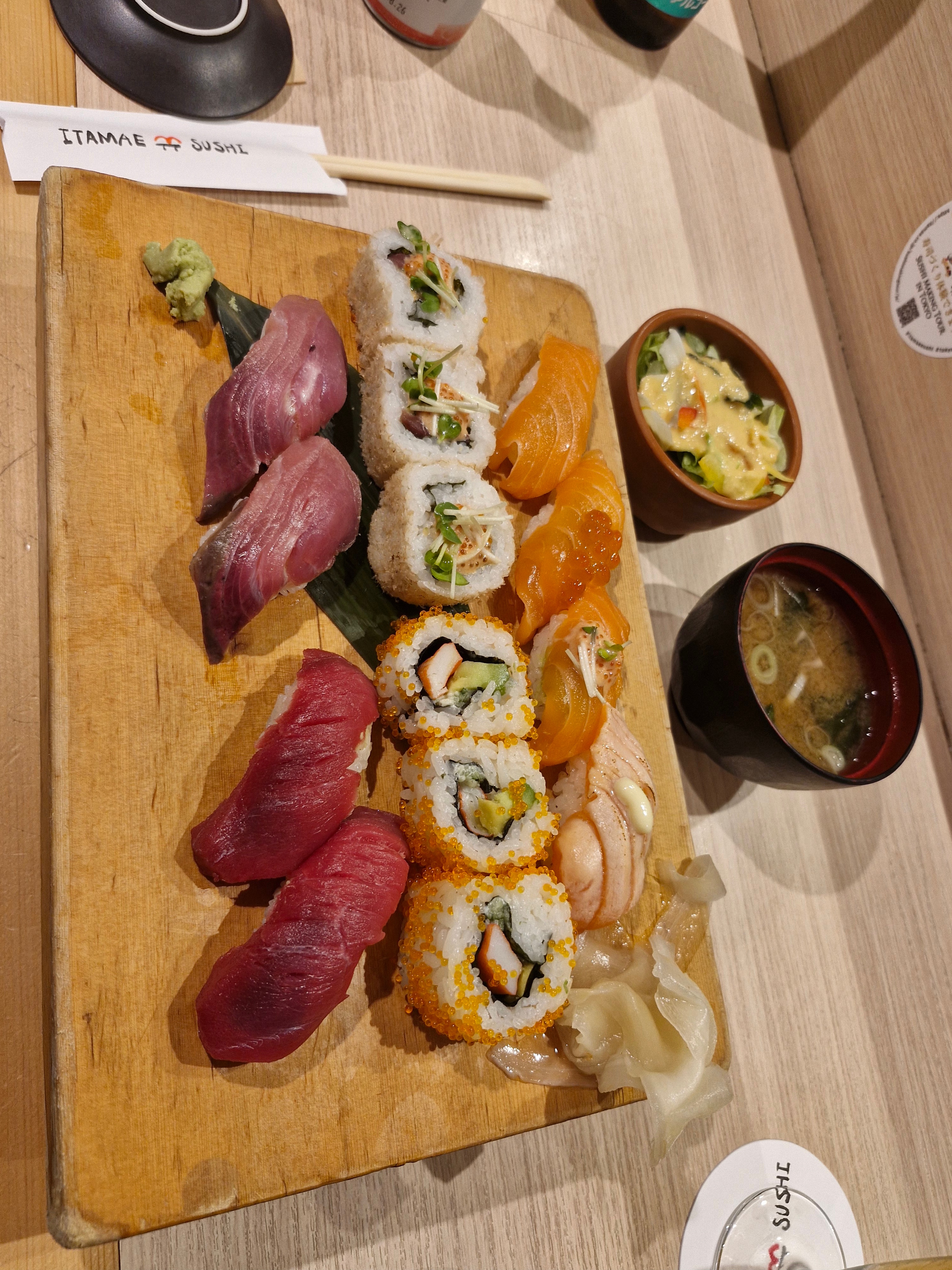
After several hours wandering around Shinjuku we were hungry so we took the train back to Akasaka and went to a sushi restaurant. We had spotted a nice place earlier that day and it didn’t disappoint. We watched the chef make the large plate of sushi right in front of us that we had with bowls of miso soup, a salad and an alcohol free beer each. It was nice to eat some fish after indulging in pork ramen and greasy tempura and gyoza. Again, the entire meal came to about 11 Euros each. Also, you don’t tip in Japan. The price you see on the menu is the price you pay. Service charges are included. 

Delicious Fresh Sushi at Itamae in Akasaka

The next morning we were up early and had our breakfast and headed back to Shibuya to our timed entry slot of 10am to the Shibuya Sky Observation Deck. It cost about 15 Euros each and was worth every penny. It wasn’t too busy yet. (At sunset it gets packed) It was a beautiful morning and we got stunning views of Tokyo in all directions from the 46th floor of the building which looks down on Shibuya Crossing. We formed an impression of just how huge and sprawling this city is with its 37 million inhabitants, making it the most populous city on the planet. The three main tall towers in Tokyo that have 360 degree observation of the city are The Tokyo Skytree, Tokyo Tower and Shibuya Sky. We opted for Shibuya Sky and it was fabulous. There is loads of space to wander around on several levels both indoor and on the rooftop. There is also lots of comfortable seating up there so you can just relax with a drink and snack and enjoy the view. They have a full bar and snack menu. (We didn’t buy any food or drinks but the prices seemed reasonable enough. Some people were having cocktails). We spent nearly 2 hours there.

Shibuya Sky Observation Deck

After descending from the Shibuya Sky we walked in the direction of the Shinjuku Gyoen National Garden. En route we passed a building site which was well fenced in and the traffic lights were still working. No matter, there were still no fewer than 4 policemen and women with white gloves, sticks, and red and white flags, guarding the site and making sure that pedestrians are safe as they walk by it. We would never see these levels of safety and vigilance near a building site, especially if it is fenced off!  We saw this a lot on our travels. Also about half the people in Japan still wear masks: pandemic or no pandemic. 

A Masked and White-gloved Policewoman/Security Guard

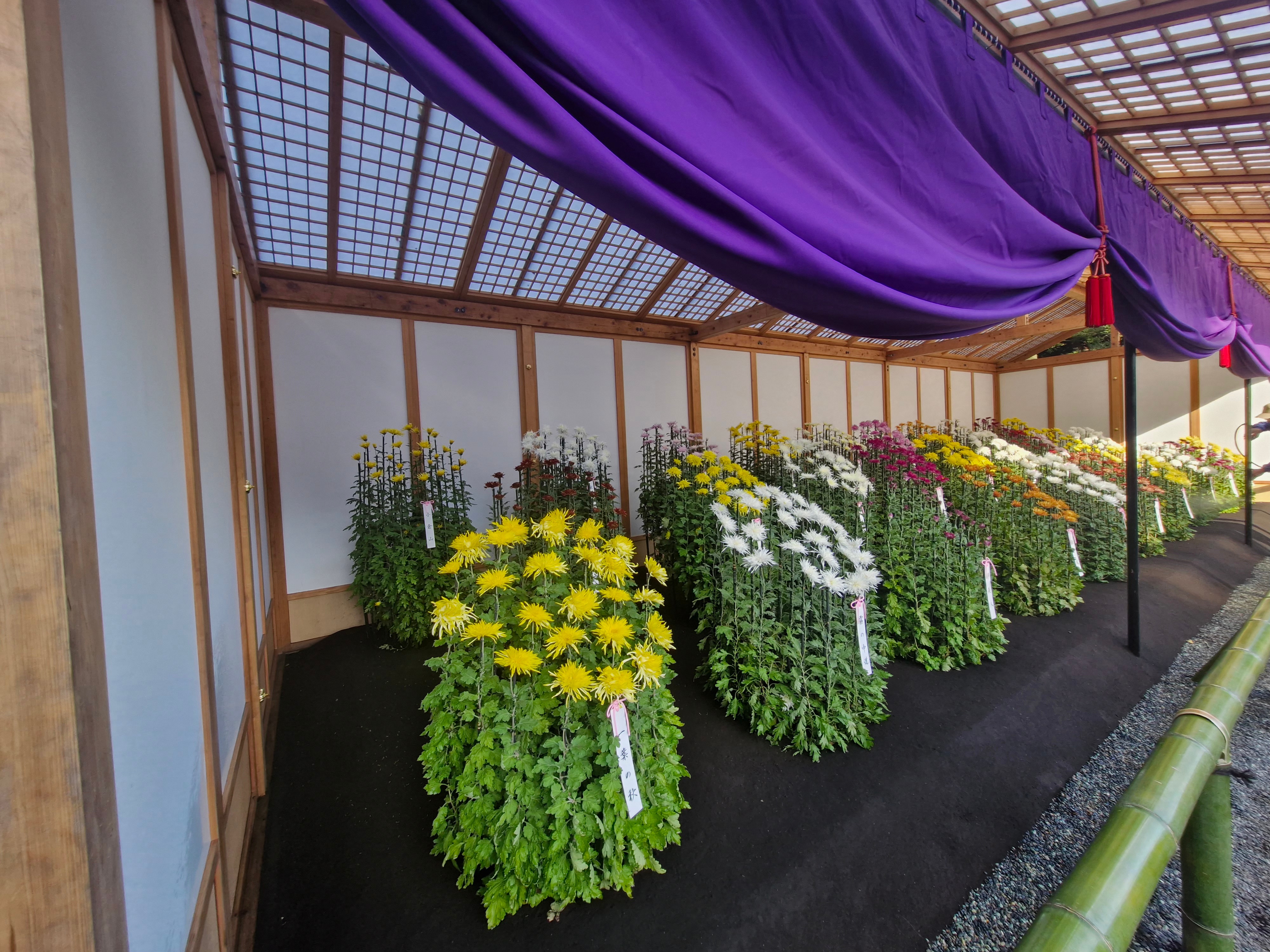
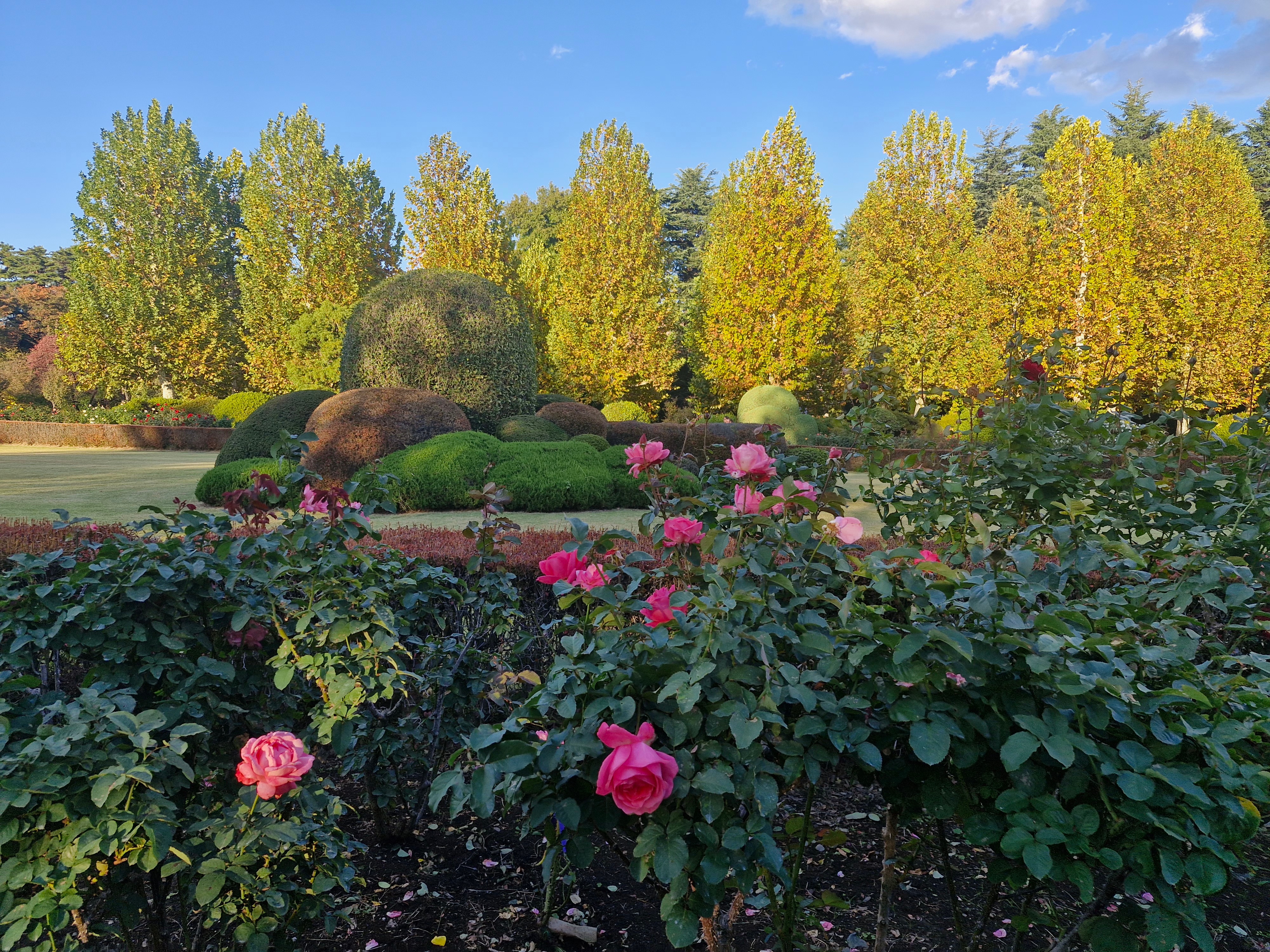
The Shinjuku Gyoen National Gardens were definitely a highlight of our trip to Tokyo. The well landscaped gardens were bathed in dappled sunlight and roses were still blooming in November. It is a 144 acre park that blends 3 distinct types of gardens; Japanese traditional, formal and sprawling lawns with other natural landscaping. One feature that we found humorous were the perfectly landscaped and pruned sets of chrysanthemums and other flowers that were growing in perfect sets and rows under canopies with purple curtains decorating the sides and tops. The flower groups looked like ballerinas on stage about to jump up and dance. I have never seen anything like it. 

Flower Stages in Shinjuku Gyoen National Gardens

We gained entry to the gardens with our IC Card which is the Tokyo equivalent of the Irish Leap card or metro card. Entry was 500 Yen which is about 2.76 Euro. The Japanese love cash. You can pay with cash just about anywhere and some places only take cash. The IC card is also good for subways, buses and trains across Japan, plus as we discovered at the end of our trip, it was good to tap on vending machines! We couldn’t believe it. On our last day in Osaka we were trying to use up all our yen only to discover that we couldn’t top up our IC cards for our trip to the airport with our debit cards and so were forced to take out another 10,000 Yen which is about the equivalent of 56 Euros. (No smaller amount was available for withdrawal). And so to our delight, we discovered mere minutes before we boarded our flight that we could buy bottled water and juice and more packets of matcha green tea chocolate biscuits in order to empty our IC cards before we boarded. So, the IC card has many uses. We could see that this minimal entry fee to a park through turnstiles was well invested in the spectacular upkeep of these gardens right in the centre of Tokyo. What a beautiful and peaceful haven in the city centre. We walked the whole perimeter of the park before exiting where we entered and headed back to Akasaka to our favourite ramen restaurant for one final bowl of delicious ramen on our last night in Tokyo. 

Shinjuku Gyoen National Gardens

The next morning we were up bright and early for one of the highlights of our trip: riding the Shinkansen – the bullet train to Kyoto. We splurged on first class tickets in the Green Car which were only marginally more expensive than 2nd class blue car tickets. We also sat on the right side of the train which should give you a view of Mount Fuji. Alas, it wasn’t to be, our second chance on the trip to see Fuji didn’t happen. First our tour was cancelled due to rain, then it was under cloud during our train ride. Oh, well. We looked at some nice photos of Fuji. Everything else went extremely smoothly on our trip. Japan is an easy country to travel in. Our next stop would be Kyoto.

The Shinkansen – Japan’s Bullet Train

As we waited to board the train, service workers in light blue uniforms boarded the train with mops, hoovers and buckets to clean the whole train in about 15 minutes before we boarded for our 2 hour and 14 minute train ride to Kyoto travelling at 300 kms an hour. Talk about Japanese efficiency! The cleaners did their job, we boarded and the train left the station exactly on time. It has to depart punctually because the next bullet train for Kyoto departs 15 minutes later. It was a treat to ride this smooth and sleek train. Again, it was peaceful and quiet. We arrived in Kyoto, right on time, but I will tell that story in my next installment. We were so satisfied with the amount of activities we had packed into our limited time in Tokyo and now had multiple activities and tours lined up for Kyoto. 

Photos by Dáire Delmar and Rhea Boyden
Interview: Psycho & Plastic

11 Jun

I had the great pleasure of interviewing Berlin-based electronic music duo Psycho & Plastic about their new album Placid House which was released digitally on May 8th. Enjoy!

Psycho & Plastic · Rhea Boyden interviews Psycho & Plastic

PLACID HOUSE (graphic design by Andrea Acosta)

NEAR 90.3 FM Community Radio Induction Training – Dublin

12 Jun

I am having so much fun on the induction training course. This evening I spent 2 hours in the studio with my wonderful group and we had lots of hands on practice at the desk learning how to use the microphones and equipment. We ran through several interviews and had a panel discussion on a range of topics from film, to blogging and current exhibits/events.

This is a perfect next step for me after my wonderful experience so far at PHEVER: TV-Radio and over the coming weeks we will be learning a whole lot more about the history of community radio, media law and more interview and research techniques. Exciting!

Visual Arts, Science and Climate Change – Cultbytes Magazine

8 Mar

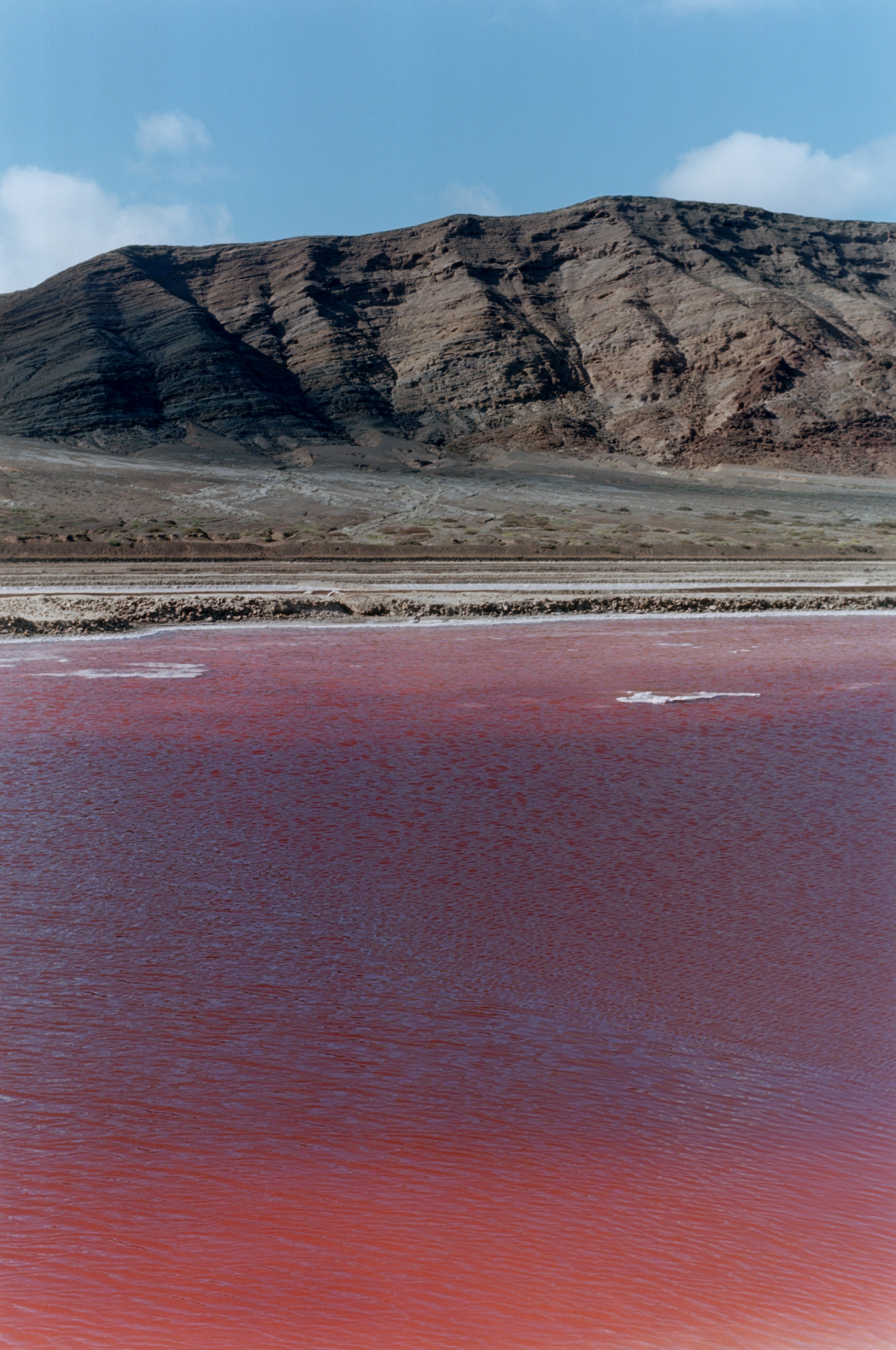
red lake-1.jpg

Wolfgang Tillmans, “Red Lake,” 2002. Photograph courtesy Maureen Paley, London.


I am delighted that my article on climate change and visual arts has just been published in Cultbytes, a New York based arts magazine. I published a longer piece on climate change, music and visual arts last November and this is a shortened piece for publication. I truly believe we can raise awareness on climate change activism using the arts as a medium for communication and discussion. It is a topic I am dedicated to. Enjoy! 


Rhea Boyden
March 2019

Dublin, Ireland

On Climate Change, Music and Activism in The Arts

13 Nov

By Rhea H. Boyden

It is late October 2018 and I am standing in my stepmom and dad’s vegetable garden at our family home in West Cork, Ireland. It’s raining. The leeks, kale, spinach and beets look delicious. This is the first time in my life that I have stopped to fully and truly appreciate and show gratitude for this garden. I am wondering if Ireland’s climate will still be stable and predictable enough to reliably grow vegetables in 2040 when I am 65 years old. I am thinking about the alarming new report that has just been published by the United Nations Intergovernmental Panel on Climate Change that states the urgency of climate action NOW if we are are to cut risks of extreme heat, drought and poverty that will affect hundreds of millions of people in the coming decades. I have been reading a lot about climate change the past few months and I find it all completely distressing. I pick a leek. The rain begins to come down harder and I am getting soaked but I don’t care.  A headline flashes through my head: ‘Climate Genocide is Coming.’ As I unearth a few beets I remember a few more headlines: ‘It’s five minutes to midnight on climate change.’ and ‘New Outlook on Global Warming: Best Prepare for Social Collapse, and soon.’ I carefully pick a few leaves of spinach and kale and then finally go back inside the house to escape the rain.

2018 began very well for me creatively. I was reading nothing about climate change and science at all. After a few years of writing venue and DJ reviews in Dublin I decided to delve even deeper into music reviewing and I ordered a pile of books that would deepen my knowledge of what is going on technically in the electronic music I was listening to. I spent months joyfully reading all about music theory, the neuroscience of music, the history of dub and the rise of  electronic music. I talked to music writers and DJs about music. PHEVER: TV-Radio DJ Hugo McCann assisted me in my quest to learn more about the music. Last summer, in the middle of an unprecedented Irish heatwave, Hugo and I met up for the afternoon to listen to some music and analyse it. As we listened to one of his many brilliant mixes he patiently explained to me what we were hearing. ‘What is that sound?’ I asked. ‘That is a Jamaican concave drum,’ he said. ‘And that sound?’ I continued. ‘That is hi hat cymbals, and then you hear organs and a sequenced clap,’ he explained. I am intrigued. It is good to finally understand what I am listening to. I want to learn more. We moved on to his latest mix that he had just aired on his weekly show the previous weekend. I always love Hugo’s mixes but this one irritates me when I listen to it the first time. ‘It’s a bit too full on for my taste,’ I tell him. ‘Well, yes,’ he says, ‘The tempo of the promos I am being sent has been increasing in the past couple of years. The tracks keep getting faster and faster,’ he says. I tell him I find this no surprise considering the pace of people’s lifestyles as well as the temperature of the planet keep increasing too. And while we are enjoying the hot July day we are also fully aware that it is absolutely not normal for Ireland and we are already well over a month into a drought accompanied by record-breaking temperatures. We talk about climate change and environmental doom as we discuss Hugo’s mixes and where he draws his inspiration from.

PHEVER: TV-Radio DJ Hugo McCann

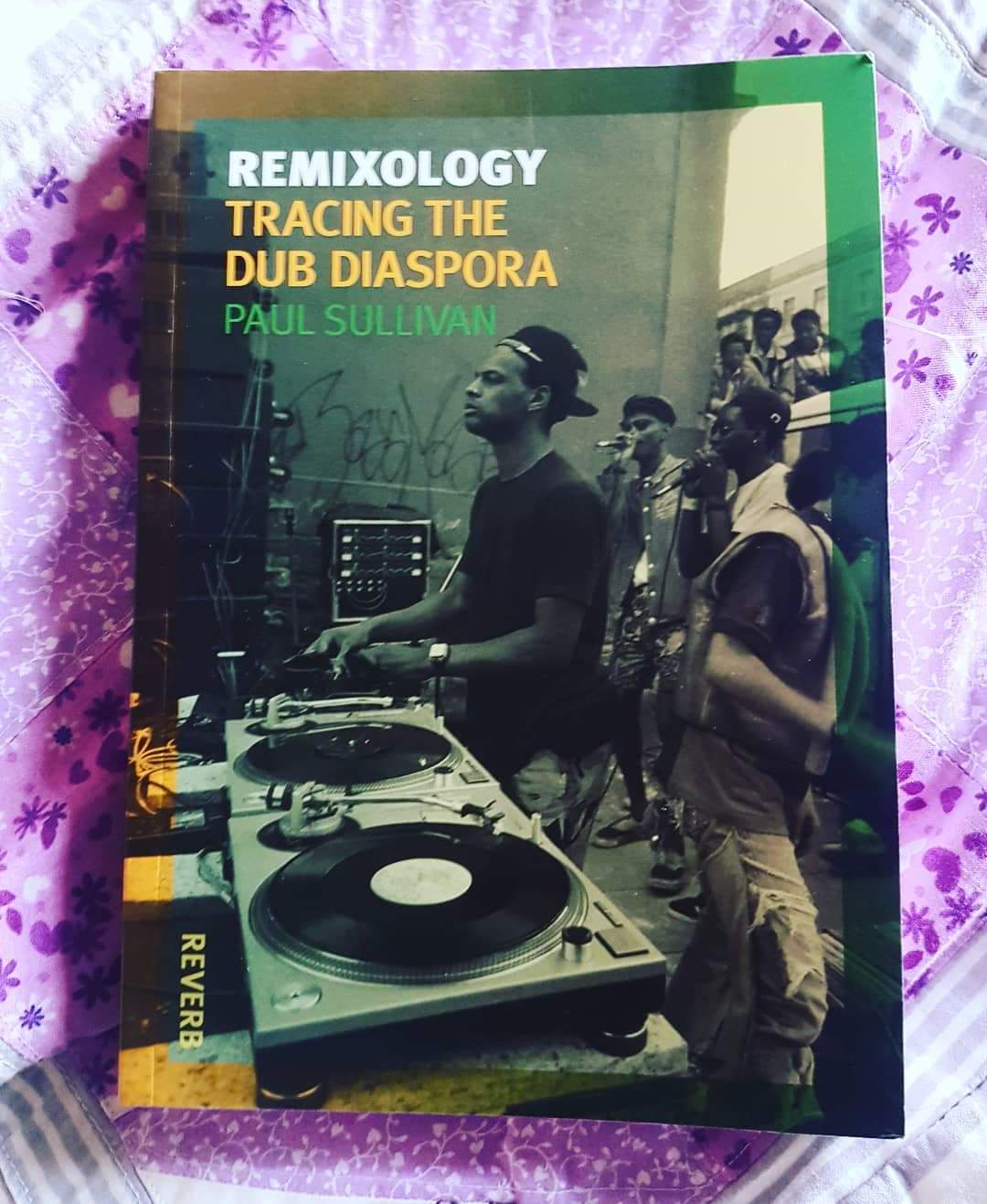
My intention after my meeting with Hugo was to continue learning about music and instruments  and to use this knowledge to bring my music reviewing to a new level. I haven’t published a single music review since then. Why not? Because I have been questioning the whole value of writing art, music and literature reviews at all with the increasing number of terrifying articles about climate catastrophe that keep pulsing through my newsfeed. So I have been reading every article about climate change I can get my hands on and as depressing as it is, I find it important to inform myself fully about the latest reports, data, projections, predictions and projects that are being implemented to protect the most vulnerable on this planet from the worst effects of climate change. And I have been talking to others about it. My friend Paul Sullivan in Berlin is a music writer, photographer and the editor of Slow Travel Berlin, a magazine I wrote for when I lived in Berlin. I have also recently read his brilliant book about the history of dub entitled ‘Remixology – Tracing the Dub Diaspora.’ ‘So what do you think about the spiritual and psychological implications of the latest reports on climate change? and ‘What do you think about the merits of continuing to review music and art? ‘ I asked him. ‘In terms of the arts and music as a response,’he said, ‘I would be tempted to say that first and foremost we should probably be dropping them in favour of direct political action. Maybe mass art protest could be useful but I think looking at paintings and listening to music just doesn’t cut it in the current climate,’ he said. I told him I fully agreed and that it was a recent encounter with a painting that made my blood boil regarding this exact topic. I was standing in the National Gallery of Ireland last summer in the large exhibit of  the work of German Expressionist artist Emil Nolde (1867-1956). I reviewed the exhibit in depth but one painting and Nolde’s description of it made me so mad. It was a beautiful oil painting of the North Sea painted in 1950. Nolde’s description of the sea was the following: ‘The wide tempestuous sea is still in its original state; it is the same today as it was 50,000 years ago.’ ‘Well, the sea is not in its original state any more!’ came my audible response in the middle of the gallery. Ocean acidification is killing off coral reefs and it is projected that there will be more plastic than fish in the oceans by 2050.

Photographer, Writer and Slow Travel Berlin Editor Paul Sullivan

A little over a year ago we experienced the tail end of Hurricane Ophelia which wreaked havoc in the south and west of Ireland. Roofs were blown off houses and thousands were left without power. Last March we experienced the humorously named ‘Beast from the East’ – a blizzard which brought the U.K. and Ireland to a standstill. We are definitely not prepared for this. I have spent many winters in the United States and Germany where there is, of course, a great measure of snow and ice preparedness because it is the norm every winter. On my street in Dublin, the pavements never got cleared and they were packed with ice and snow causing many injuries to pedestrians. I did not suffer at all during either of these events. I didn’t lose power and I didn’t run out of food. My room was warm and I stayed home from work and read a tonne about art and music. I enjoyed the days off. I guess you could say I was pretty lucky. You could also say I was pretty smug and complacent. I feel that my reading of the past few months has stripped me of a great deal of complacency. My recent reading has informed me that we citizens of affluent countries most certainly will not be spared the effects of climate change for a whole lot longer than those in the poorest and most vulnerable areas of the world. We are all in this together. A leading climate scientist named Peter Wadhams believes an ice-free Arctic will occur one summer in the next few years and it will likely increase by 50% the warming caused by the CO2 activity produced by human activity. The temperature was 20 degrees above normal in the Arctic in early 2018.

During the blizzard last March I read and reviewed a wonderful memoir entitled ‘Playing the Bass with Three Left Hands’ by Will Carruthers who was a bass player in Spacemen 3 and Spiritualised, two pioneering British psychedelic bands of the 1980s and 90’s. His book is the funniest and most heart-wrenchingly real book I have read in years and I have been praising it and promoting it all year. Will writes so beautifully about music and politics, and life in a touring band and I have thoroughly enjoyed studying his work and listening to his music this year. I also asked him what he thought about climate change and climate doom and his first philosophical response was: ‘Every second is doomed to fall.’ I pondered this. He then said ‘Have you heard of the Dark Mountain project? It is a website for enviro goths who have abandoned all hope.’ I told him I did not want to abandon hope and that despair and gloom will not mobilise us into climate activism. He told me there was also hope to be found in despair. Will has also written about climate change and, in fact, I laugh out loud when I read what he has written. A bit of comic relief is essential. An excerpt from his brilliant piece on climate change goes: ‘A terrible darkness descends upon humanity, as nature claws back what is hers, eventually the balance is restored as cockroaches and rats get to have a go at the top of the food chain. The billionaires are the last to go, having been forced to watch the terrible fate of humanity unfold in real time with an increasingly uneasy feeling that survival might not actually be the best prospect, even if you are rich. The last human sound on Earth is the screaming of billionaires being nibbled by rats.’

Musician, Artist, Writer and Poet, Will Carruthers

No, I most certainly don’t want to give up hope and I also don’t want to give up reviewing art, music and literature either because it brings me a lot of joy and connects me to many wonderful people. I do feel, however, that my reviewing henceforth will become more focused on activism. I truly believe at a time when arts, music and cultural funding is being slashed and also not being prioritised in schools that writers, artists, musicians and DJs have a duty to fill this void. So I have been having a look around for people who are doing great things and one person I have connected with recently is artist Stephan Crawford who is the executive producer of the ClimateMusic project which is a group of scientists, musicians and composers based in San Francisco who create music based on climate data. They then throw concerts to communicate the urgency of climate change activism to the public. I asked him about it and he said: ‘Our concerts combine science-guided music with data animations and visuals to viscerally communicate the urgency of climate action. We then engage our audiences in conversations about solutions and we connect them to a network of organisations that can help them learn more about the issue, take action at home and build community around engagement.’ I am completely intrigued by the work of the ClimateMusic project and the following is a lengthy quote about a current project of theirs:

‘Climate’ is an original composition by Erik Ian Walker. It was made by identifying four key indicators and assigning each of these a musical analogue: Carbon dioxide concentration is reflected in the tempo of the composition with increasing amounts of CO2 accumulating in the atmosphere causing the tempo to speed up. Near Earth atmosphere temperature is represented by pitch where a rise in temperature translates to detuning, increased dissonance, harmonic complexity and/or a rise in pitch. Earth energy balance (the balance between incoming energy from the sun and outgoing heat from the Earth) changes are audible as distortion, ring, modulation (a wobbly metallic sound), volume and a general ‘unhealthy’ unevenness of the atmospheric tone. The greater the imbalance, the greater the distortion and the loss of natural harmonics. Ocean pH is represented by compositional form and as the pH in the ocean drops (becomes more acidic), the compositional form degrades.’

I am thrilled to be reading this and it lifts my spirits and inspires me to read more.  For in it I have found a wonderful description that rolls into one the two things that have been preoccupying my thoughts the entire year; descriptions of music and climate change. I watched and listened to a clip of what this is trying to get across to the audience and essentially you hear very clearly how the pitch and tempo of the music increases to an anxiety-inducing level in line with carbon dioxide levels and earth energy balance over the years. It makes me think of another book I have been studying this year: ‘This is your Brain on Music’ by Daniel Levitin in which he writes: ‘Pitch is one of the primary means by which musical emotion is conveyed. Mood, excitement, calm, romance and danger are signalled by a number of factors but pitch is among the most decisive.’ And it also instantly reminds me of what Hugo told me about tempo increases in the music he has been airing on his show. I go back and listen to his mix again that was a bit too full on for me before. I listen to it twice and three times and with each listen it grows on me. It is dark and it is evocative of doom and gloom, but like all of Hugo’s mixes he has shared with me, it takes you on a journey. And I can’t help but think about environmental doom when I listen to it. Daniel Levitin explains is his book exactly why, from a neural perspective, I am making these associations: ‘Each time we hear a musical pattern that is new to our ears, our brains try to make an association through whatever visual, auditory, and other sensory cues accompany it; we try to contextualise the new sounds and eventually we create these memory links between a particular set of notes and a particular place, time and set of events.’ The event was the heatwave and the discussion with Hugo was about climate change and I am brought right back to that experience by listening to the music. It helps, of course, that the vocal samples in this particular mix of Hugo’s include the words ‘foolish’ ‘frightful’ and repeatedly the word ‘justice.’ It isn’t hard to link it to climate change. I now love this mix and it has become my climate doom soundtrack that inspires me to write and act.

Anthropologist, Writer and Eco-Feminist Activist Carolin Cordes

So what about Climate Justice? Another person I have recently become friends with is the lovely Carolin Cordes. Carolin is a writer, anthropologist, and eco-feminist climate change activist based in Dublin. She tells me the latest IPCC report has also spurred her on to greater activism. In her article entitled ‘Women, Climate and the Rise of Eco-Feminism’ published in Green News, Carolin writes the following: ‘In 2010 former president of Ireland Mary Robinson  founded the Mary Robinson Foundation for Climate Justice which works towards securing justice for the most vulnerable victims of climate change.’ Carolin points out in her article that climate change disproportionately affects those who contribute to it the least, and also that according to UN statistics 80% of those displaced by climate change are women. I have been talking to Carolin a lot and she and I have been sharing ideas and articles. Eco-feminism is a cause close to her heart. ‘Women have a strong link to the environment because globally they represent the majority of those working in small-scale farming, as well as resource management around water and wood,’ she writes. ‘Females also preserve strong traditional knowledge by saving seeds and farming organically, hence they protect the natural world with their long-term outlook.’  When reading Carolin’s writing I once again think about music and the maternal and feminine nature of dub that Paul writes about in ‘Remixology’. He writes beautifully about the penetrative and male nature of the heavy bass beat as it vibrates the body, but he also writes the following: ‘A great case has been made for dub’s maternal nature. Music listeners such as Simon Reynolds have noted dub’s ability to take us back to the ‘amniotic sea of the womb… the lost paradise before individuation and anxiety.’ ‘ Individuation is, of course, a hallmark of our carbon-fuelled society.

The main piece of literature that has inspired me to write this piece is a 30 page research paper by Jem Bendell, who is a professor of sustainability leadership and the founding director of the Institute for Leadership and Sustainability at the University of Cumbria. His paper entitled ‘Deep Adaptation: A Map For Navigating Climate Tragedy’ is both riveting and terrifying. He spells out in detail how doomed we are as a species by quoting all the latest climate data. If you believe what he writes, that we are now facing runaway climate change with no way of preventing it, as I am tending to believe now, he offers practical solutions to prepare ourselves for the coming decades of inevitable climate chaos.

He offers a three step plan of what he calls ‘Deep Adaptation’ – Resilience, Relinquishment and Restoration. How can we make ourselves spiritually and psychologically resilient once we have entered into the post-climate change denial stage which I feel personally, I am slowly moving into. Do we completely fall apart and lose all hope? No, we prepare, we collaborate and we adapt, something we are good at as a species if we put our minds to it. I think of my own resilience training. Every morning, I cycle 4.8 miles to work in Dublin and 4.8 miles home again in the evening. This may not seem like much, but I do it in all weather besides a hurricane or a blizzard. As the weather becomes more unpredictable this is something I need to plan a little more cautiously. I am dealing with traffic and dangerous obstacles every day. I believe it keeps me mentally and physically fit, enabling me to manage many other challenges in my day to day life.

Bendell writes- ‘Given that analysts are now concluding that social collapse is inevitable, the question becomes: What are the valued norms and behaviours that human societies will wish to maintain as they seek to survive?’ This question then brings us to Bendell’s second step in his plan which is relinquishment. On a more global scale this will mean moving away from coastlines and shutting down vulnerable industrial sites. On a personal level it will involve giving up personal pursuits that only exacerbate  problems such as flying. When I was recently home in West Cork my brother, who is now helping my father to manage our property, turned to me and said ‘Rhea can you come home some weekend soon and help us with firewood?’ With guilt I thought of the two flights I have just booked: one to London for New Year’s and another to Portugal in February. I love travelling. I have been doing it my whole life. My family and friends are spread all over the United States and Europe and the travelling lifestyle is one I am well accustomed to. Our property in West Cork has beautiful woodlands on it that my father has been sustainably managing for decades. It provides us with plenty of firewood for our wood-burning stoves. In the future I will spend more time at home chopping firewood and expanding our vegetable garden in the hopes that the climate will cooperate. It may not be glamorous but it is life-sustaining.

This brings me to Bendall’s third step which is restoration. What are the values that we will wish to restore that have been eroded in our carbon-dependent and growth-driven society? Bendell writes: ‘Examples of restoration include rewilding landscapes so they provide more ecological benefits and require less management, changing diets back to match the seasons, rediscovering non electronically powered forms of play and increased community level productivity and support. When I read this I immediately thought of my closest neighbour in West Cork, a wonderful woman a few years younger than me named Jessica Mason. Jessica is a mother of two, a gardener and an environmental educator. She has a lot of great skills and a tonne of energy to achieve wonderful things in a rural community. After my decades of city life, I am very grateful to have someone like Jessica as my neighbour to offer me advice when I eventually move home, whenever that will be. I have also been talking to her about all these topics and we have been sharing articles and book recommendations.

Gardener, Mother and Environmental Educator Jessica Mason

If all of this seems alarmist and extreme it is also heartening to read what Bendell writes about how people react when he discusses his ideas with them. ‘In my work with mature students,’ writes Bendell, ‘I have found that inviting them to consider collapse as inevitable, catastrophe as probable and extinction as possible, has not led to apathy or depression. Instead, in a supportive environment, where we have enjoyed community with each other, celebrating ancestors and enjoying nature before then looking at this information and possible framings for it, something positive happens. I have witnessed a shedding of concern for conforming to the status quo, and a new creativity about what to focus on going forward.’

In a Guardian article from April 2018, 86 year-old British social scientist Mayer Hillman said ‘We are doomed.’ He told a shocked audience at the University of East Anglia that accepting the impending end of life on Earth as inevitable might be the one thing that will help us prolong it. He says when someone is told they are terminally ill they generally appreciate life more. He claimed that the important things will be music, education, community and love as we adapt to climate chaos. The best that can be hoped for is community support because the likelihood of us now pulling together as a planet and stopping carbon emissions are slim to none. The recent election of Jair Bolsonaro in Brazil spells catastrophe for the rainforests. He is only the latest in a series of far-right politicians to gain power across the world. And while scientists and activists work valiantly to provide solutions such as large machines that will suck carbon out of the atmosphere, such a machine is largely a fantasy, and in any case, to produce something at scale takes a lot of time and money, both of which are in short supply. I am not a scientist. I am simply quoting from what I believe are trusted sources and trying to make sense of it all for my own life. I am sure I will have critics for writing this essay, but it is too important and has been on my mind obsessively the past months to not write it.

Despite all this, I still live in hope and I find my solace in continuing to learn about music, writing, reading, and continuing to collaborate passionately with people I care about. The nature of projects I work on will likely change over the next while but I still do truly believe that the arts and music are important in helping us build resilience and form connections in an uncertain climate and by no means a frivolous pursuit.

Paul Sullivan writes the following in ‘Remixology’  ‘Since echo is also related to human memory (the human brain codes remnants – the echo – of a memory), it can be used as a tool to transport listeners to the past. Jamaica’s dub pioneers used echo in combination with the sentiments and spirituality of roots reggae to provoke a sense of Jamaica’s ancestral African roots.’ Does music hold the power to bring us back to the simpler lifestyles many of us led before our lives were so driven by consumerism and growth? I think of life in West Cork in the 80s. How we lived with very little money and no running water or electricity while my parents were building our house. We and most everyone else in West Cork lived pretty frugal lives. An important ritual in rural Ireland back then was the trad session in pubs. Everyone brought instruments and there was a great sense of community. I took Irish dancing lessons and I remember dancing in pubs a lot as a child. This tradition has nearly died out in Ireland. Perhaps it will return in the future. We have to live in hope for a restoration of less carbon-intensive activities otherwise what is the point.

I wrote this essay while I was sitting in bed alone on a rainy Sunday afternoon in Dublin in November. I spend a lot of time alone, but it is also worth noting that the word loneliness only entered the English language around 1800. I love my solitude to read and write but there is certainly a thin line between solitude and loneliness, for modern loneliness is, after all, largely a result of our pursuit of individual lives in a carbon-fuelled world.

There are other ways of living.

Thank you for reading my story.
With love and gratitude,

Rhea Boyden
Dublin, Ireland
November 2018

Many thanks to Paul Sullivan, Hugo McCann, Will Carruthers, Carolin Cordes, Jessica Mason, Stephan Crawford and many others besides for sharing their stories with me.

Photo of Will Carruthers by Francesca Sara Cauli

Thanks so much to Paul for his photo which he took of himself.

All other photos taken by Rhea Boyden
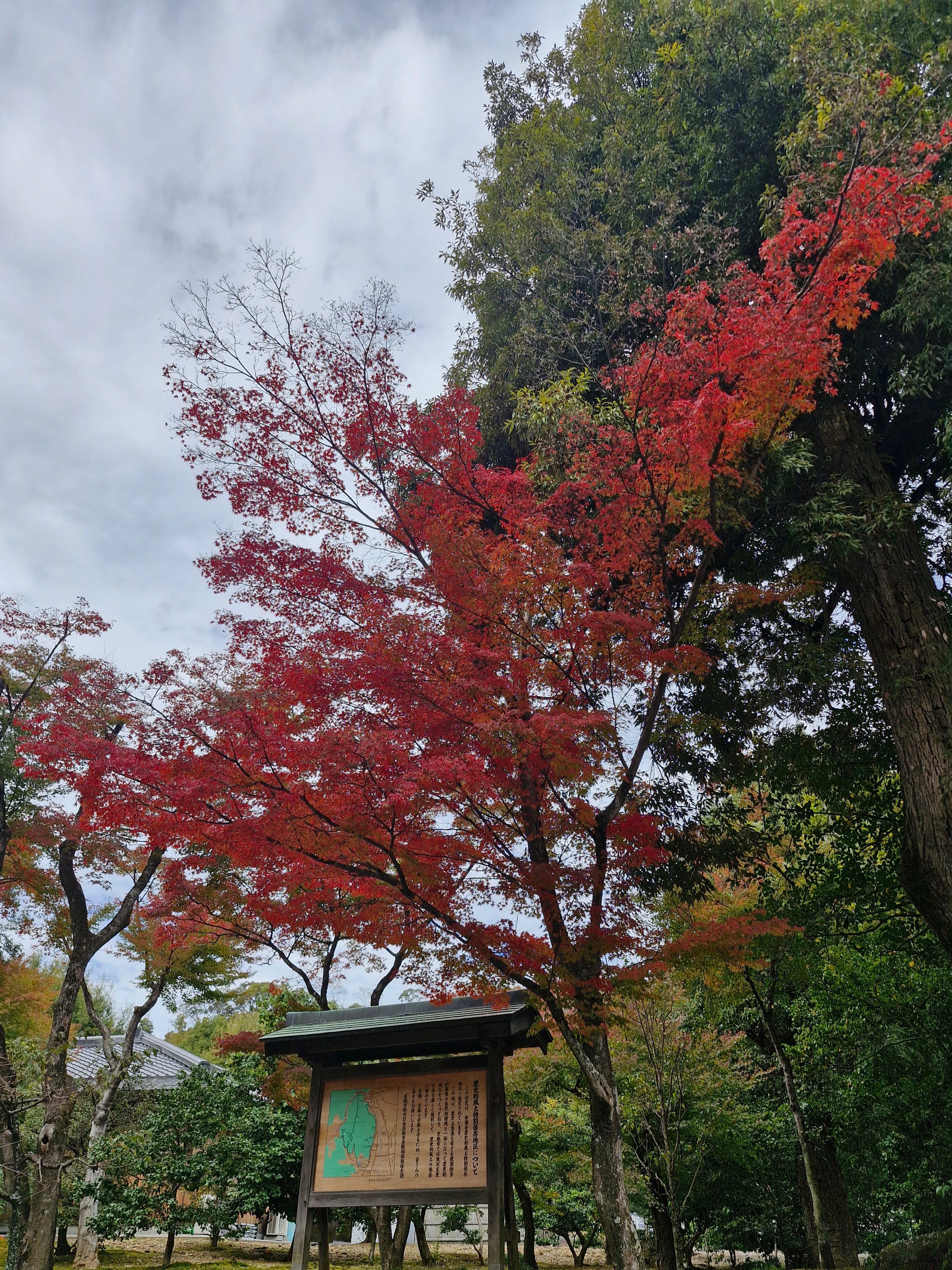
Review: Emil Nolde at the National Gallery of Ireland

14 Jul

20180407_221848.jpg

By Rhea H. Boyden

I am sitting in a Dublin cafe on a date with a man I met on Tinder. He is polite and well-mannered. He asked me out for a coffee so here I am. There is no real chemistry between us and I am sure I will never see him again, but it is pleasant, nonetheless, to meet him for an hour and chat about our lives. He is a graduate of Massachusetts Institute of Technology and holds a degree in mathematics and artificial intelligence. He tells me a bit about his work, which is fascinating. On the table between us lies the book I have with me; the exhibition catalogue of the Emil Nolde exhibit at the National Gallery of Ireland. He asks me about the book. I tell him that one of my passions is reviewing art. He looks at me curiously and asks: ‘How and why do you review art? That must be so difficult. How do you understand the emotions and intention of the artist?’ There is a pause between us. Here is a man who holds an advanced degree from one of the most prestigious academic institutions in the world and he genuinely does not understand or have a subtle appreciation for the wonderful creative process that is interpreting, analysing and reviewing art.

I have thought a lot about his questions the past few weeks and have been asking myself why and how I review art with the Emil Nolde exhibit as a focus point to aid me in answering these questions. I have been reading and rereading the exhibit catalogue and, because it is summer, and I am feeling a little isolated I have also been on a few more dates with various men in the hopes of finding some intellectual and emotional connection. The dating experiment has failed and so I have given up on it, once again. I have found no connection and so reviewing art becomes even more relevant and significant to me. When one man I was chatting with started being extremely sexually explicit with me I ended the conversation and realised that one of the main reasons I review art is because it presents erotica in a far more enticing and subtle manner. I would rather spend a whole day in a museum spotting subtle hints of erotica than partake in what seems to be the norm these days: brazenly exposing yourself sexually online in an unsolicited manner. Perhaps I am a little old-fashioned? I will stick to my principles.

20180407_221848.jpg

Emil Nolde – Rain over a Marsh -Copyright -Nolde Stiftung Seebuell (NGI)

There is a lot of subtle erotica in the work of German expressionist painter, printer and watercolourist Emil Nolde (1867-1956). In his autobiography ‘Das eigene Leben: Die Zeit der Jugend-(My own life: the time of youth) he describes the following religious/erotic experience that he had as a boy in his windswept Northern German home of Schleswig Holstein: ‘After school was over, work on the farm began. Sometimes, however, I walked alone over the fields, driven by thoughts and indistinct feelings. In a cornfield, unseen by anyone, I lay down, my back flat on the ground, my eyes closed, my arms outstretched, and then I thought: this is just how my saviour Jesus Christ lay down after men and women had taken him down from the cross, and then I turned over, with a vague belief that the whole wide, round, wonderful Earth was my beloved.’

Emil Nolde grew up in religious Northern Germany and practically the only book in his house was the Bible which he read and studied regularly. His paintings bear many religious and spiritual messages and this is another reason I review art: because as an atheist who never attends church, museums and galleries have become the spiritual halls where I find solace and hope, inspiration and joy. Art galleries to me are landscapes of pleasure and reflection. They help me understand my inner emotional landscape and make peace with myself or solve life’s dilemmas. Keith Hartley, curator of the Scottish National Gallery writes the following on Emil Nolde: ‘Creating an art from within lies at the heart of Nolde’s art: whether it comes from an inner spirituality, from deeply felt emotions, from a powerful self-identification with nature or from a self-abandonment to it.’ I see my own life reflected in Nolde’s work. His spectacular painting ‘Large poppies (Red, Red, Red)’ 1942, are an ode to colour and life and, of course, sex. Red flowers are a pretty cliched and not so subtle metaphor for sex and the female genitalia, but in an age when people send unsolicited photos of their genitalia to shocked recipients on online dating platforms, I like to think that the red flower metaphor has, in comparison, regained its position of being a subtle erotic metaphor. The darker flowers in this painting that are hanging low on their stalks remind me of how I hang my head in dismay when I am unable to make sense of some of the perils of modern sexual expression online.

20180407_221848.jpg

Emil Nolde – Large Poppies (Red, Red, Red) 1942 Copyright – Nolde Stiftung Seebuell

In their collaborative book ‘Art as Therapy’ Alain de Botton and John Armstrong lay out the potential uses of art in modern society and how we could re curate our museums to better serve human emotional and psychological frailties. They identify and discuss seven functions of art: remembering, hope, sorrow, rebalancing, self-understanding, growth and appreciation. They argue, for instance, that museums are a wonderful place to help us grieve with dignity. Sorrow and mourning are a natural part of life that we all have to deal with. And while I have pondered some of Nolde’s ideas that deal with sex, Botton and Armstrong discuss methods of helping us deal with that other eternally confusing mystery: death. They analyse a large black rectangle sculpture by artist Richard Serra. ‘The sculpture is encouraging a profound engagement with sadness.’ they write. It grants you permission to grieve. I find this comforting, for as I write this essay I am aware of a looming anniversary. My mother died one year ago this week and so naturally I have spent a lot of the last year thinking about death and grief. And while the Nolde exhibit is alive with colour, last summer the National Gallery of Ireland held an exhibit of Dutch Baroque painter Johannes Vermeer’s work and I went to the exhibit a few weeks after my mother died. It was a much darker exhibit than the Nolde exhibit and I, naturally, was in a pretty dark and confused place in my head and heart. But I drew what solace I could from the exhibition, nonetheless. I recall standing in front of Vermeer’s painting ‘The Astronomer’ and feeling profoundly sad. My mother loved astronomy and I remembered clear starry nights as a child in the States when we would go out stargazing with my mother and she would pull out her glow-in-the-dark star wheel and teach me and my siblings the names of planets and constellations.

20180407_221848.jpg

Emil Nolde – Light Breaking Through, 1950 – Copyright Nolde Stiftung Seebuell

Another reason I review art is because it constantly inspires discussion about politics, the environment and the natural world. Art gives us space to reflect on scientific and environmental discoveries without having to be an expert in scientific fields. Last year I worked as a panel discussion moderator at the Cuirt International Literature Festival in Galway. After hosting my own panel discussion I attended another fascinating panel of environmental writers and they entered into quite a heated debate about how we are still attempting to portray our planet as this wonderful pristine specimen in our well-curated Instagram and Facebook posts. It simply portrays some fantasy of what we wished our planet still looked like. A friend of mine recently posted a photo on Instagram of plastic bottles and bags floating down a river amongst swans and ducks and I liked it and commented saying ‘Thanks for expressing the truth.’ I thought again about this when I read what Emil Nolde had to write about his spectacular paintings of the North Sea: ‘The wide tempestuous sea is still in its original state; it is the same today as it was fifty thousand years ago.’ If Nolde only knew the pitiful state of the oceans today with their shocking level of plastic pollution. Last year President Trump cancelled an Obama era plan on the sale of disposable plastic bottles. I am also writing this essay in the middle of an ongoing and unprecedented heatwave in Ireland. How can art inspire us further to action to battle climate change? Lest we sink into depression at the inaction of our political leaders?

Emil Nolde died decades before witnessing our oceans filling up with plastic, but he did witness the destructive effects of Western Civilisation on native peoples during his trip to the Southern Seas and New Guinea in 1913-14. He took a huge interest in ethnological studies and frequently took trips when in Berlin to the ethnological museum to study, sketch and paint Germany’s exotic new artifacts that were being brought back there from the Southern Seas.

20180407_221848.jpg

Emil Nolde – Exotic Figures II, 1911 – Copyright – Nolde Stiftung Seebuell

Another piece by Nolde that really struck me was his oil on canvas piece entitled ‘Party’ (1911). He and his wife spent a lot of time in Berlin at cabarets and dances and Nolde was fascinated with colour, dance and music. But in this painting you are made aware that Nolde is merely an observer and not actually participating in the party. Botton and Armstrong talk about the huge importance of art in helping us remember the important and impactful events of our past, so naturally this painting makes me think both of the many years I spent partying in decadent Berlin and then also, when I quit drinking and partying and merely became and still remain a distant observer of the party. I still love music and dancing of course, and I become very excited at any comparison between music and art and the parallels between the two. Nolde writes in his autobiography that ‘Colours vibrating with the sound of silver and bells ringing of bronze’ are what herald ‘passion and love, blood and death.’ Curator Keith Hartley elaborates: ‘The musical analogies that Nolde uses in talking about colour were common parlance by the mid 1930s. Kandinsky made it a central argument in his theoretical writings.’ To enjoy art I simply need to be open and receptive to music, painting, song and dance. But to answer HOW I review art? It takes a lot of reading and searching for connections. And since I quit the decadent party life I spend way more time reading. It is work, but it is enjoyable work because of the spectacularly sophisticated levels that art curation keeps striving for as well as exquisitely and brilliantly written exhibition catalogues that are being published these days to accompany shows all over the world.

Woodcut by Emil Nolde – Prophet – 1912 – copyright – Nolde Stiftung Seebuell

Nolde was also very talented at woodcuts and carving and he was fiercely proud of his peasant roots. He likened the tools used and the physical labour applied to creating a woodcut to the hard labour and tools used by the peasants. Art History lecturer Christian Weikop writes the following: ‘The sense of primitive authenticity in the hand-printed woodcut, where no two impressions were ever entirely the same, was for Nolde, a way of proclaiming his kinship with old rural artisan and peasant cultures against the standardising technologies of industrialisation.’ It is the abundance of connections and metaphors that spring up constantly in discussing art that make it a joy to review.

I cannot with good conscience, write a review about Emil Nolde without discussing the fact that he supported the National Socialists and wanted to please them with his art. Hitler despised modern art, however and Nolde’s work was deemed ‘degenerate art’ much of it being confiscated by the Nazis and he was subsequently banned from painting but continued working underground. Can we enjoy the wonderful work of artists who support political regimes that are abhorrent and corrupt or is this hypocritical? I am thinking long and hard about the moral implications of this because Nolde was a hugely talented artist and his work continues to be displayed today. Can we forgive him his political sentiments? These are big questions to ponder.

20180407_221848.jpg

Emil Nolde – Young Couple 1913 – Copyright – Nolde Stiftung Seebuell

There is a lot to consider but I will conclude this review where I began; pondering relations between men and women. One of Nolde’s much loved works is a lithograph of a young couple which he reproduced 86 times in different colours. It depicts the tension between the sexes. We can draw any conclusion we want from this piece but naturally I think about the relationships I have had to date, how they have ended, and what my hopes are for the future. I will continue my communication of subtle erotica with people I hope understand it. And in the meantime, I think about and review art and I live in hope. Hope, according to de Botton and Armstrong in ‘Art as Therapy’ is something that will never die as long as we keep an open mind and keep engaging with art.

Images courtesy of the National Gallery of Ireland Press Office

Featured Image – Emil Nolde – Party (Gesellschaft) 1911 Copyright – Nolde Stiftung Seebuell

Emil Nolde ‘Colour is Life’ will move to the Scottish National Gallery of Art in Edinburgh where it will be on show from July 14th – October 21st 2018

Review: Hang Dai Chinese – Dublin

10 May

20180407_221848.jpg

By Rhea H. Boyden

Over the past few months I have been going to a spectacular new spot on Camden Street in the heart of Dublin city: Hang Dai Chinese Restaurant run by Dubliners Karl Whelan and Will Dempsey. A few weeks ago, I was there on a busy Saturday night and I had the pleasure of being introduced to them both. Karl, who is the executive chef, had just pulled a beautiful duck out of the oven when I met him and he looked very happy with it. And so he should be. Hang Dai, which opened its doors last November is doing a roaring trade. ‘We are delighted with ourselves,’ Karl told me when we finally had a chance to have a longer chat about Hang Dai’s decor, food and importantly, its sound system which was custom built to the highest standards. Karl told me that they had played around with different ideas when trying to get the desired feel and ambience for the venue.

On one side of the wall there is a subway car with plush dining booths. I asked Karl how this idea came about. ‘Our original idea was to have a glass and rubber handrail going down to a subway in an open stairwell so it would feel like an escalator, but then the idea morphed and we started looking at train images and train parts. We were aiming for a sci fi-esque look.’ The result is spectacular. They commissioned talented graphic designer Donal Thornton to create the graphic art that fills the spaces where one would find subway ads. One of the graphics is a subway map of various nightclubs. ‘We wanted to do a bit of music lineage from Jazz clubs to modern day clubs,’ he told me. ‘We are also planning to update those graphics and keep them fresh,’ he said. On the opposite wall there are impressive dragon murals which are the work of artist Johnny Fitzsimons. ‘He is our resident artist and is currently working on more murals in the bathroom,’ Karl said.

20180407_231313.jpg
Karl, who was formerly executive chef of Luna Restaurant and sous chef of Michelin star restaurant Chapter One among many other fine dining places, told me that they have recently revamped their menu. I have sampled their asparagus spring rolls with spicy bean curd hollandaise, as well as the steamed eggplant in fermented chilli sauce and their super special fried rice, but the star of the menu appears to be the apple wood-fired duck. Karl and Will have been to China several times visiting Beijing, Hong Kong and Chendu to research the food and culture of China. One big aim of these trips was to learn how to prepare Beijing duck in a wood-fired oven. Another menu item that caught my eye was whole brown crab in the shell ‘typhoon shelter’ style. I asked Karl about it. ‘We are just coming into summer and it is crab season,’ he said. ‘One dish we ate in Hong Kong were these massive crabs at a restaurant under a bridge where the fishermen come and shelter with their boats from the typhoon so that is where the inspiration came for that dish,’ he said.

MAC10167.jpg

And while the menu is superb, Hang Dai is by no means only about food. Co-owner Will Dempsey is a record collector and DJ and a lot of time and effort was put into having the highest quality sound system installed. They both want quality late night music with the priority being talented vinyl DJs playing using the handmade rotary mixer that was sourced in Japan by Will. The rest of the system was built by the talented Toby Hatchett, who is a boat builder by trade but also constructs custom-built sound systems in his West Cork workshop. I also spoke to him about his work at Hang Dai and he said: ‘The brief was that it needed to be a very clean, undistorted sound, so that the listening experience is very pleasant while people are dining and it is not too loud. I built the DJ console around the rotary mixer which is really the heart of the whole sound system,’ he said. Toby worked with sound designer and engineer Abe Scheele on the sound design of the room. ‘We measured the whole room with microphones and we did it in a very detailed fashion in order to get that clean, clear sound wherever you are in the room,’ he said. Toby also told me that he loves Hang Dai and that it is a joy for him to continue tweaking the system.

20180407_232547.jpg

Dragon mural by Johnny Fitzsimons

Toby also did the decor and sound system for the recently opened upstairs section of Hang Dai – The Gold Bar, which is also stunning with a fabulous balcony looking over the bustling Camden Street below. As I stood on the balcony with some friends speaking to co-owner Will Dempsey, he proudly pointed out to me that they get sun all day long which makes it the perfect spot to enjoy the smaller upstairs menu of 8 cocktails and 8 dishes. ‘8 is a lucky number in China,’ Karl told me, ‘So we thought that was significant.’ Downstairs there is an extensive menu of expertly crafted and delicious cocktails including a house favourite, the Hang Dai sour.

The roster of talented DJs includes Sally Cinnamon, Nialler 9, Aoife Nic Canna, Eddie Kay, Donal Dineen and many others. ‘We recently had Brian Cross in to play,’ Karl said. Cross who is originally from Limerick is a successful photographer and DJ in Los Angeles and he was home giving an exhibition of his work. ‘He is a success story, so we were delighted he joined us for the night.’

IMG_20180408_114348_878.jpg

DJ Aoife Nic Canna and DJ Eddie Kay at Hang Dai

DJ Aoife Nic Canna who shares a monthly Saturday evening slot with DJ Eddie Kay told me: ‘Eddie and I get on well and I love the ambience. Our job is to keep the diners there after they eat and to keep it a Saturday night party set. I really look forward to playing there more during the summer.’ I have been at Hang Dai a few nights when Aoife and Eddie were on the decks and their music certainly kept me dancing a little longer than I had anticipated. I was about to call it a night the last time I was there when Aoife played the thrilling new release from Irish producer Glenn Davis entitled ‘Body and Soul’. Hang Dai’s menu and cocktails enjoyed while listening to quality music surely are a treat for the body and the soul and I am very happy to have found such a great new local in the heart of Dublin.

Hang Dai is at 20 Camden Street in Dublin City

Photo of Duck by Terry Mc Donagh

Featured image of dragon mural by Johnny Fitzsimons

Thanks to Karl Whelan, Will Dempsey, Toby Hatchett and Aoife Nic Canna for their stories.

Review: Bazza Ranks and The Prisoners of Audio

24 Mar

By Rhea H. Boyden
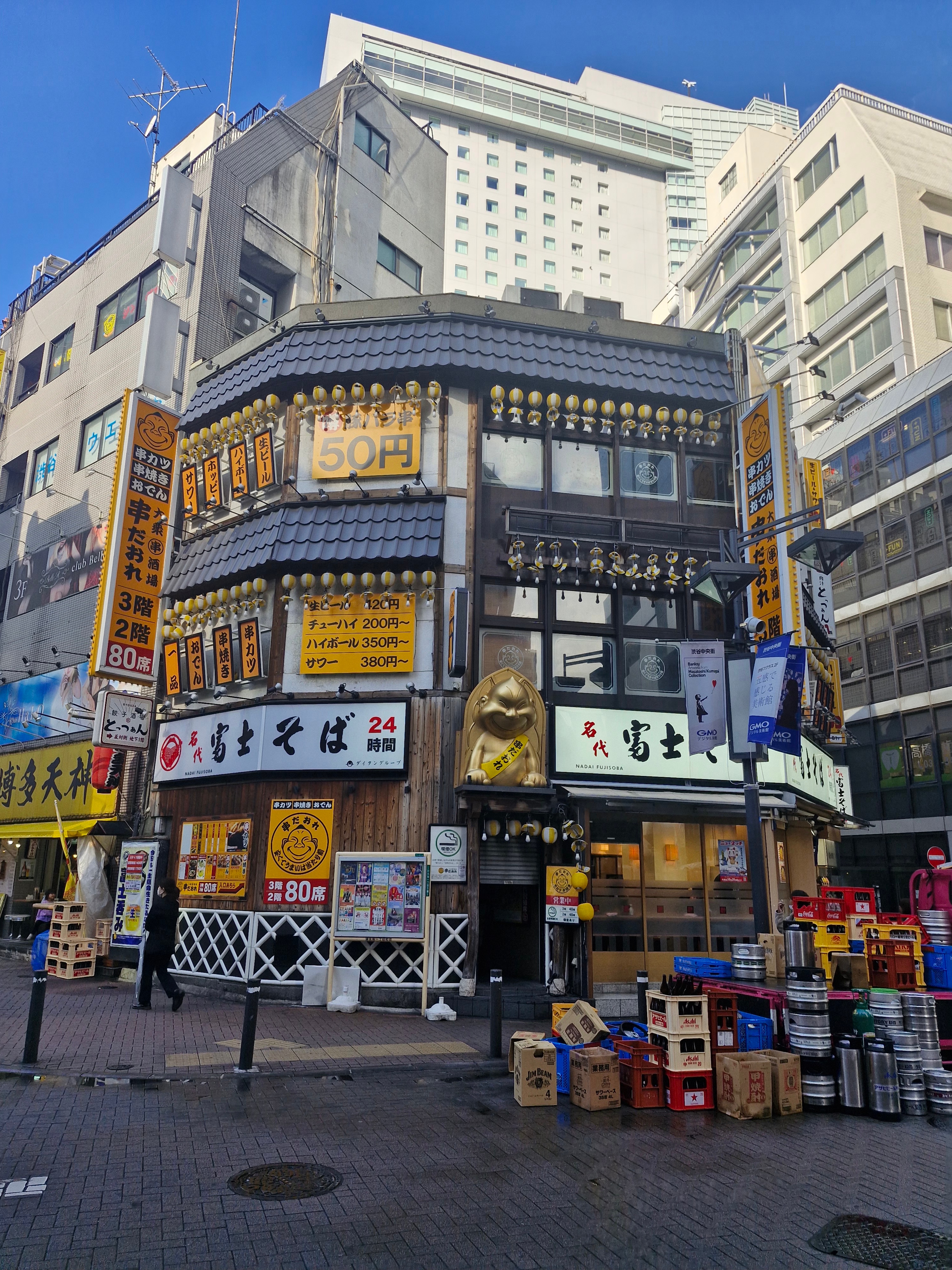
Last week Barry O’Brien aka DJ/Producer Bazza Ranks sent me over his latest release: ‘Where Would We Be (Without Our Music)’ which is a top notch collaboration with Irish hip hop group Prisoners of Audio. P.O.A. as they are also known, comprise MCs Ricki Rawness from Dublin, Russell Flow from Waterford City and Leiko Tola who is originally from Zimbabwe, but has resided in Ireland for the past decade.

I listened to the track and I immediately liked it so I asked Bazza to tell me a bit more about it. ‘It is a 90s style reggae hip hop track that fuses reggae samples and dub basslines with classic Boombap hip hop drums and tight rhymes,’ was his response. That seems like an awful lot for one track to cover and I realised when he told me this, that I really know very little about the magical fusion of all of these genres and how they all influence on and work with each other. I also spoke to MC Russell Flow who told me: ‘All of these genres are hinged together in some way, shape or form; that is the beauty of urban music. It’s very easy to dabble among different genres; to me hip hop and reggae are the lego pieces of the urban music world.’ Bazza Ranks also told me that he doesn’t like to limit himself to one genre and that he produces everything from reggae to hip hop to dancehall and house music. They both told me how much they love the vibe and music of Jamaica and are both reggae and hip hop fanatics.


The past week I have been listening to the track ‘Where Would We be Without Our Music’ and I have been reading about Jamaica and reggae, hip hop and dub. And indeed, my big question now is, Where would we be musically without Jamaica and reggae? One book that has enlightened me a lot on this topic is the brilliantly written and very entertaining ‘Last Night A DJ Saved My Life’ by Bill Brewster and Frank Broughton. In it they write the following about Jamaica: ‘This tropical volcanic rock only 200 miles long was where many of dance music’s key innovations were first made flesh. To many, reggae is just a quirky local flavour, bouncy beach-party music. In fact, it is one of the most forward thinking genres in history. Reggae was the first style to value recorded music more than live performances. As the meeting place of African, European, North American and native influences, the Caribbean, as a whole, has an astonishing range of musical cultures.’

Bazza Ranks and The Prisoners of Audio

I asked both Bazza Ranks and Russell Flow a little more about their musical influences and backgrounds and the musical cultures that have inspired them the most. ‘Growing up in Dublin I had an older brother who used to give me tapes and I know it is a little cliched, but one of the first big ones that I loved so much was Bob Marley and that fired a love of reggae in me.’ Bazza, who is now 36 said he was a little young to be a part of the Irish rave scene, but it affected him musically nonetheless. ‘I loved rave and house and became a huge hip hop fan, ‘ he told me. He is one half of successful Irish electronic music act The Dirty Dubsters who have toured all over Europe, Canada and the U.S and have been a staple on the reggae stage at the annual Irish music festivals The Electric Picnic and Body and Soul. He has held many residencies in London where he currently resides and performed at numerous festivals all up and down the U.K. His musical bio to date is impressive indeed.

MC Russell Flow, former member of acclaimed hip hop group The Animators was introduced to hip hop and reggae in the U.K. as a teenager. ‘In 1995, there was a budding Jamaican scene in London. I was only 15 and was hugely influenced by the likes of early hip hop group London Posse and various local acts in Luton where I was living.’ He told me that the new release ‘Where Would We Be Without Our Music’ of which he raps the last verse, is truly a love letter to music. Each MC raps a verse about his own love of music and what music means to him.

We also spoke about the challenges they face producing music together seeing as they are spread out over 3 cities – London, Dublin and Waterford. ‘Recording is easy enough. I can record things and send it over to the guys and vice versa;’ Bazza told me. He told me that the ‘hook’ – the line of audio, ‘Where Would We Be Without Our Music’ is a sampled part and that gives the MCs a direction. He gives them that and a beat he has produced and then they fill the empty space in between with their rapping. It certainly is intriguing to hear about the process of how a song is constructed. ‘Filming the video was of course a little more challenging;’ Bazza told me, ‘Because naturally we all have to be in the same place at the same time to do it, so it was just a waiting process until we all had time.’ The excellent video was filmed at The Record Spot on Fade Street in Dublin as well as in North Strand where Dublin’s Rub A Dub Hi-Fi have their soundsystem. There is also a clip of Bazza Ranks on the decks at The Purty Kitchen in Dun Laoghaire, Co. Dublin.


We also spoke about how elements of dancehall music and hip hop have a bad reputation for glorifying guns, violence, and drug use and also how many lyrics are degrading to women and blacks. Bazza admits that is true in a lot of cases, but he also hopes that the tunes that will withstand the test of time musically will be the ones with more spiritually uplifting vocals. Hip Hop sprung from Jamaican and Bronx ghettos after all, and a lot of it expresses the harsh reality of life there. In his book ‘Caribbean Currents’ Peter Manuel writes: ‘The glorification of guns may be primarily rhetorical, especially insofar as it expresses the theatrical rivalry between between DJs. Many DJs claim to be singing about a lyrical gun; it is better than taking up a real gun and pointing it in a man’s face.’ Indeed, my further reading about the history of hip hop in the Bronx has shown this to be true. Music was a saving force for many in the ghetto with the police turning a blind eye on extremely loud Bronx block parties, reasoning that it was far better and more peaceful than the alternative which was gang warfare and gunshots.

In the course of my conversations with them, both Bazza Ranks and Russell Flow enlightened me on many further aspects of how all these genres work in harmony and how the music works. ‘Some of the 90s dancehall stuff is some of my favourite music with its powerful basslines and what drives me to that music is the tone and voice of Jamaica. I just love the sound of a Jamaican singer or toaster over a hip hop drum,’ Bazza said. ‘Yes, and if you take hip hop and reggae in its rawest form you can do so much with it,’ Russell Flow told me. ‘You can take reggae and add something to it and then you have dub, for example. I decided to read more about dub of which I knew little before and ‘Last Night A DJ Saved My Life’ contains the following stunning description of it: ‘Dub is a new universe of sound. It is the first full flowering of the dance remix. Dub opened up such dramatic possibilities that it is considered a whole new genre. Dub techniques are so powerful they are now used across the entire spectrum of popular music. A dub mix is essentially the bare bones of a track with the bass turned up. Dub separates a song into its stark component parts and subtracts each strand of sound until a new composition is made. By adding space to a track what is left has far more impact. By boosting a bassline until it’s a monstrous shaking presence, dropping out the whole of the song except its drums, sending a snatch of singing into a reverberating echo, stretching out a rhythm with an interminable delay, dub can make a flat piece of music into a mountainous 3-D landscape.’


Dub, reggae, hip hop and dancehall; they certainly seem to collide and fuse frequently with each other and my reading and discussions the past week have opened my eyes a little more to this world. Bazza also told me about his record label Irish Moss Records. ‘Irish Moss is a famous drink over in Jamaica so we thought that was fitting. It is a dance music label with a very definite reggae heartbeat,’ he said. ‘Yes, a love of reggae is very definitely something that bonds us,’ Russell Flow agreed. Bazza is also a podcaster providing a platform to speak to many other DJs about their musical passions. ‘It really is something I love to do. It was born out of talking to DJs at length when I bumped into them. I don’t really have access to the A list of DJs but it is great because people like to hear about the hard-working local DJs just as much.’ And it really is true. There are so many fascinating stories to hear about people’s many creative projects.

‘Where Would We Be’ is released on Irish Moss Records

Photos and graphics courtesy of DJ Bazza Ranks and MC Russell Flow.

‘Where Would We Be’ video courtesy of Dan Gill

Black and white photo by Tara Morgan