Written by Rhea
Editing and Layout by Eve
Photos by Johanna and Euan
by Rhea H. Boyden
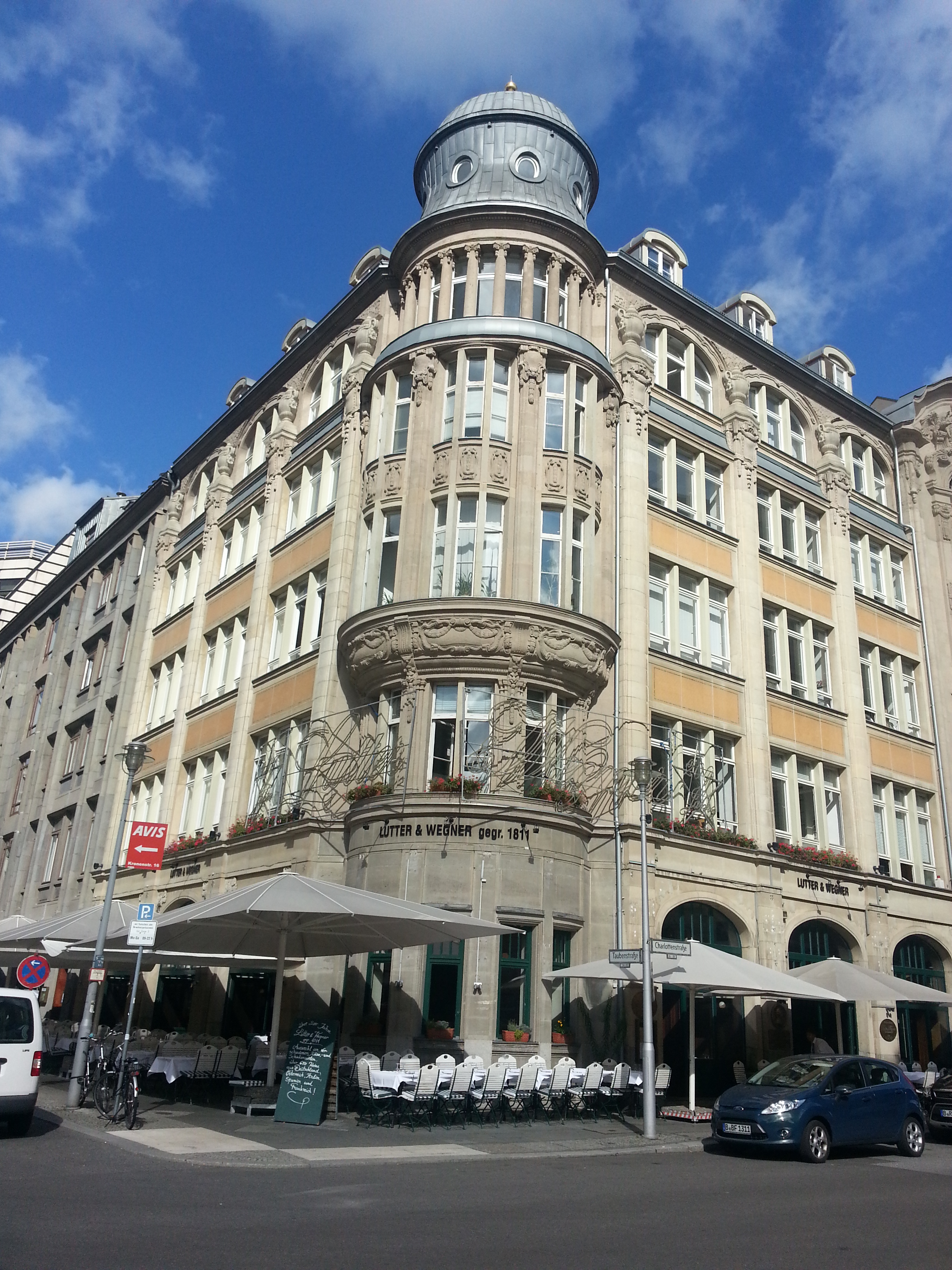
Lutter und Wegner Restaurant at Gendarmenmarkt
Berlin has a whole range of eateries ranging from the simple curry sausage stand to an elegant brunch served at the fancy Adlon Hotel with a view of the Brandenburg Gate. There is something to suit everybody’s budget, lifestyle and taste. If you are looking for something special with a serious dose of Berlin history, then you could do very well to treat yourself to an evening meal at Lutter und Wegner at Gendarmenmarkt in the historic centre of Berlin.
The modern restaurant is located behind the fabulous Konzerthaus that was designed by the renowned Prussian architect Karl Friedrich Schinkel, and was opened 1821. On either side of the Konzerthaus lie the German Cathedral and the French Cathedral, each of which have a long history of destruction and renewal throughout Berlin’s turbulent history. The restaurant is decorated and furnished with a combination of contemporary art, as well as traditional furnishings. The Jugendstil lamps are from Vienna and there is a bronze sculpture of a monkey sitting on the bar to greet guests that was crafted by the German artist Joerg Immendorf. There are three beautifully painted columns that are named ‘wine, woman and song’, that are the work of the German artists who belong to the group known as the ‘Neuen Wilden’ (new wild ones) whose aim was to break free of stiff conventions in art in the 1970’s and create a newer, freer form of expression.
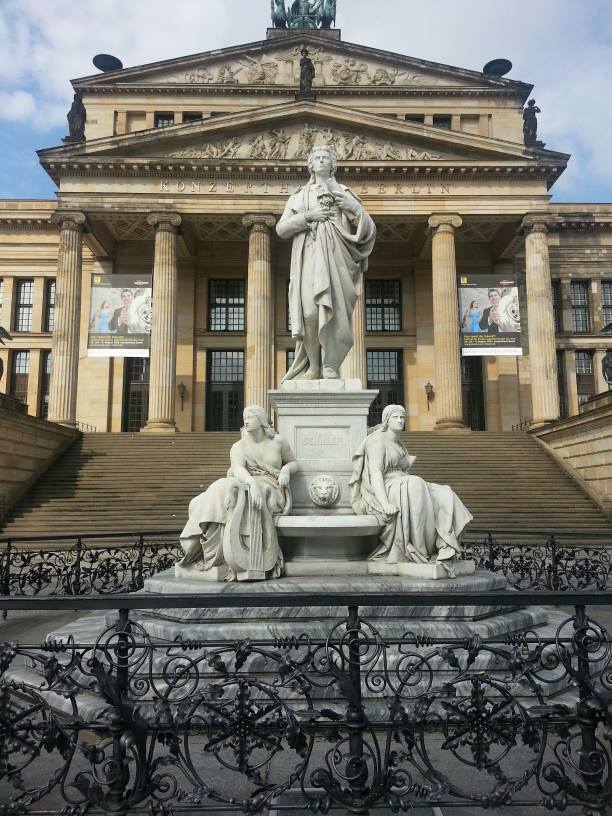
Konzerthaus with statue of Schiller
While dining on a traditional veal cutlet, or a delicious slow-cooked goulash served with exquisite Swabian noodles, your eyes may also fall upon a painting of the eccentric genius E.T.A. Hoffmann, the famous German fantasy and horror writer who penned the novella ‘The Nutcracker and the Mouse King’ upon which Tchaikovsky based his famous ballet. There is also a room in the restaurant named after Ludwig Devrient, who was one of the best and beloved actors in Germany in the early 1800’s when the restaurant first opened its doors in 1811 at its original location a few doors down from the present day location. Devrient made a name for himself playing Mephisto in Goethe’s Faust, and also for his interpretation of the works of Shakespeare and Schiller. The restaurant is indeed indebted to both of these talented men for its early success. They would wine and dine the night away after an evening at the theatre, and people would pack the restaurant in the hopes of eavesdropping on or partaking in their conversations. It was E.T.A. Hoffmann and Ludwig Devrient who came up with the name ‘sekt’ for sparkling wine, a name that is still used throughout Germany as a generic name for different brands. Lutter and Wegner has its own house sekt, as well as a wide range of exquisite wines to satisfy every palette. The young Romantic poet Heinrich Heine was another of the restaurant’s famous patrons in the early 1800’s.

E.T.A. Hoffmann Plaque
In the 1920’s, as Berlin was flourishing culturally, it was home to 3 opera houses, 49 theatres, 70 cabarets and 363 cinemas. More and more cafes and restaurants opened during this time to accommodate the many actors, artists, performers, theatre and movie goers, and Lutter und Wegner did a roaring trade in this time too. During the Second World War, however, Gendarmenmarkt was nearly completely destroyed by allied bombing in 1944/45 but this did not stop the restaurant from operating for long. A previous employee of the restaurant named Hermann Neumann continued serving wine from the bombed-out ruins of the wine cellar on Gendarmenmarkt in June 1946.
During GDR times, however, the restaurant was forced to close its doors, but swiftly opened them again at a new location in West Berlin. Finally, after the Berlin Wall fell it then returned to Gendarmenmarkt in 1997, but not to its original location, but by a wonderful twist of fate, a few doors down, in none other than the former home of one of its first and most famous patrons, E.T.A. Hoffmann.

Deutscher Dom (German Cathedral) at Gendarmenmarkt
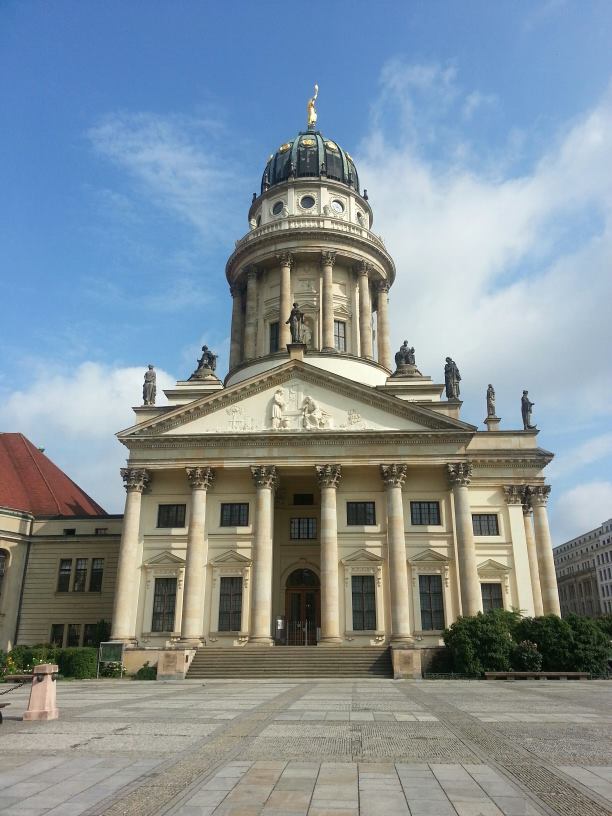
Französischer Dom (French Cathedral) at Gendarmenmarkt
The restaurant has now expanded and has many different locations, both in Berlin and Hamburg and the Austrian Spa resort of Bad Gastein, and each has its own delicious offering of German and international cuisine, along with extensive wine lists. Some delicacies on the menu of the diffferent Berlin restarants include Pot au Feu, aubergine lasagne, shrimp with chantarelle risotto served with grapes, estragon, spring onions and corn salad, a fantastic chicory salad with goat’s cheese, pomegranate seeds, mandarine and crunchy homemade bread, caesar salad, as well as classic meat dishes such as roast duck with dumplings and red cabbage. Lamb chops and steaks are available for the carnivores. For those with a sweet tooth a seasonal mulled wine ice-cream, crème brulee, chocolate mousse and of course the traditional apple strudel with vanilla ice-cream is served. An evening at Lutter und Wegner is a sweet and heady mix of wine, food and history that is bound to leave you happy, sated and inspired.
By Rhea H. Boyden

When I am in Berlin I generally have a light breakfast of fruit, yogurt and muesli, or perhaps I will have one egg on a small piece of toast. It is only on special occasions when I am with family in Ireland or the U.S. that I will go mad and have pancakes, waffles, omelettes and bacon. Several of my siblings love making pancakes and french toast so it is always nice on holidays to indulge a bit and eat the delicacies that are placed before me.

My aunt and uncle live in Pacifica which is a town on the Californian coast just south of San Francisco and north of Half Moon Bay. My dad grew up there before he moved to Ireland and he and my uncle were keen surfers. Pacifica has a popular surfing beach- Linda Mar Beach-which attracts surfers from all around the Bay Area.

View of Linda Mar Beach, Pacifica
A new breakfast, brunch and lunch restaurant named Breakers opened in Pacifica last year, and while I was visiting my aunt and uncle this May we went there for breakfast twice. Just over the hill from Linda Mar Beach is the Pacifica neighbourhood of Rockaway Beach which has a few other nice restaurants too such as The Moonraker that my grandparents used to take me to in the 90’s and Nick’s which has cocktails and crab cakes.

Eggs Benedict with Hash Browns
Breakers is run by father and son Steve and Robbie Bancroft from Pacifica and it is their dream come true to finally open this restaurant. The first time I went there I couldn’t resist the Eggs Benedict with crab cake and hash browns. The second time, when my sister came along we ordered the plain Eggs Benedict and a large blueberry waffle which we then split. The hardest decision at a breakfast place like this is deciding whether you are in the mood for a sweet or savoury dish so it is great to be able to order both and share. Some of the neighbours joined us for breakfast and one of them ordered the chocolate chip pancake which looked like a giant chocolate chip cookie. The fun bit of course, is then covering it in whipped butter and heated maple syrup. The Breakers wait staff always make sure you have a full pot of fresh coffee and a jug of iced water on your table too.
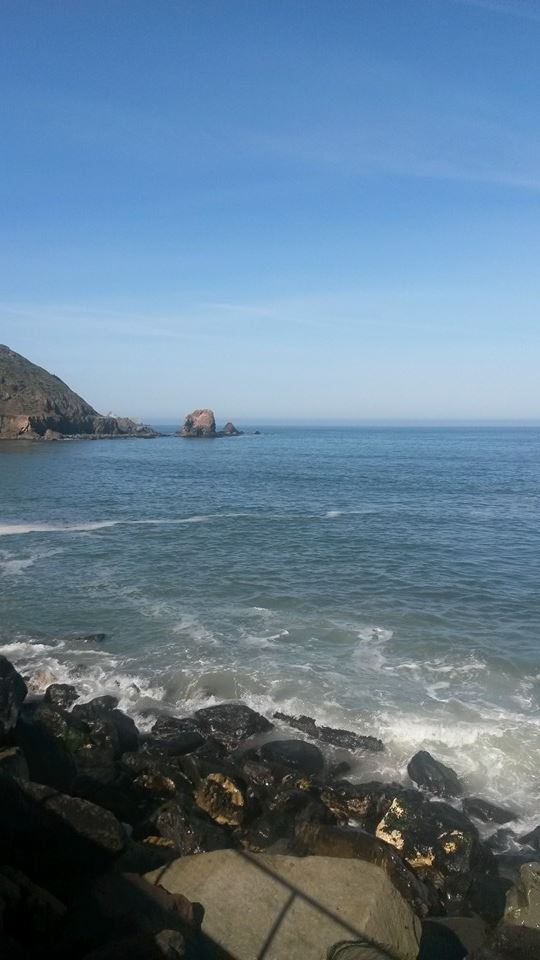
View of Rockaway Beach from Breakers Restaurant
Other specialities include a Lox and Bagel, Eggs Florentine with sliced avocado and spinach, cranberry pecan pancakes, raisin walnut pancakes, as well as every conceivable type of omelette. Breakers, which is located at 135 Rockaway Beach Avenue, is also open for lunch serving lunch crepes, tuna melt on rye bread, burgers, Reuben sandwiches, clam chowder and a great variety of salads.
I felt no guilt in indulging because after breakfast when staying with my aunt and uncle we always go for a long walk on the beach and then climb the extremely steep hill back up to their house which certainly burns the calories off again. Breakers is a delightful place to breakfast while on holiday and I look forward to going back sometime and trying their enticing lunch menu.
by Rhea H.Boyden

Exactly half a century ago, in the spring of 1964, Hans Helmut Kornhuber, the chief physician at the department of neurology at Freiburg University, and Lüder Deecke, his doctoral student went for lunch in the beautiful and serene garden of the ‘Gasthaus zum Schwanen’ at the foot of the Schlossberg hill in Freiburg. Their discussion over lunch was about their frustration at worldwide attempts thus far to investigate self-initiated action of the brain and the will. They were inspired, no doubt in part, by the fresh mountain air of the Black Forest to push ahead in their research using the primitive (but most advanced for the time) brain imaging tools at the university. After many test cases and a lot of research, the EEG (electroencephalogram) readings showed that there is an electrical signal in the brain that proves we are going to move a body part even before we want to move it. They had discovered the ‘Readiness potential’ or ‘Bereitschaftspotential’ and debates on whether or not we have free will continue to today in all disciplines from neuroscience to psychology and philosophy.
Now I am no scientist and my knowledge of neuroscience is limited. I have read articles about Alzheimer’s in an attempt to grasp a basic understanding of the disease which is rapidly stripping my dear mother of all sense and vitality, and I have read some articles in the past week or so to understand the title ‘Bereitschaftspotential’ the latest release by Automating which is the solo project of soundscape artist Sasha Margolis from Melbourne, Australia.

Lüder Deecke- Bereitschaftspotential Brain Image Scan
I have listened to the piece several times through with my good headphones relishing in Sasha’s sounds once again, with my eyes closed in meditation dozing into a dream world and seeing where it takes me thereafter in my writing. I have thought long and hard about why he has titled this piece ‘Bereitschaftspotential’ and what he intends with this title. I have come to the conclusion that it is a heavy and loaded title that has led my thinking and reading to some dead ends and frustration about what to do with all my notes that I have been frantically scribbling trying to make sense of it all from a neuroscientific perspective.
I have decided, therefore to not dwell too much more on the title and have a look at it from a more poetic and philosophical angle, for therein lies my ability to make sense of it. Here I quote Friedrich Nietzsche to send me in a better direction: ‘Free will without fate is no more conceivable than spirit without matter, good without evil.’
Nietzsche spent much of his time in the same stretch of mountains and woods not far from where Kornhuber and Deecke carried out their work, (more than half a century earlier) and he found the fresh mountain air and peace most conducive to working in. He would take long walks in the woods stopping to take notes before returning to his room to continue working. Quite apart from his many groundbreaking philosophical ideas and writings, Nietzsche took a great interest in the human body.
I believe one reason I have become so frustrated in trying to write this review is because the title ‘Bereitschaftspotential’ forces me to think I should be writing about the mind, brain and consciousness when what I really want to write about here is the body. Nietzsche believed that what living things sought above all, was to discharge their physical strength. He also believed that knowledge was rooted in the body and that the whole of Western philosophy had a deep misunderstanding of the human body. It is little wonder that Nietzsche took such an interest in the body; he suffered immensely thoughout his life from various ailments, many of which were symptoms of the syphilis he supposedly picked up in a brothel during his student days. It is no coincidence that a large part of his philosophy contends that human suffering is inevitable and indeed, necessary to go though in order to achieve greater goals.
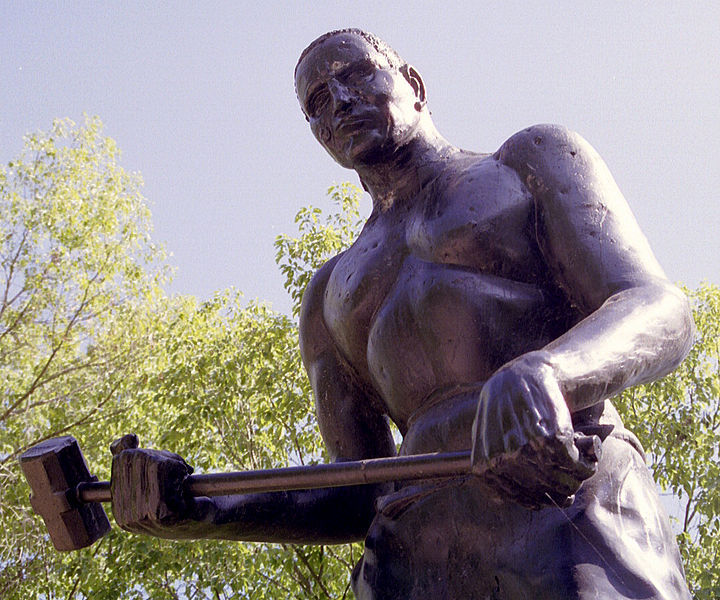
Photo of Statue of John Henry by Ken Thomas
This idea of Nietzsche’s that living things seek to dispel their energy makes me think of the core of Sasha’s philosophy behind his work and I quote from his website: ‘Sifting through the sonic waste and discarded technology left by the roadside of a world speeding too fast into the future.’ It makes me think of the men who have been replaced time and time again by machines, rendering their bodies and ability to dispel their physical energy useless, in essence, emasculating them. We do have a lot of waste out there, both physical and sonic and I believe it is the duty of everyone to reuse it all in some useful way. If machines have all but replaced our physical work, then what to do with all the machines once they turn to waste but to turn them into art to provide us consolation as we gaze at these post-industrial wastelands. Sasha deals with found sound in his work, but many others work with found objects; turning industrial artifacts that were not intended for artistic purposes into art to make a point, among other things, about waste.
‘Bereitschaftspotential’ released by Iceage Productions, runs for a little over 20 minutes and it is serious food for thought. To me the opening sounds are entirely industrial and repetitive. It is evocative of a machine turning or a small animal digging, trying desperately to get some job done and then in frustration giving up. I hear an electrical generator trying to start and then failing. This failing is frustrating to the humans who are trying to use this generator perhaps, but the peace they can then enjoy is then ever more appreciated; an appreciation which is then heard in birdsong. Quiet contemplation is to be found in nature and not to the sound of a generator.
The idea of this sound being either an animal or a machine is very exciting to me because there are so many examples in which we can compare an animal or a human to its machine counterpart. One example that immediately springs to mind is the horse. It was largely replaced by the train in the United States as the great railway building projects began there. And as exciting as it was to have all these new railways going across the country, they were built at a great cost in men’s lives.
Construction of Big Bend tunnel in West Virginia commenced in 1870 and the work was treacherous for the many men working on this project. They would have welcomed today’s tunnel drilling equipment (and dynamite). At least one hundred men died digging the tunnel, many of them black men. There is a legend about a certain John Henry who has been immortalised in a ballad performed by many singers including Johnny Cash and Bruce Springsteen. He worked on the railroad and was a ‘steel driving man’ and proud of it. One day however, a salesman came to town boasting that a steam-powered drill could outdrill any of the men. A race began, machine against man and John Henry won, beating the steam drill, but he eventually collapses when his body can take it no longer and dies leaving behind his wife Polly Ann and a baby. There is a constant beating of a drum in ‘Bereitschaftspotential’ which to me is the steady march of the working man before he collapses. To repeat Nietzsche’s quote: ‘Free will without fate is no more conceivable than spirit without matter, good without evil.’ Is this the battle of good and evil between man’s body and the uses and abuses of the machine?

Photo of Thomas Bayrle Exhibit at Documenta 13 by Erin Reilly
A couple years ago at the Documenta Contemporary art show I was standing with a friend observing an exhibit by German artist Thomas Bayrle. It was a pumping piston, and as we both stared at it she suddenly said: ‘It’s so sexual’. I had to agree with her. Bayrle says that he believes machines are a reflection of the body and he draws inspiration for his artwork from the precision of machines and engineering. Indeed, what can we do but work artistically with all these wasteful things we have created? Bayrle’s was only one of many exhibits at Documenta that provoked commentary on the effect of machines and waste on our bodies and the environment. In our post-industrial society many men have been left unemployed by the subsequent collapse of many of the machines that once sought to replace them. For the first time in history women hold more jobs and more college degrees in the United States than men and the implications of this are serious indeed for those who still believe in and strive for traditional family structure. A whole reshuffling of gender roles continues to happen and many men and women suffer from confusion and anxiety at what role they should play and a general frustration at modern dating rituals and body image. I know that one of my biggest sources of solace is to get lost in reading and writing and collaborating on meaningful projects with others. In doing so I can escape from the fact that I am nearly 39 years old and single, and have not necessarily fullfilled a certain role that a large part of society expects of me by this age. Thankfully I have an open-minded family who let me do whatever I want and are supportive and don’t judge me, but many women, and men too, suffer from not fullfilling certain expectations; especially when it comes to getting married and having children.
Most of the time I enjoy my solitude and only rarely do I get lonely. The constant barrage of city noise, human noise and industrial noise is hard to escape, and I relish it when I can get away from it. There is a lovely part in ‘Bereitschaftpotential’ that seems to me to be the sound of engines being swallowed by birdsong which again says that nature is triumphant over industrial noise. It signals a retreat into nature where we can again listen to our bodies and give them the peace and rejuvenation that they need. For without a healthy body it is very hard to have a healthy and clear mind to produce new poetry, songs and stories. Indeed, there is a burst of birdsong in ‘Bereitschaftspotential’ which is evidence to me that the willful person or animal has happily found peace again amongst the elements. The piece ends very abruptly leaving you suddenly staring into an abyss of silence which is quite uncomfortable. As much as we humans seek silence, its suddenness and completeness can be disconcerting. Nietzsche also said: ‘if you gaze long into an abyss the abyss also gazes into you.’
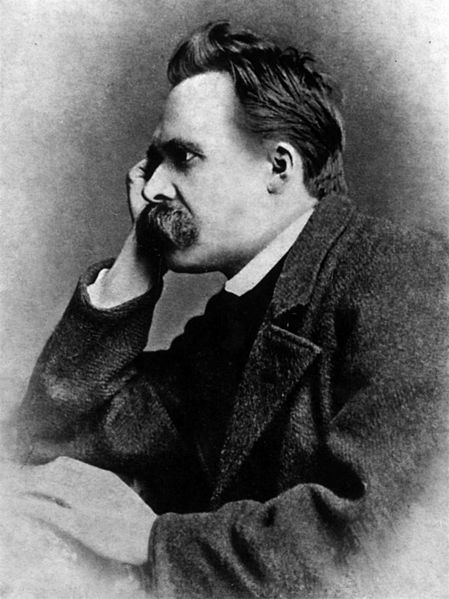
Portrait of Friedrich Nietzsche by Walter Kaufman 1882 (Princeton Archive)
I have spent considerable time gazing into an abyss and thinking about ‘Bereitschaftspotential’ and in the final analysis I can say that it has inspired me to think of our bodies, machines, animals, birds, walking in the woods, new creativity and then I think repeatedly about the horse. 2014 is the year of the horse in the Chinese calendar and it is a great year to gallop ahead into new adventure and take some risk. As I mentioned earlier, it was the horse’s body that was replaced by machines. 2014 is also exactly one hundred years since the outbreak of World War One which showed the disasterous consequences of cavalry warfare mixed with modern machine guns. Again: Bodies against machines! And to conclude it must be pointed out that Nietzsche, in his madness, finally broke down and embraced a horse that had collapsed on the streets of Turin in January 1889 before he then went completely mad and was commited to a sanitorium. There have been various speculations as to what was going through Nietzsche’s mind at the time, but I like to believe the assumption that it was the philosopher who was most skeptical of showing compassion for human suffering finally showing it for himself (he loathed self-pity) and for one of the most beautiful of animals, in a vain hope that both their bodies can have the will to survive against the machines and noise that drive them both mad.
Featured image is artwork by Ieva Arcadia accompanying ‘Bereitschaftspotential’ released by Iceage Productions (courtesy of Sasha Margolis).
Link to listen to and purchase ‘Bereitschaftspotential’ by Automating on Bandcamp: https://iceageproductions.bandcamp.com/album/bereitschaftspotential
This is a delightful video made by two good friends of mine from school- Mattie and Mary. They take us on a culinary tour of West Cork. I smile so much when I watch this video. They are both charming, as is my lovely home of West Cork. So much delicious and healthy food to be enjoyed there surrounded by stunning scenery. Makes me homesick (and hungry!)
by Rhea H. Boyden

‘Can I recommend a great book?’ I said excitedly to one of my colleagues at the language school last week. ‘My dad wrote it and it really is good!’ I exclaimed. My colleague looked at me with a teasing smile and said ‘This can hardly be an unbiased recommendation coming from you!’ I countered this by saying that I was arguably in a good position to give a fair judgement of the book PRECISELY because the author is my father. Given the very fact that I could cringe at something he had written, or read a joke in the book that he had already told a dozen times at the dinner table.
‘Nima gyalyung tokpo chunmo duk’ is a saying in Tibeten that I heard my dad repeat many a time when I was a kid, but I will confess that I actually never asked him what it meant. I guess it is normal when you are growing up to not show an interest in your parents’ creative pursuits. Now that I am writer myself I read my dad’s book with great awe and interest last weekend and I have now learned that ‘Nima gyalyung tokpo chunmo duk’ means ‘When the sun shines the streams come flowing’ and that this is a common greeting in the Kingdom of Zanskar in Tibet. And as I read I realise that my dad’s book really is pure poetry and there is not a word in it that makes me cringe at all. I praise it to the heavens.
My dad Mark Boyden and his friend Paddy O’ Hara hiked through Zanskar and Ladakh between April and August 1981 accompanied by a white horse which they named ‘Himself’. My dad stiched saddle bags for the horse to carry their supplies and they went off on an incredible adventure being welcomed at Buddhist Lamasaries, learning about local agriculture, customs, and acquiring an increasingly impressive command of the language which they had already swotted up on in West Cork, Ireland before embarking on the trip.
The horse becomes their companion and friend for the journey but not before it learns that it belongs to them and not to escape and wander off. My dad writes in chapter 5: ‘After four days, the morning came when, opening the tent flap, I was greeted by an abondoned tether. Paddy headed back down, and I up the valley, but when we met at noon neither of us had had any luck. Then something caught Paddy’s eye and he gestured to a tiny white speck high on the mountainside. Careful study revealed that it was in fact moving about, though by the time we gained his station and convinced Himself to rejoin us the day was done, and any progress would have to wait until another day.’
On another day my dad describes spotting a herd of yaks in the distance and he realises that this is a golden opportunity to restock their diminished supply of yak butter. My dad leaves Paddy to hike ahead and set up camp and he sets off in pursuit of the owners of the yaks. Upon reaching them, a deal cannot be struck before drinking endless cups of butter tea with them. The Zanskaris drink a tea with yak butter and salt in it which is a kind of bouillon that they drink by the bucket load to counteract the harsh and potentially dangerously dehydrating climate. My dad scores a deal and secures some yak curd to boot and after finding Paddy at the camp, proceeds to make some delicious hors d’oeuvres of apricot kernels and carrigeen moss fried in yak butter accompanied by Paddy’s delicious flat breads. I know what a fabulous gourmet cook my dad is and how he always seems to be able to whip up a delicious meal at home in Ireland seemingly out of nothing, even after I have been complaining to him that the cupboard is bare and we need to go shopping.It is clear that some of his early experimental cooking and eating was done on this trip in 1981 when he was 29 years old.
I have been writing very seriously for nearly 3 years now but because I live in Berlin I have had little opportunity to focus on descriptions of nature in my writing. Last year when I was in Santa Cruz, California I decided very consciously to become aware of my natural surroundings and try and bring these descriptions into my writing. I wrote about the crescent moon rising over the redwood grove and the chorusing Pacific tree frogs, the flowering dogwoods and azaleas, and the creature that fascinated me the most- the banana slug-which is the biggest landslug in North America. I wrote to my dad about this slug at the time and I asked him if he had ever heard of or seen this disgusting creature. Of course he had, he told me, reminding me that he had grown up in the Santa Cruz mountains.
So with my interest heightened in descriptions of nature, plants, trees, flowers, the heavens and the planets in order to improve my own writing I slowly savoured my dad’s descriptions in his book. Chapter 6 opens thus: ‘We slept through the clear, cold night and awoke to the sound of a distant avalanche. As the myriad mountains worked through a palette of dawn blushes we broke camp and headed off into the ice.’ On their travels they were constantly in search of a place to camp that held some grasses for the horse to munch and that had clean, clear water. They happen upon a willow coppice and set up camp there. Before crossing a river my dad writes that ‘there was an inviting coppice on a sun-drenched sandy shore. Forty dwarf willows had rooted and, with the season, had laid a lush carpet of down. The summer wind had strewn petals of rare briar about the down.’ This place was so beautiful that they sought it out on their return hike too and my dad writes of pulling out his watercolours to capture its beauty whilst Paddy practices his calligraphy.
And it must be added that both of my parents have always had a huge interest in astronomy. I remember my mother and my father pointing out Mars, Venus, Jupiter and Saturn to my brother and me as children, so it comes as no surprise that my dad mentions the location of the planets and the moon throughout the book. In chapter 13 he writes: ‘Saddling up, we left Lamayuru as we found it, with a dusky Venus hanging there to the southwest to remind us we were on Earth.’ Elsewhere in the book he writes that ‘the quarter moon had cleared a lofty saddle to the south and now illuminated the barley.’
As I read the final word of the final chapter, a feeling of pride washed over me at what a beautiful book my dad has created. Its poetic vignettes are marvelous and I am in awe. And it gives me hope and inspires me for my own future as a writer. 33 years after going on this wonderful (and sometimes quite dangerous and challenging) adventure, his story has been published in a beautiful book. Sometimes good things take a long time to come into being and with writing you need time and patience with yourself. Patience my dad has proven he has in producing this gem of a book.
The book can be ordered directly from the publisher, The Liffey Press: http://www.theliffeypress.com/travels-in-zanskar-a-journey-to-a-closed-kingdom.html
by Rhea H. Boyden

‘Dreams are the touchstones of our characters’ -Henry David Thoreau
‘Mayday, Mayday!’ We hear this distress call repeatedly in the track ‘Projection’ but do we get the help we are looking for? Not always when we project all our hopes and dreams onto another person. The album ‘Somnambulist’ by ‘Automating’ which is the solo project of Sasha Margolis from Melbourne, Australia explores hopes, dreams and fears in an 18-track album. The album, released under the label ‘Wood and Wire’ is a tantalising collection of field recordings, found sound and tape manipulation. With track titles such as ‘PET Scan’, ‘Neuronal Response’ and ‘Repetition Compulsion’ we can expect this album to explore deeper states of consciousness and a yearning to make sense of the world through an understanding, in particular, of dreaming and various sleep states.
The album opens with the track ‘Alpha Wave’ and we hear the sound of a chirping bird. Is this a sign that the day has commenced happily? The Alpha brainwaves are present when we are relaxed, meditative, aware and enjoying the moment. It’s a positive note to start on, but as we listen to the album we hear that it explores a whole range of human emotions experienced in various states of sleep. The track ‘Delta Wave’ does not keep one in a happy and relaxed manner for long. It is sinister, spooky and frankly, quite terrifying to listen to. In fact, much of the terror, stressors and stimulants of modern life prevent many of us from reaching the delta brainwave state as often as we should- it is the state of deep sleep and unconciousness that is most restorative. Following this is ‘Voices of the Dead’ and in this track we hear a lot of wind and water. The voices of those we have lost can be found in nature if we listen closely, but we cannot stop the passage of time and hold onto that which has slipped away. I am reminded, when listening to these tracks, of the Gothic poem by Edgar Allan Poe: ‘A Dream within a Dream’- ‘I stand amid the roar, of a surf-tormented shore’ writes Poe, in great despair, realising that he cannot hold onto the dream that is slipping away from him. He sees that he cannot even hold onto one grain of sand that slips from his hand making him question the passing of time-the sands of time- and also whether everything he ever experienced was just a dream and never reality at all. Where does the border lie between dreams and reality? And what happens in that hazy land between waking consciousness and deeper sleep?
A lot of really interesting things can happen in that hazy land and that is the part of this album that to my mind, is really exciting. The track ‘Hypnopompia’ samples distant eerie voices. Are these the voices of creativity that speak to us as we awaken in the morning? The hypnopompic state is the state of semi-consciousness that is experienced coming out of sleep and many a writer and composer swears that the insights that hit them at this moment are the ones that turn into the best stories, songs and poetry. We all know that feeling we have in our gut first thing in the morning-the one that puts us in tune with our strongest emotions- erotic feelings or feelings of deep mourning. Sentiments of joy or loss. If we can capture the truth at the core of these feelings right then and there we can turn them into new energy and life in our various creative pursuits. The track that follows ‘Hypnopompia’ is ‘Synaptic Transmission’ and in it we hear fireworks which are a wonderful way of sonically sampling and expressing the workings of the synapses. Are perhaps the fireworks a celebration of the ideas that have been successfully captured in the hypnopompic state? Happy creative synapses at work that have been well exercised in the dream state?
In other tracks we hear chanting, church bells, organs, bleating sheep, speeding trains, a didgeridoo and muffled voices. How to make sense of all of this? In the track ‘Acoustic Encoding’ I am reminded once again of that Edgar Allan Poe poem, or indeed, any poem I love that begs to be read out loud. For this is what ‘acoustic encoding’ is: the process of remembering and understanding things you hear. When we read a poem out loud we are engaging in acoustic encoding.
The album ends with the track ‘Theta Wave’. This is the perfect finale as the Theta brainwaves are activated when you are falling asleep. New ideas and enhanced creativity occur in a Theta brainwave state. And after listening to an album that makes me ponder the colourful spectrum of human emotions in a dream state, it is very pleasing to end on a track that is a gateway to learning, healing and spiritual growth. In the Theta state we retreat again to the voices and signals that come from within us, and, most beautifully, we can connect to the divine, readying us again for a new morning in the hypnopompic state: another day of capturing our dreams and commencing the cycle over. ‘Somnambulist’ (which means sleepwalker) is a truly inspiring and thought-provoking album on many levels.
Images courtesy of Sasha Margolis
English for Meetings: Offering your guest a cup of coffee.
by Rhea H. Boyden
A couple of weeks ago I went to the Schiller Theater to see a Staatsoper production of Czech composer Leo Janacek’s opera Katja Kabanowa. I purchased a chocolate bar with raspberry filling and wandered around the foyer absorbing the atmosphere before taking my seat for an opera that promised to be a thrilling 1 hour and 40 minutes with no intermission. With the tang of raspberry still on my tongue, I read in the German supertitles over the stage that it was to be behind the raspberry bush and through a gate that the leading lady Katya was to be seduced and led to her doom.
Katya, sung by Dutch soprano Eva Maria Westbroek, is the unhappy merchant’s wife who attempts to escape her weak husband and overbearing mother-in-law by starting an affair with Boris a local merchant’s nephew. Janacek based his character somewhat on his muse, the merchant’s wife Kamila Stösslova, a woman 37 years younger than him who he was very much in love with throughout the composition of the opera Katya Kabanowa, which he wrote between 1919 and 1921. He showered her in letters and did not get the response he had hoped from her. Remembering that raspberries were the fruit that impressed me in the opera, I read with much entertainment that Janacek tried to conceal his erotic fantasies for Kamila in fruit metaphors, writing to her: ‘you are as round as a small apple that is ripe for biting into.’
As obsessed as he was with Kamila, he clearly did not waste all his time on fruit fantasies of her, as he also managed very well, quite apart from being a successful composer, to master the Russian tongue. He was very much in awe of Russian literature and it is easy to see that Katya Kabanova is influenced by Leo Tolstoy’s Anna Kerenina. The opera is also based on the 19th century Russian playwright Alexander Ostrowski’s popular play ‘The Storm’.
‘The Storm’ and ‘Katya Kabanova’ are both examples of Realism which had its roots in French literature in the mid 19th century. Realism depicted every day and banal activities of especially rural life and the hardships people faced. Janacek was a modernist and was fervently anti-romanticism. He set his opera on the banks of the River Volga in Russia in the 1860’s and the story shows how miserable the main leading lady-Katya-is with her lot in life.
Previous operas such as ‘Tristan and Isolde’ and ‘Pelleas and Melisande’ had sung and praised everlasting romantic love, but by the end of the 19th century this ideal of romantic love was dying, and its death was being depicted frequently in art, music and literature. It was clear that a grown human can change and have more than one passionate love in a lifetime and also that adultery happens.
So what happens to Katya behind the gate that is behind the raspberry bush? It is here that she follows Varvara, sung by mezzo-soprano Anna Lapkovskaya, Kabanicha’s foster daughter, to meet her lover and to cheat on her husband. But Katya does not do this without realising fully that it is a sin that she will have to pay for, ultimately with her life, for Katya is deeply religious and she knows that her erotic fantasies are a huge sin. She is driven to madness and suicide by her inability to reconcile her need for love and affection from a man who is not her husband, and her deep-seated knowledge that it is so very wrong.
In the scene before Varvara leads her to the gate behind the raspberry bush, Katya sings of how easy and free her life was before she was married. How she loved it, above all, to go to church. The orchestra, conducted by Sir Simon Rattle, sets the scene of a church mass. Indeed, it was very important to Janacek to have his music match the action on the stage as closely as possible. Katya tells Varvara of her deepest and most intense dreams. She dreams of golden high cathedrals and high mountains and unseen voices that speak to her. One unseen voice that enters her now is evidently the voice of the devil, that will, despite her pious nature, lead her to her doom and she has no strength or will to ignore it.
Love was very much depicted as a sin in much of Russian literature and it is also the women who seemed to suffer the most for it. Katya is surrounded by weak men, especially her husband, Tichon-tenor, sung by Stephan Rügamer- who is unable or unwilling to protect her from his overbearing mother Kabanicha who is the heartless, jealous, cold and hypocritical character in this story.
Kabanicha, sung by American mezzo-soprano Deborah Polaski, seems to be the ultimate symbol of cold realism in this story. And it is she who drives Katya into her escapist and intense dreams and erotic fantasies that provide her a balm to soothe her pain-temporarily.
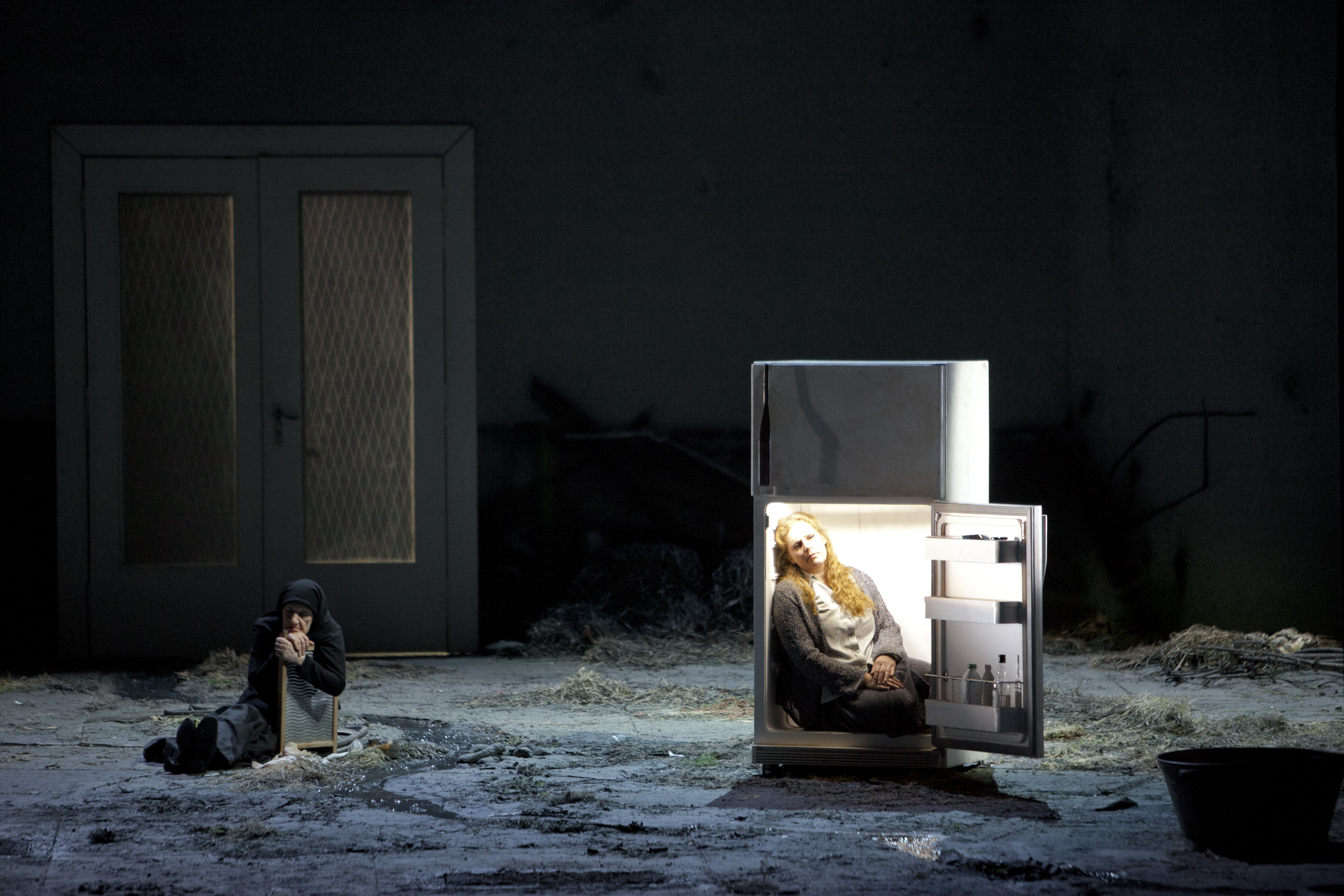
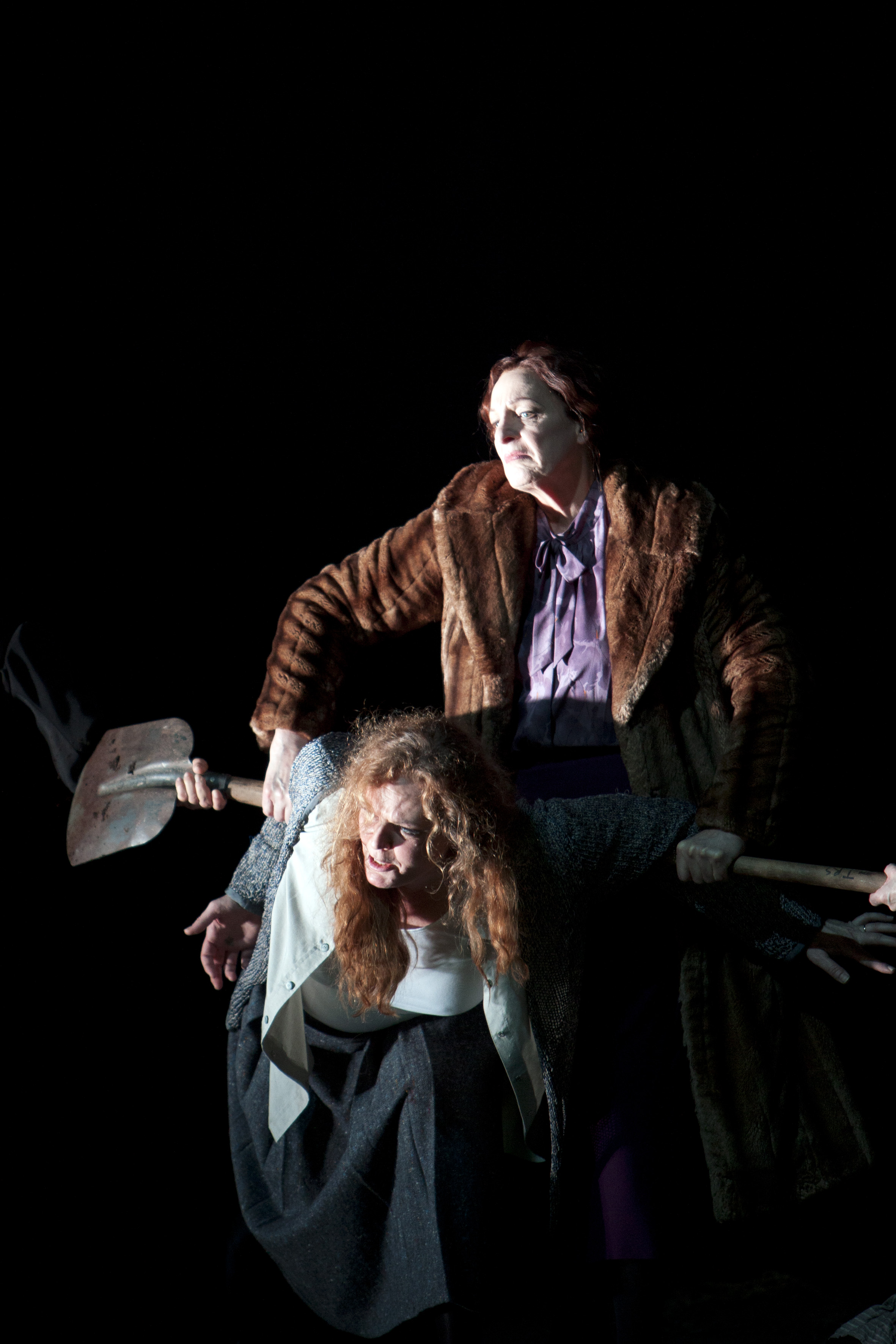
And while Janacek set the original story on the banks of the River Volga in the 1860’s, German stage dierector Andrea Breth sets this story in modern times and the opening scene shows Katya in a fridge next to an empty bottle of vodka. In the first act the fridge door is closed in her face locking her inside. This is not exactly a subtle metaphor for being locked up and treated coldly by those around her. And the bottle of vodka? It is not drunk by Katya but by Dikoj the drunk and maudlin merchant, sung by bass Pavlo Hunka. One scene depicts him and Kabanicha on the table engaging in a ridiculous looking sex act, him drunk and her putting her hands down his pants. All the time she is dressed in a beautiful purple dress, the fanciest in the whole set of costumes, which in some ways is supposed to show her decorum. But it is a false decorum, clearly. She is just as weak as the next person, but tries to hide her human weaknesses behind her social standing and powerful position in the community. Kabanicha and Dikoj feel that they are immune to sin by doing the right things in society such as paying alms and duties. They will never suffer the pain of great love as Katya does, as they are incapable of loving and caring as deeply as she does.
There is one scene in the opera where Katya and Boris- sung by tenor Florian Hoffman- sing a duett. It is the only scene in the whole performance that is a duett and is a chilling reminder that the romantic love depicted in many operas past is dead. It is a last stab at love that will soon die with Katya’s demise and downfall. Katya hopes for some relief for her sins when she admits to all -in the middle of the raging storm that has rolled up the Volga- that she has betrayed Tichon. She does not gain any relief from this confession, but rather angers all involved, bringing yet more criticism upon her from her evil mother-in-law. Boris, her love, is sent to Siberia by his uncle for his sins, and to add to Katya’s misery, he does not seem to really protest this.
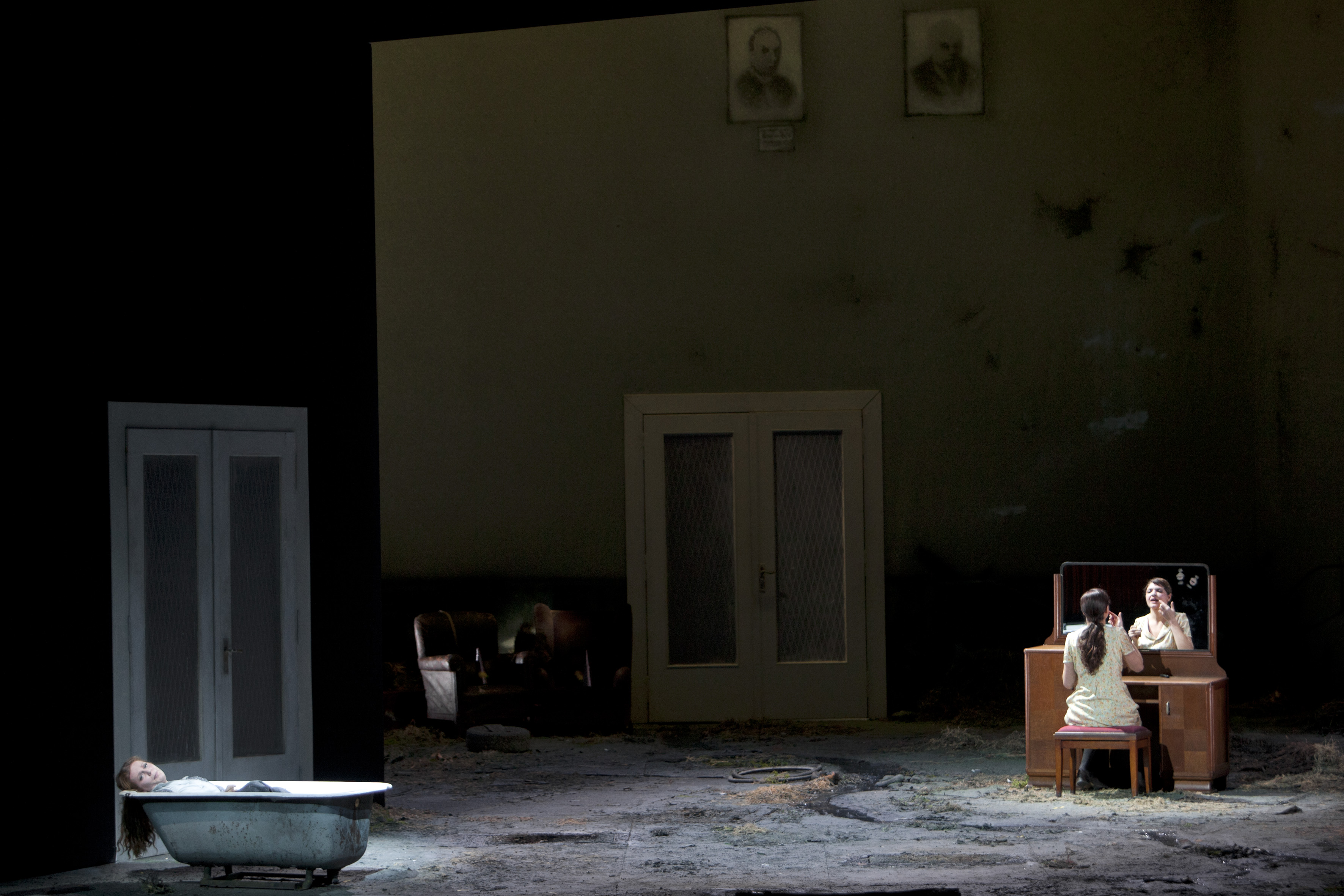
Katya is now completely alone and she sings of how her grave will look after she is dead. It will be beautiful and birds will fly over it- you can hear the birds in the violins and clarinets. Flowers will grow on her grave and she will finally be at peace- a peace that was never afforded her in her time on earth. In Janacek’s original piece she then opens her arms and jumps in the Volga and drowns. In this, Andrea Breth’s interpretation, she slits her wrists while lying a bathtub. And the greatest tragedy of all lies in the fact that the opera does not end with Katya’s death, rather the assembled group argue over her dead body. Tichon cries and blames his mother Kabanicha for Katya’s downfall. His accusation is not heard and Kabanicha shows little remorse for Katya’s death. Tichon loved her, to be sure, but he was never able to stand up to his mother and his love for Katya was too little too late. The opera ends with Kabanicha thanking the assembled company for their help. She can continue in her false ways, no doubt still holding power over her spineless son.
Photos by Bernd Uhlig courtesy of the Schiller Theater Press Office

 rheaboyden
 Rhea Boyden