

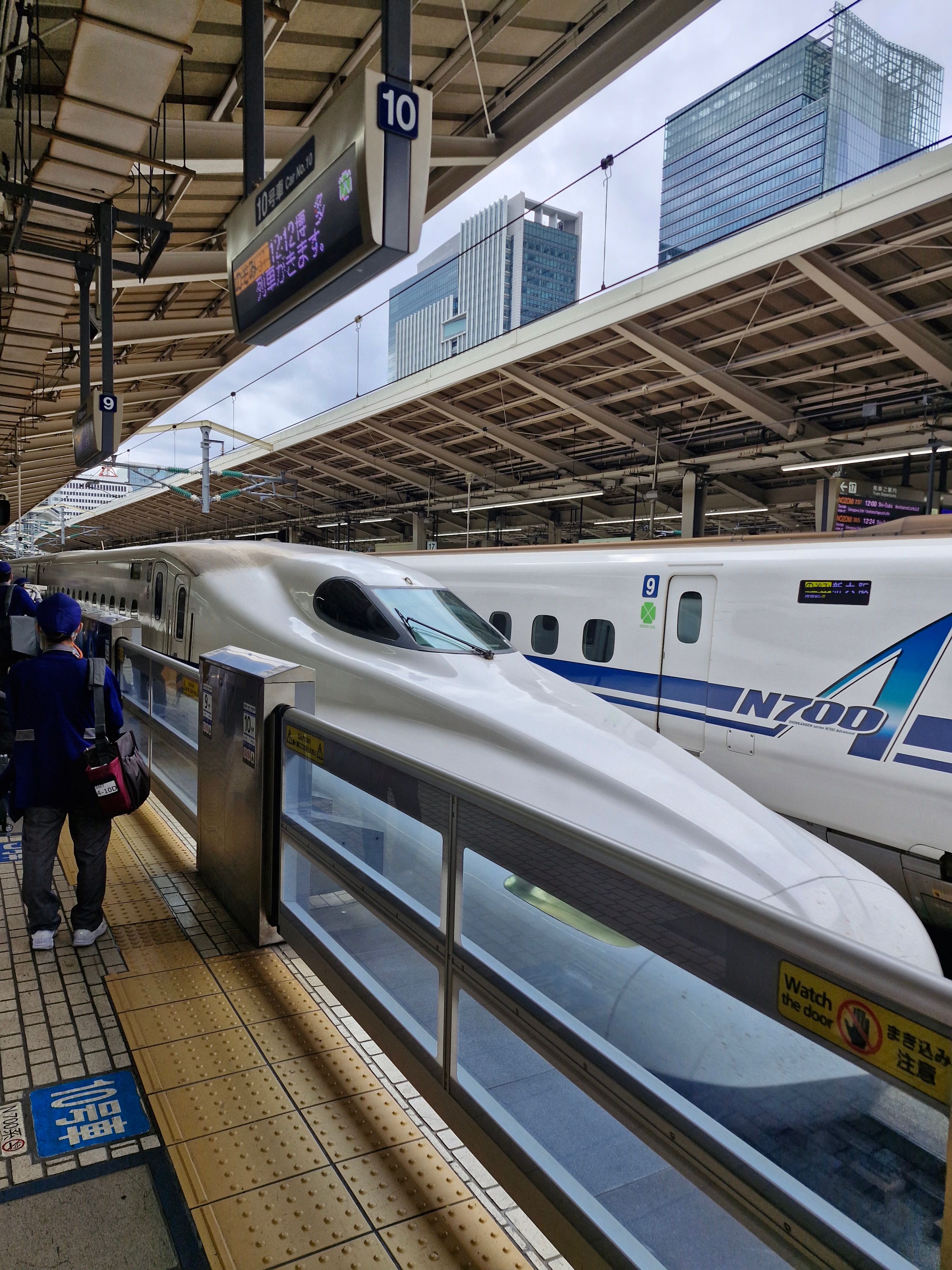
Dáire and I arrived at Kyoto Station after a fabulous, speedy Shinkansen (Bullet train) ride from Tokyo which only took 2 hours and 14 minutes to cover more than 450 kilometers. We took the Nozomi train which is the fastest service between the cities and we splurged on first class tickets which cost 107 Euros each. It was so worth it for this once in a lifetime experience: being whisked along at speeds of up to 300 kilometres an hour sitting in comfortable, reclining armchairs with lots of legroom. It was a sunny afternoon when we arrived so we decided to walk with our luggage to our accommodation which was less than a half hour walk away. Central Kyoto is a grid so it was easy to navigate. We had arrived in the city of shrines, temples, lanterns and Geishas and we had 3 nights here to explore this fascinating city on 2 tours to maximise the use of our limited time here. Kyoto is not a small quaint town with a couple shrines but has a population of two and a half million people and has approximately 1,700 Buddhist temples and a further 400 Shinto Shrines.
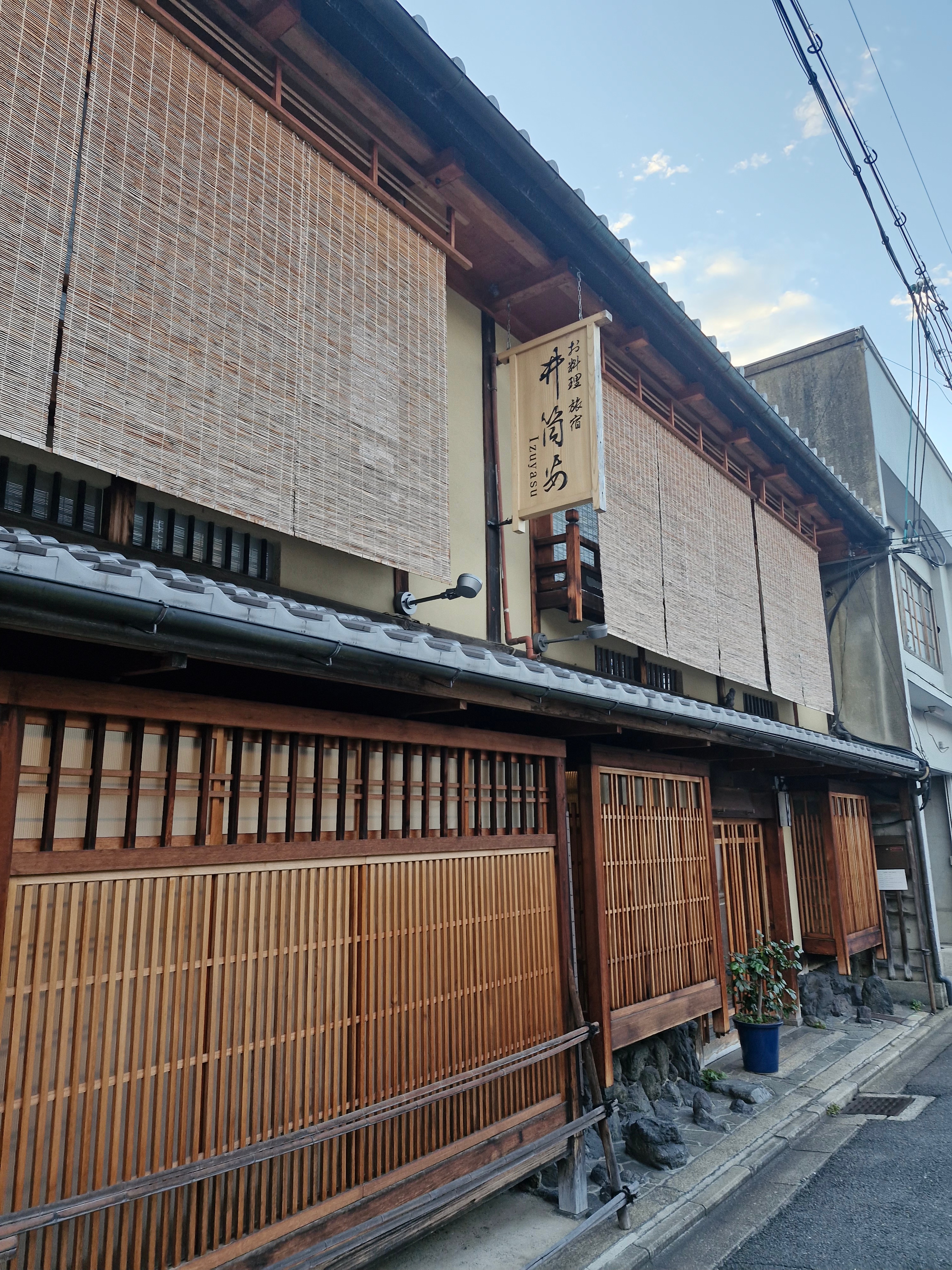
The Gojo area of Kyoto
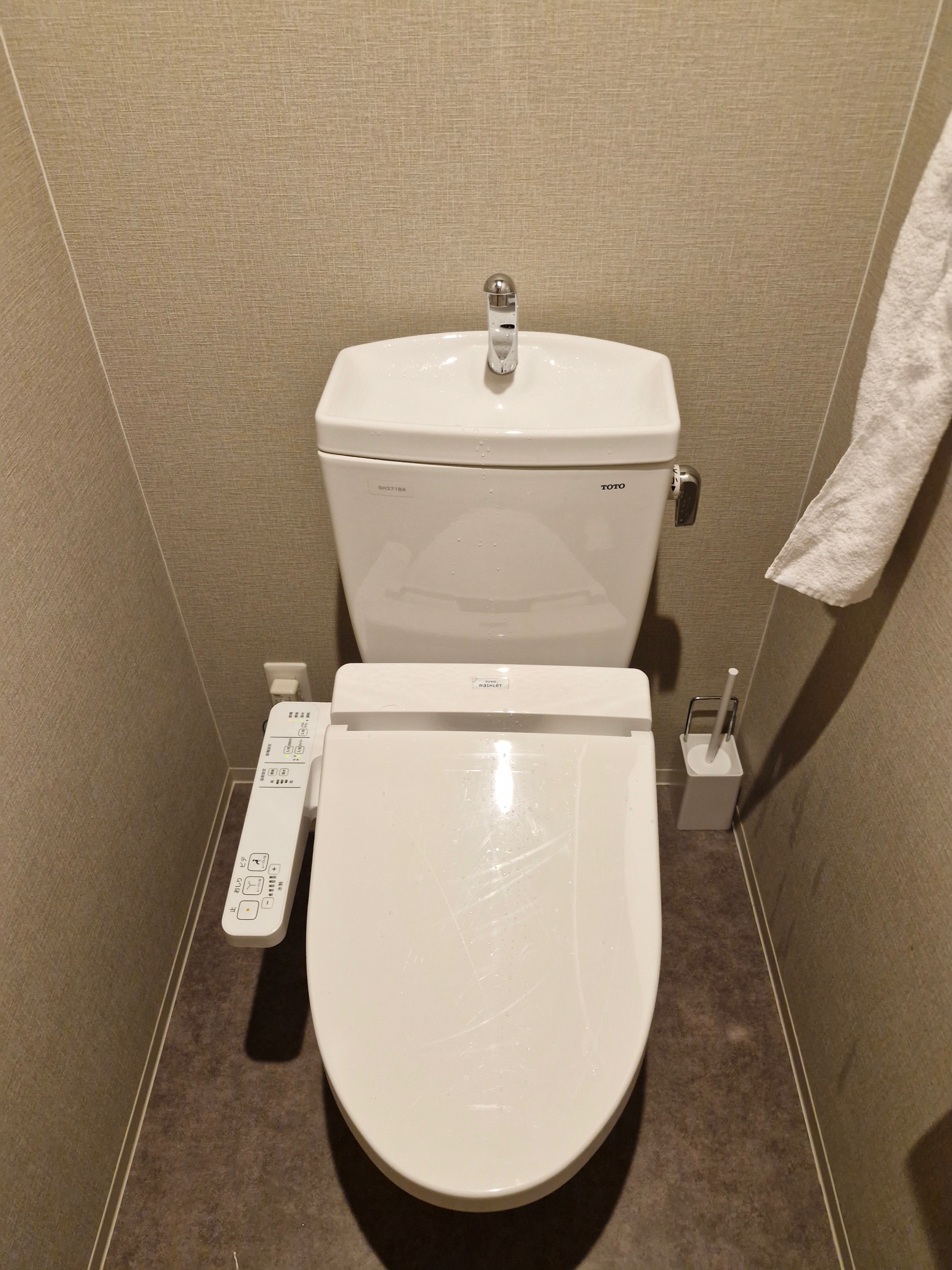
We stayed in the lovely residential area of Gojo at the Hotel Mondonce in a large self catering room with 2 double beds, a balcony, a kitchenette, a bathroom with bathtub and a separate room with a bidet toilet. It felt spacious after our Tokyo hotel. I wanted to call it the Moondance hotel but Mondonce simply means a concrete block of flats in Japanese and nothing quite so romantic as the ideas I have while humming the famous Van Morrison tune. We were quite satisfied with our room that cost us 64 Euros each per night. We had brought our muesli and tea and bought more milk, bananas, prunes and walnuts to start the day. They also offered fresh pajamas every night and lots of toiletries. We had to take off our shoes at the door of our hotel room, but any establishment that required us to remove our shoes provided slippers.

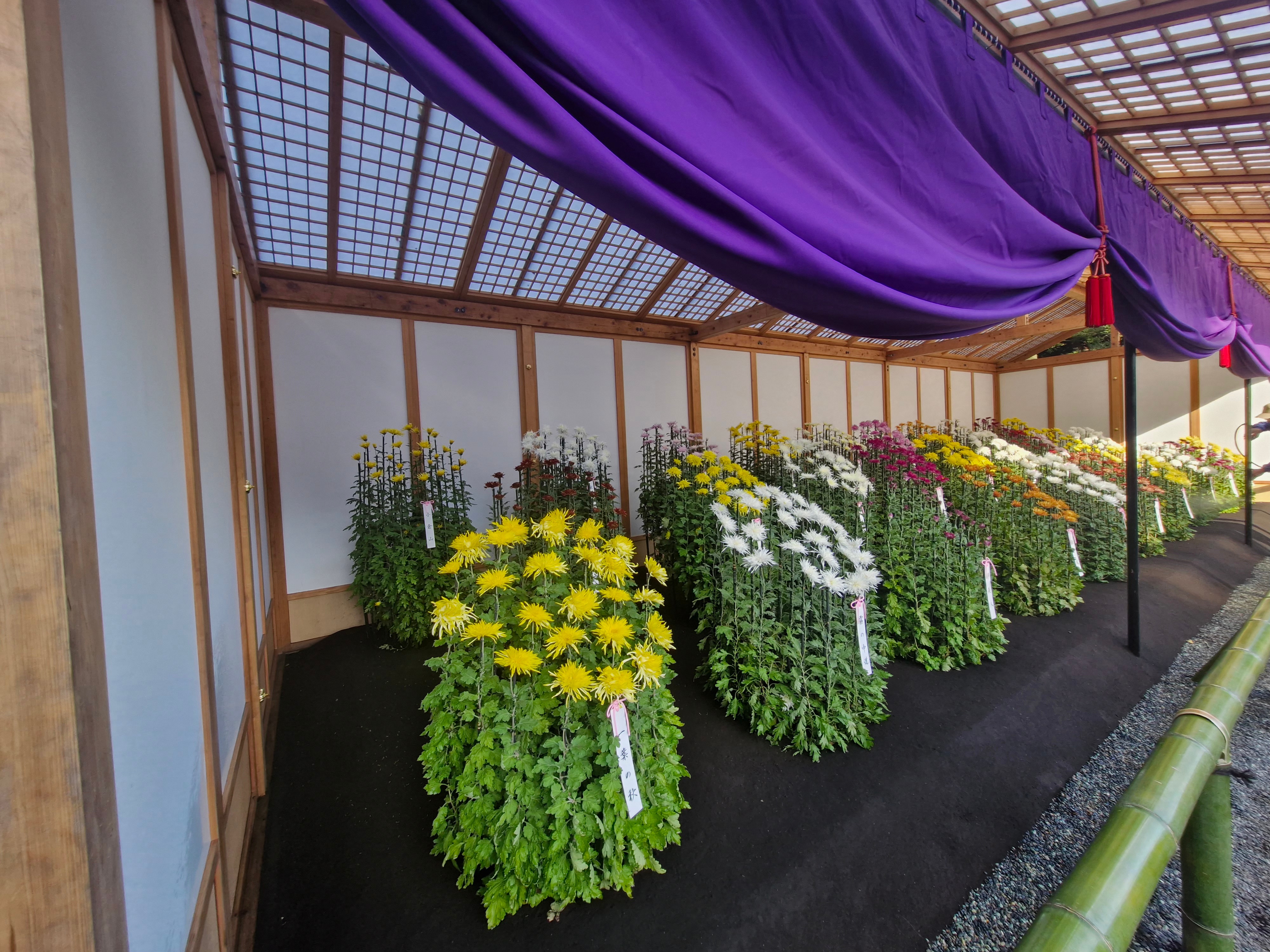
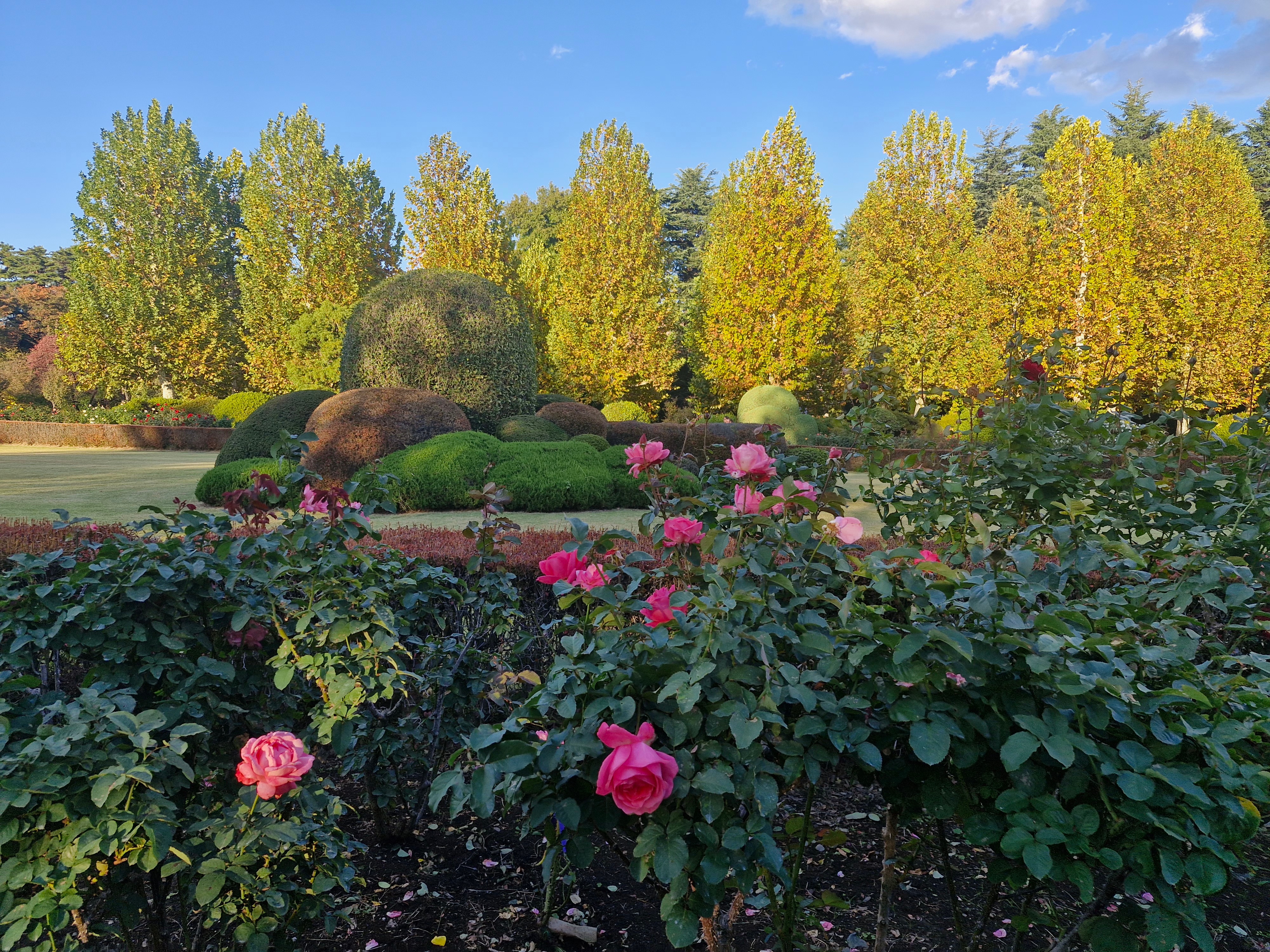
Flower Garden in the Gojo area of Kyoto
As soon as we dropped our bags we headed out and walked towards the Kamu River to find a bite to eat before joining an evening walking tour of the Gion District of Kyoto. We happened upon a restaurant called Kacto next to the river and their menu seemed appealing to us because it wasn’t ramen, sushi, gyoza or tempura, which we had just eaten a LOT of in Tokyo so we were craving something different, namely: vegetables. We ordered a large kale and sweet potato salad with pomegranate, followed by an excellent caesar salad and then a delicious beef ragu with pasta. We split each dish and it was a satisfying meal. We each had lemonade and lots of water. The bill came to about 22 euros each which was a bit pricier than Tokyo but it also wasn’t typical Japanese food so you pay a premium for it. The service and atmosphere was excellent and our guts welcomed the change in diet.
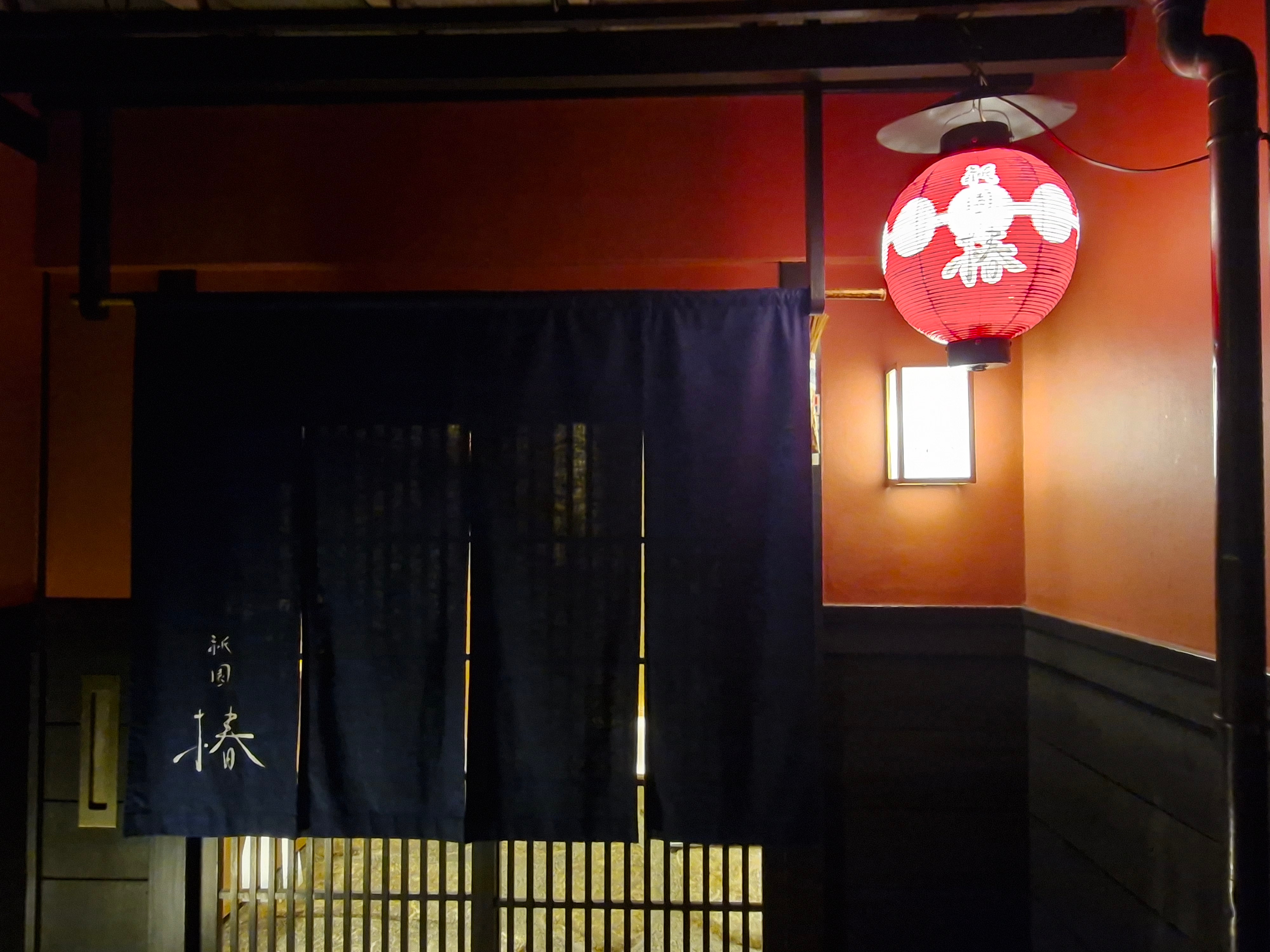
Tea House in the Gion region of Kyoto
We arrived right on time for our 7pm tour of the Gion district of Kyoto. Our guide was a knowledgeable and very pleasant young Chinese man named Ryu who has lived in Kyoto for years. There were 6 other people on the tour. He walked us through the tea house area of Kyoto and these tea houses with their many lanterns are elite institutions and are mostly only accessible by invitation or booking: they are frequented by wealthy businessmen who have lengthy tea ceremonies and meals with many courses accompanied by Geisha performances. Someone in our group posed the question ‘So are the Geishas prostitutes?’ The answer: no.
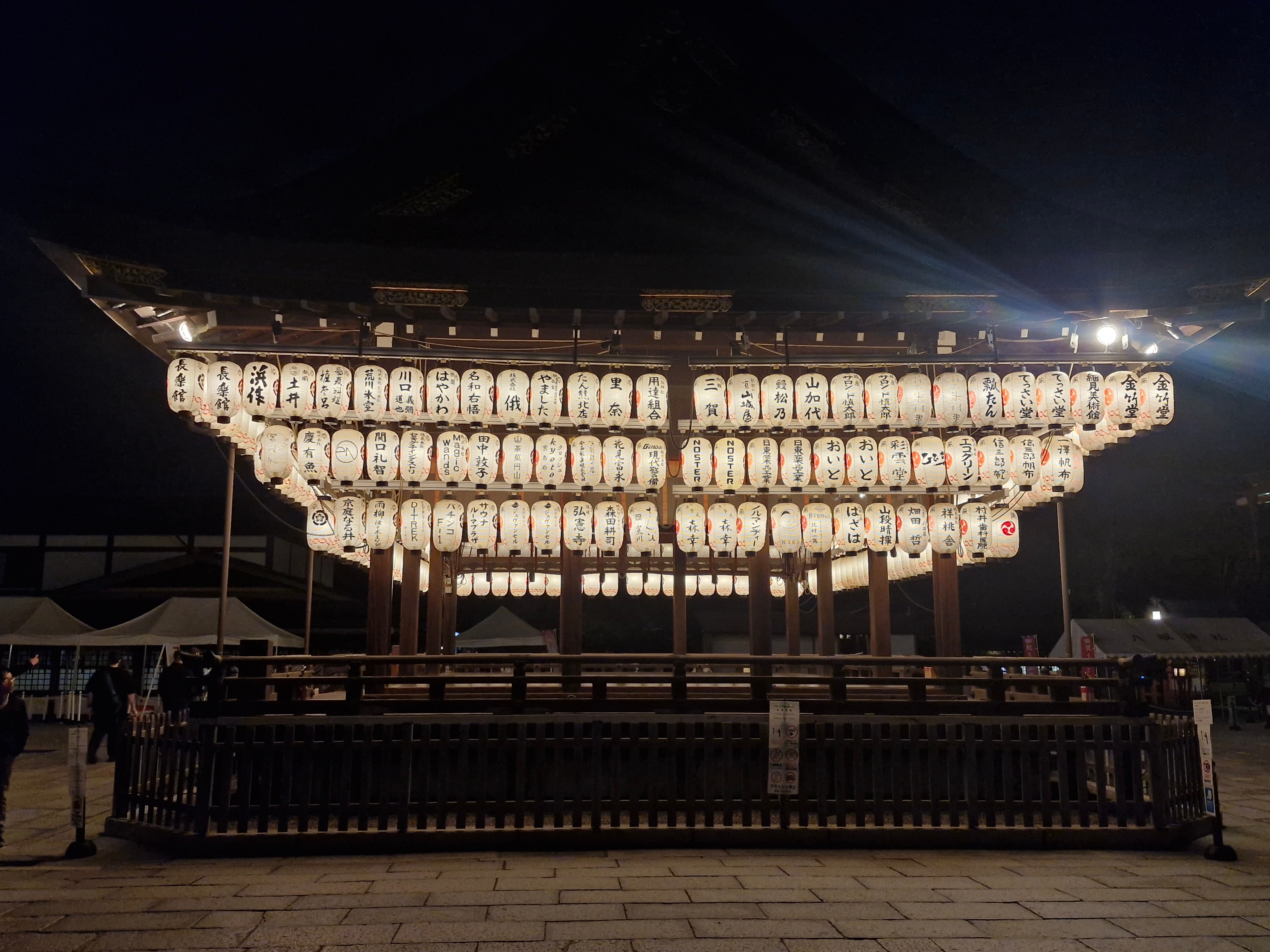
Yasaka Shrine
Our guide walked us past the front gate of Chionin Temple, through Maruyama Park and into the main grounds of the Yasaka Shrine. Shinto Shrines and Buddhist Temples exist side by side in Japan with most Japanese following both faiths. Buddhist rituals are especially used for funerals. Our guide told us that an evening walking tour is popular because it isn’t as busy as the day time tours. Kyoto is packed with tourists. Not only foreign tourists. The bulk of the tourists are Japanese from all over the country. It is a firm favourite with them and it is no wonder, with its incredible architectural charms on every corner. We walked onto the main grounds of Yasaka Shrine. There was Japanese script on the lanterns and it looked charming to us as foreign tourists. We liked to think that it is some kind of poetry or rituals written on the lanterns, but no, it is the name of wealthy individuals and corporations who pay for the upkeep of the shrine. It is basically an illuminated billboard, albeit a very pretty one. We ended the tour at the Kyoto Opera house and our guide gave a tonne of links and tips for Kyoto. It only cost 10 Euros each on the Get Your Guide app and was a great thing to do the first evening we arrived in Kyoto – dive right in and see that area of the city. But we were tired after travelling from Tokyo and we also had to get up at 5.30am to be back at Kyoto Station at 7.15am for a 6 hour Kyoto highlights tour also booked on Get Your Guide for 100 Euros each.
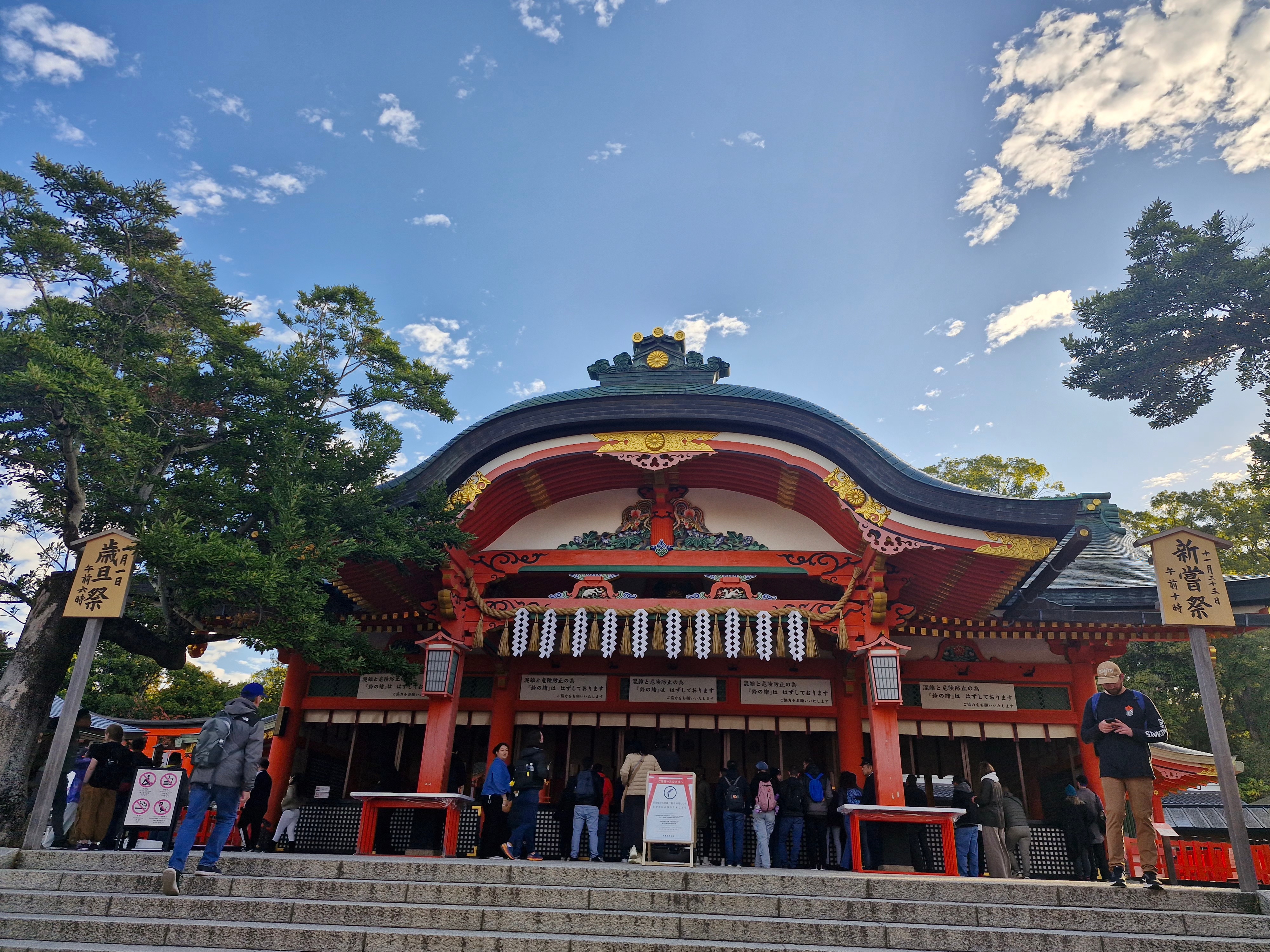
The Fushimi Inari Shrine
We had a short but good night’s sleep and were back at Kyoto Station by 6.50am, giving us enough time to grab a coffee at 7-11. (We had had our breakfast in the room and walked to the station). It was a nice morning and we met our guide, Leo, a fairly young Japanese student in Kyoto. There were 2 couples from Los Angeles on our tour, one with their 10 year old daughter. (They didn’t know each other beforehand). We all introduced ourselves as we would be together for 6 hours and they were all very pleasant. It was great to be in such a small group. The tour was well paced and was worth every penny because we had 3 main destinations to go to that were spread across the city: The Fushimi Inari Shrine, Arashiyama Bamboo Forest and Kinkaku-Ji- The Golden Temple. We took trains and buses to reach them. It was nice to be led around because there is no way we would have easily managed to see all three places as easily on our own. When you have limited time a tour is the best deal.

Torii Gates at Inari
We took the train to the Fushimi Inari Shrine with its approximately 10,000 orange torii gates leading up Mount Inari. We arrived there before 8am and it was already packed. This is iconic Japan and everyone wants to see it. As I mentioned already, the crowds of people in Japan didn’t bother me or feel as overwhelming as in other places because people tend to be quiet and well-behaved. Everyone wants their photos for Instagram in front of the beautiful temples and gates so you just wait your turn and people politely take photos of each other with their smart phones. This is modern tourism. Like it or hate it, it is what it is. There are simply a lot of people on the planet who have money and want to travel. I sometimes get depressed and think, ‘Oh God, everywhere has been discovered, there is nothing new any more. Maybe I shouldn’t travel anymore because it causes problems with the local economies, housing and the environment’ and so forth. But then I am planning the next trip (and it is nice to get out of Ireland in November). I try to lessen my impact, respect local customs and be grateful that I can have these experiences. This is why we wanted to go to Japan in the first place: because it is something completely different. I am really glad we went but it is highly unlikely that I will ever return. It was a once in a lifetime trip that we had as much fun planning as we did on the trip.

Torii Gates Leading up Mount Inari
We stopped at the shrine and our guide explained to us the prayer rituals at a shrine. First you purify yourself by washing your hands at a fountain with water flowing through bamboo pipes, then you make an offering by throwing a coin into the donation box. A five yen coin is considered good luck. (about 2.8 cents), you then ring the bell to get the deity’s attention. You then bow twice to show your respect. Then you offer your prayer (for good grades, gainful employment etc.) clap your hands twice to express joy and then bow a third time. There was a large sign that said, ‘This is a place of prayer, not an amusement park.’ Indeed. How do authorities combine a place of meaningful prayer and reflection for people and accommodate tour groups at the same time? It’s a tricky combo. We saw the same at the Hagia Sofia in Istanbul which has grappled with this dilemma forever and has had to pose different solutions: the upper part of the Hagia Sofia is now for tours and the floor of the mosque is for the devout only. It must be hard to pray in peace with hoards of gawking tourists every day. But, the tourists bring in money for the upkeep of these buildings and monuments.
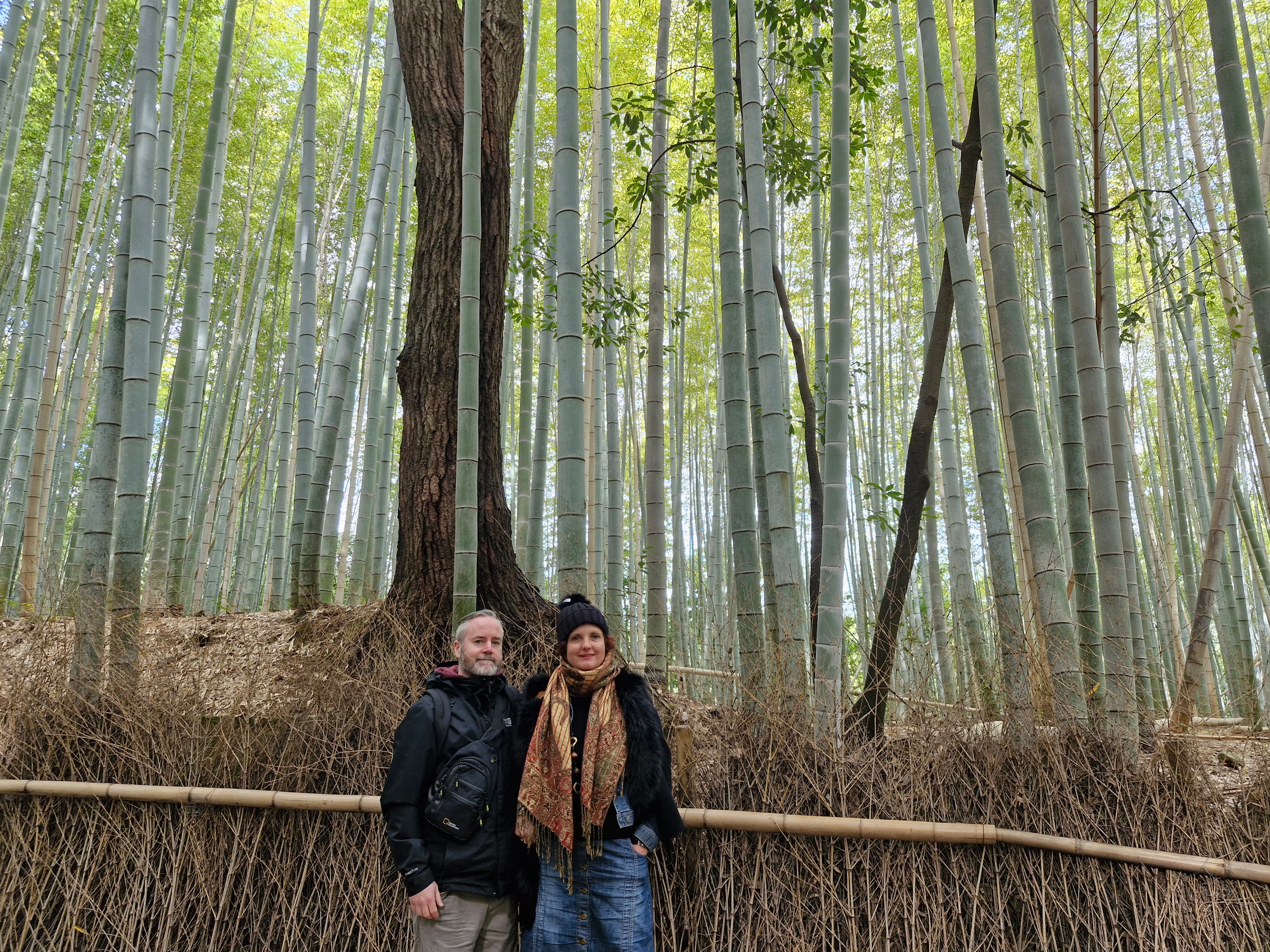
Arashiyama Bamboo Forest
From there we took the train to the Arashiyama Bamboo Forest, which is a natural bamboo forest in the western part of Kyoto. We were there by 10am and it was packed, especially with groups of Japanese school children in uniforms. About a third of the Japanese population visits Kyoto every year. We walked with the throngs of other tourists, got our photos and then walked out of the forest through a quieter area of maple trees turning red and then down along the Katsura River where we saw boats being navigated by Japanese men wearing traditional round oriental bamboo sun hats. We then walked through what was called a Kimono forest which was basically a lot of poles which had colourful kimonos wrapped around them. There were many places where you could rent a kimono but I have mixed feelings about this. It’s one thing to buy a beautiful kimono in Japan and bring it home, but renting one as an American or European tourist and parading around Kyoto wearing it seems like a strange sort of cultural appropriation to me.

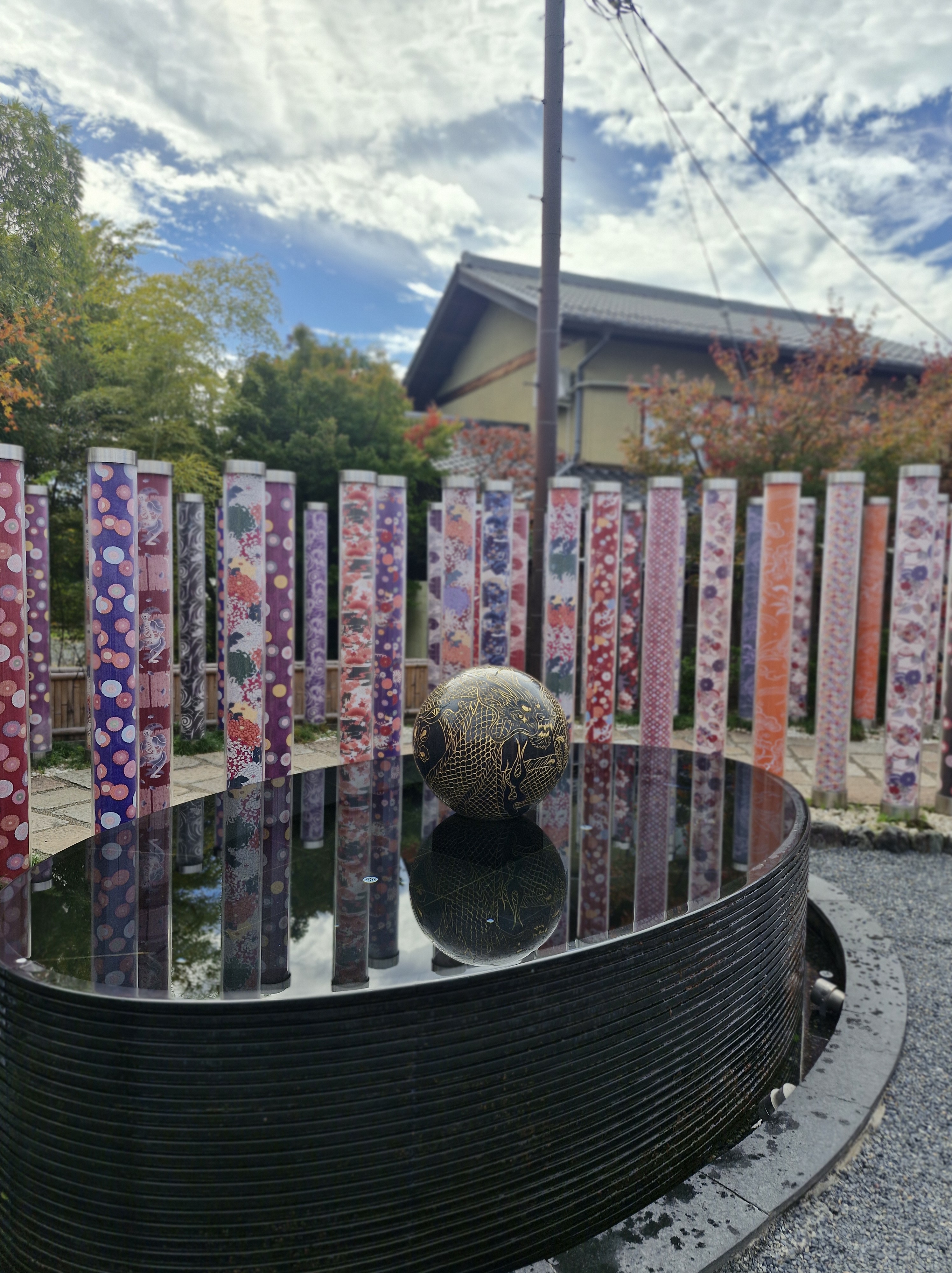
A boat on the Katsura River and The Kimono Forest
Our tour was well paced and it was really relaxing to be led around and not have to think too much. Our guide then ushered us onto a bus and we headed to our next stop: Kinkaku -Ji – The Golden Temple. A note about buses in Japan: the bus driver is masked, has a microphone headset on and is constantly talking (very politely) telling passengers to move in more to the front, and away from the door, because the bus is packed. You board the bus through the door in the middle and you only pay as you exit the bus at the front and apart from having to drive the bus and instruct the passengers on what to do, the bus driver also nods and thanks every passenger individually as they exit the bus; in Japanese and in English if the person doesn’t look Japanese. If the bus is too full for the person to exit at the front, they get off at the middle door and walk to the front of the bus and board again to pay their fare before exiting again. When the driver isn’t talking there is a recorded female voice announcing the next stop no less than 3 times repeatedly in Japanese followed by once in English. People talk a little more on buses because there seems no real compulsion to remain as quiet when you are hearing a constant stream of announcements anyway. We have never seen anything like it. In Dublin, you thank the driver as you exit the bus, not the other way around!
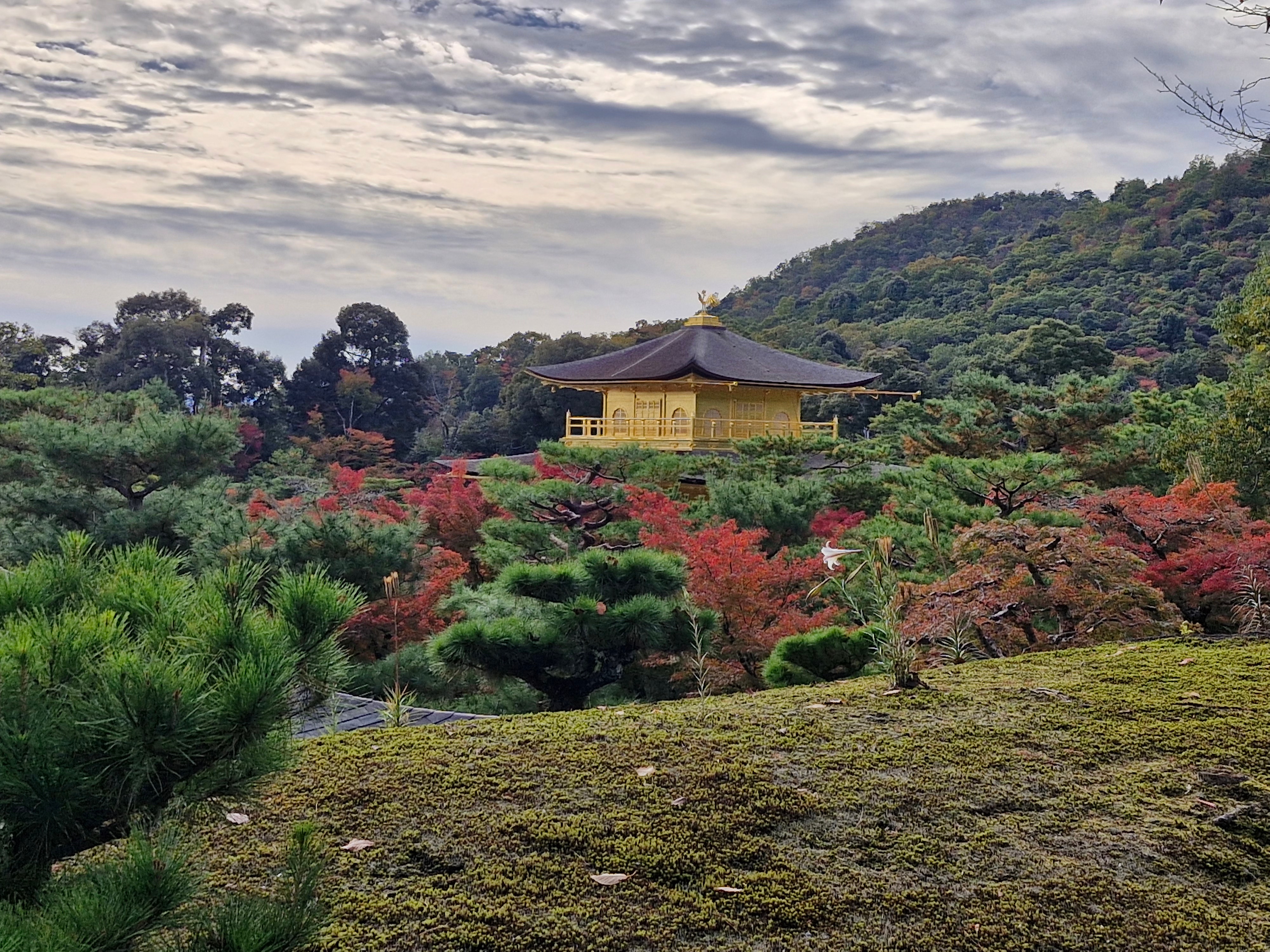
Kinkaku -Ji – The Golden Temple
Our next stop was the Kinkaku -Ji – Golden Temple which is a Zen Buddhist Temple and is a designated World Heritage Site situated on beautifully landscaped gardens which included a huge bonsai tree that is 600 years old and shaped like a ship. You are not allowed to access the temple itself but only walk around it because it is, indeed, coated in real gold leaf. Our guide also pointed out that you are not allowed to drink alcohol on the site of the temple and as we exited, there was immediately a stall selling Sake (rice wine) again. Many temples and shrines have huge barrels of sake on either side of the entrances as offerings to the rice Gods for a good harvest. Rice, as most people know, is the staple grain of Japan and there have been shortages in recent years.
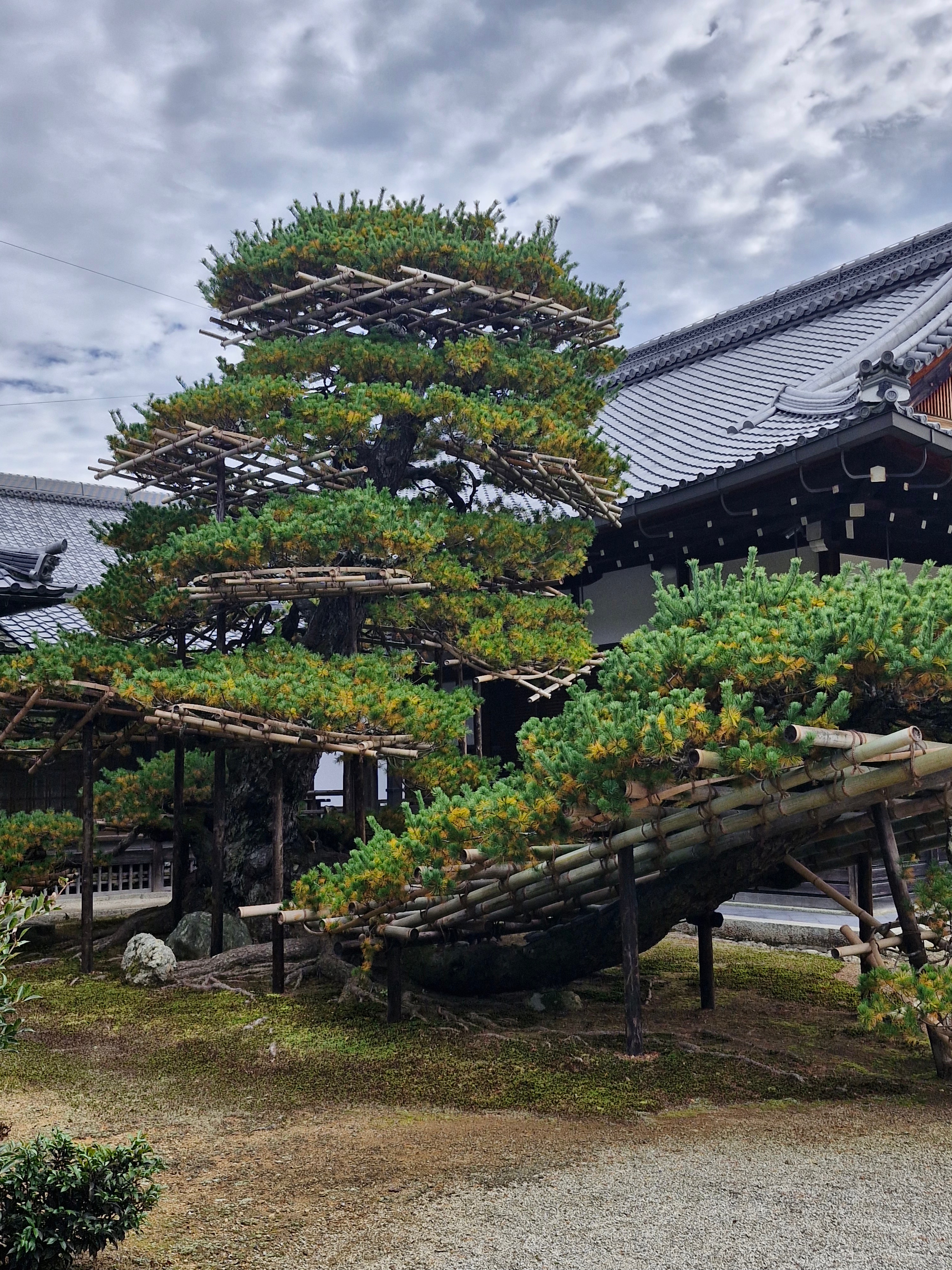
600 Year Old Bonsai Tree
As we exited the temple grounds we said goodbye to our group and were told which bus to board for the half hour ride back to Kyoto Station. We got seats, which seemed like a miracle. Our feet were tired after all the walking so it was a welcome break. When we got back to the station we went to Cafe Veloce, a chain in Japan that serves large black coffees for about 2.18 Euros a cup. We went to this cafe several times in different cities. After our coffee we walked back to our hotel to take a break, as we had been up since 5.30am. We got back to the hotel just after 3pm. We also noticed on our walk back through our neighbourhood that not a single bicycle was locked (amazing!) and there were lots of them parked right outside houses.

Small vans seen everywhere in Japan
A lot of Japanese also drive these small box shaped vans which are practical because they fit into the many small alleyways and people park them very precisely into their designated spot. We also couldn’t help but notice in Tokyo that everyone seemed to drive black, white or silver cars that were different to cars in Europe and The U.S. and also that practically every car looked brand new with not a scratch on them. Where do the old cars go? The exception being the vintage taxis that were nearly all black. Kyoto had more variety in cars but it was still fairly uniform.
After relaxing for a while we were hungry and so ventured out to find some food. At this point, I will admit that we were really craving the following: PIZZA. Yup, after eating 4 bowls of ramen, lots of sushi, tempura and gyoza in Tokyo we really wanted CHEESE and TOMATO SAUCE for a change. At this point in the development of our planet, there is probably no place left on Earth that does not at least attempt to make some kind of pizza. We found really delicious pizza in Kyoto that night with a yummy salad at Pizzeria Osteria. It was a small restaurant with a brick oven. It satisfied our palates and was also very affordable. The next night we would eat more Japanese food. After dinner, we went and had one of the culinary delights of Kyoto: Matcha Green Tea Soft Serve ice cream. It was delicious. We ate it a few times there.
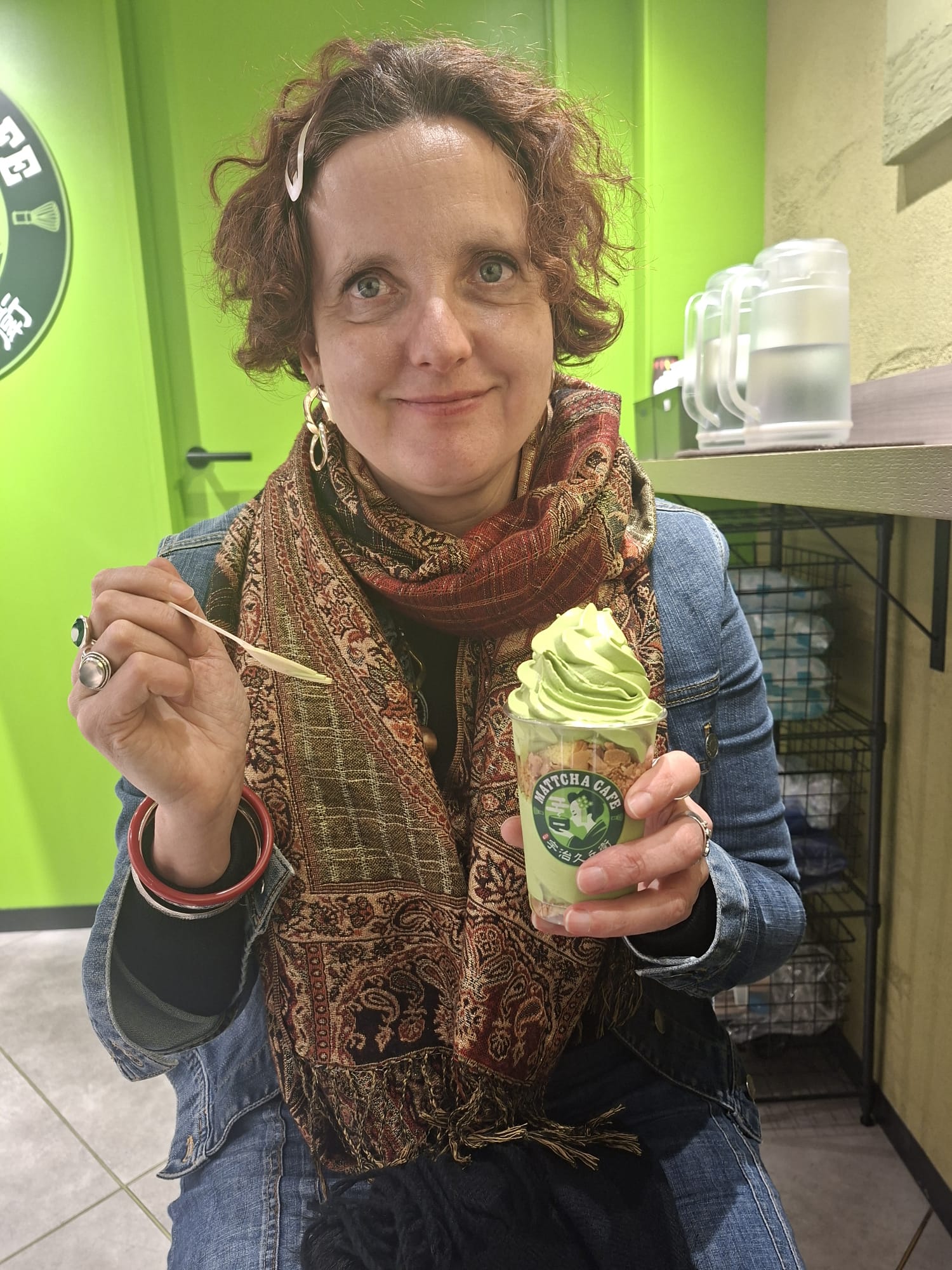
Matcha Green Tea Soft Serve Ice Cream
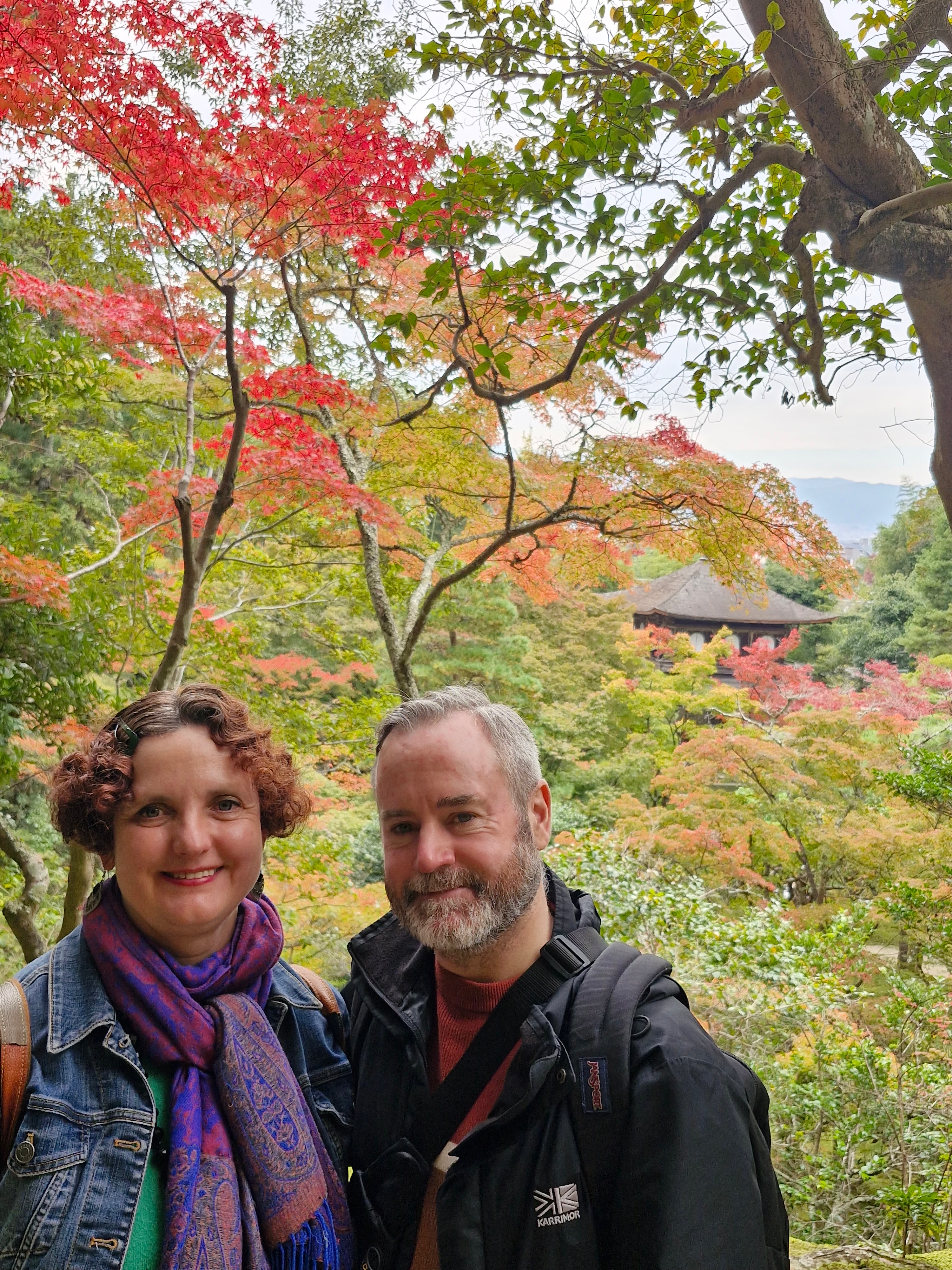
The next morning we slept in a bit after our whirlwind tour of Kyoto of the previous 24 hours. After a leisurely breakfast we took the bus (now that we knew how it functioned) to the Ginka Kuji Temple – the Silver Pavilion. We didn’t have a guide for this section of Kyoto so we just rode the bus near to the temple, stopped for a coffee and then paid the small entry fee of 500 Yen to enter the temple grounds which were absolutely beautiful. As you enter you see a raked sand monument that is called the sea of silver sand. It is meant to look like ocean waves.


The Silver Pavilion and the Sea of Silver Sand
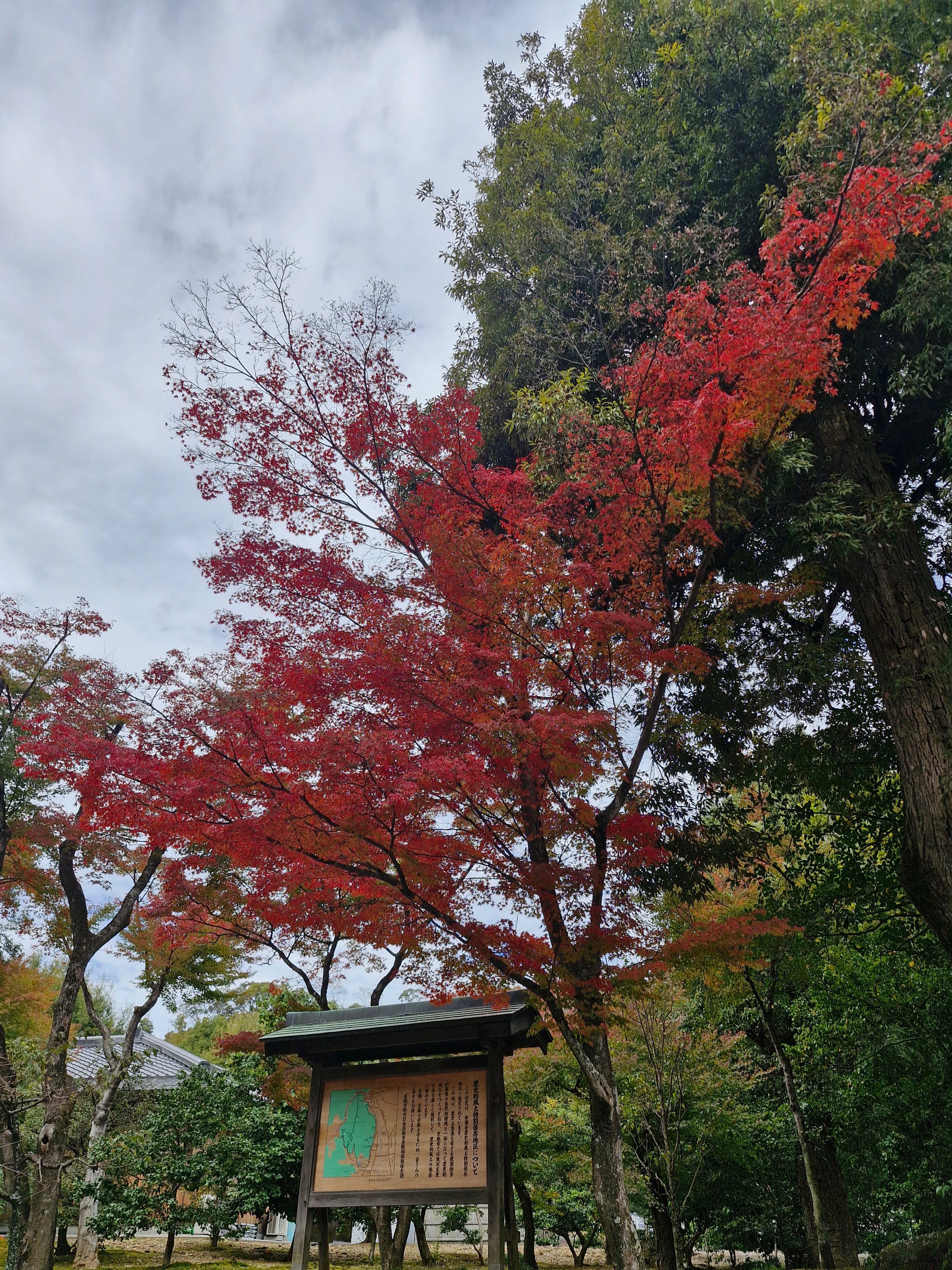
You then walk a loop uphill over bridges, streams and ponds and a well-maintained moss garden. The maple leaves were turning red and it was pleasant but overcast weather. We had noticed many Japanese people with beautiful coloured notebooks and they were lining up not for tickets to enter the temple but to get their goshuin stamps in their books. It is a souvenir and also a record of your visit to that shrine. Many of the goshuin stamps are hand painted calligraphy. It seemed to be a very important part of visiting the temple. When we left the temple we were a bit hungry so we got some chicken and potato swirls on sticks. Yakitori is the Japanese word for grilled chicken on a skewer but the term is used more broadly to refer to various savoury foods on skewers.
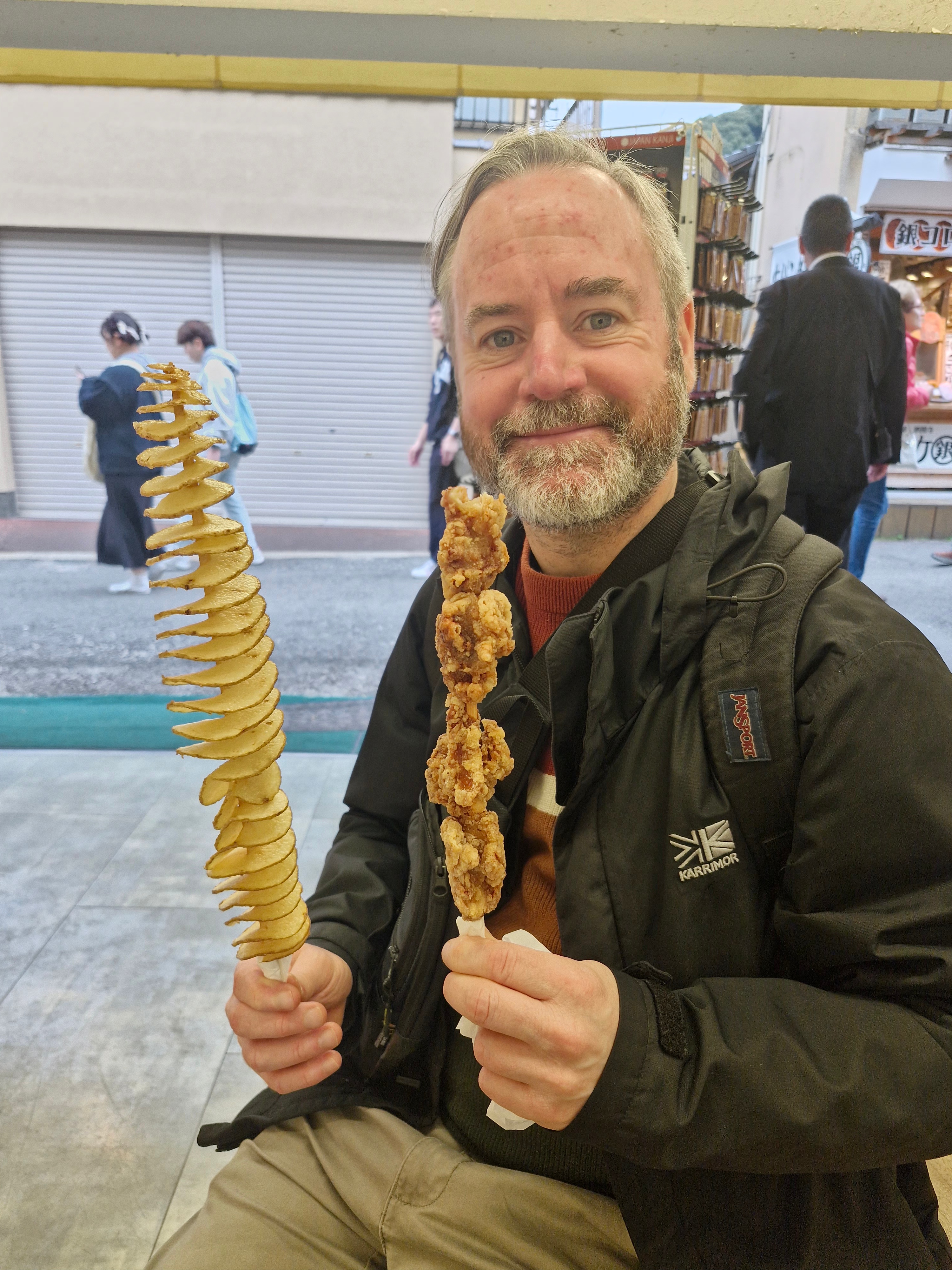
Yummy Yakitori make a great snack when you are walking miles every day
Another reason we had come to the eastern end of Kyoto was to walk along the famous Philosoper’s Walk. It is a 2 kilometre walk along a narrow canal (with no guard rails and very shallow water). It is lined with cherry trees so naturally it is packed in springtime, but it was very pleasant and quite peaceful to walk under the autumn cherry trees. There were ducks and large koi swimming in the canal. We even happened upon another temple that was completely empty. We had the whole temple to ourselves for a few minutes. A rare occasion on this trip!

The Philosopher’s Walk
At this point we were getting hungry and Dáire had said he wanted to eat another Japanese speciality: tonkatsu, which is cutlet made from pork and battered in breadcrumbs and fried. He had done a bit of research and found a lovely place for dinner that evening called Katsukura Sanjo in downtown Kyoto. We entered the restaurant through a long alleyway off a shopping mall and suddenly we were in a wonderful atmosphere with excellent smelling food. We were immediately seated by a man who was probably in his sixties. We didn’t understand what he was saying but we could understand by his gestures and tone that he was probably saying quite loudly something akin to:“Welcome! Come in and have a seat, enjoy the food!” and handed us menus. He greeted every guest in this enthusiastic manner. He seemed like a real character. We ordered the tonkatsu (breaded pork) and the breaded shrimp and shared it. It was served with rice, miso soup and shredded white cabbage. We were also each instructed to grind a bowl of roasted sesame seeds and add various savoury sauces to it for dipping the pork and shrimp into. It was such a delicious meal that we thoroughly enjoyed and it only came to about 15 euros each including a lemonade and an alcohol free beer. After dinner we walked around exploring a bit more and had another matcha green tea soft serve ice cream cone.

Delicious Food at Katsukura Sanjo in Central Kyoto
One thing that stood out to us while wandering around Japanese cities was just how many vending machines there were selling not only drinks (mainly iced coffee and energy drinks) but also machines called Gachapon which sold little plastic capsules with toys in them. You don’t know what you are going to get when you put your coin in so it is a little like gambling (which is illegal in Japan) There are whole stores filled with these machines. We did not buy anything in them, but the woman who was on our tour confided in me that her 10 year old daughter had been nagging her constantly for coins for these machines. One of the funniest things we saw in Kyoto was a sort of talking robot-like machine that clapped its hands over its head and tried to urge you to come into one of these Gachapon stores. It spoke to us in Japanese and English and we laughed at it every time we walked by it on our way to the station.

This guy talked to us and clapped his hands every time we passed by
We packed as much as we possibly could into 2 and a half days in Kyoto. On the last evening we had nice, long hot baths, got into yet another clean pair of pajamas and got a good night’s sleep before departing for our next destination which would be Nara Park for a few hours followed by Osaka for 2 nights. We would be taking the regional train and leaving, as always, after rush hour.
Photos by Dáire Delmar and Rhea Boyden












 rheaboyden
 Rhea Boyden